02 Dec 2016 - {{hitsCtrl.values.hits}}
 Sri Lanka celebrates the most commercialised Christmas in South Asia. The decorations, festivities, carnivals, parties, Santa Claus and Christmas trees are some elements promoted by commercial entities rather than the churches and religious organisations. The State patronage given to commercialised elements far outweighs religious values, further encouraging a ‘commercialised Christmas.’ The spirit of Christmas is absorbed and diluted with spirits and wine that take prominence in all advertisements, supermarket handouts and hampers. Apart from the criminal waste of wealth, it makes Christmas unpalatable to the ordinary Sri Lankan who is rooted and nourished by spirituality, humility, non-extravagance, sacrifice and love that meets the needy.
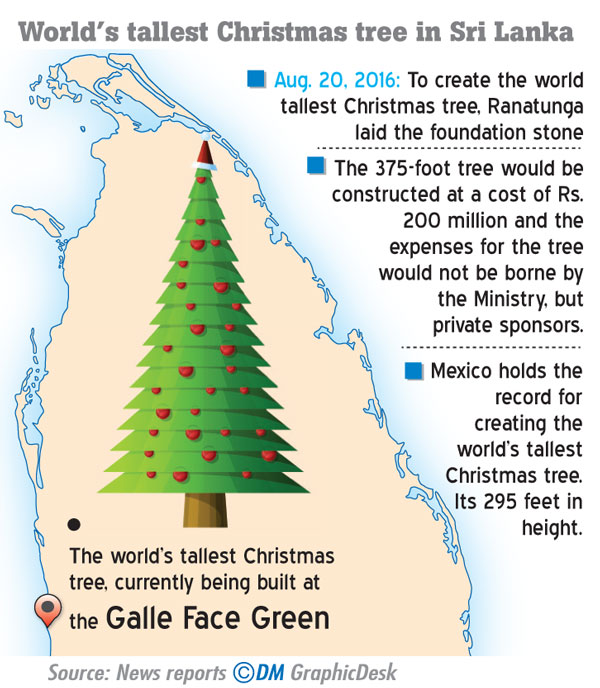
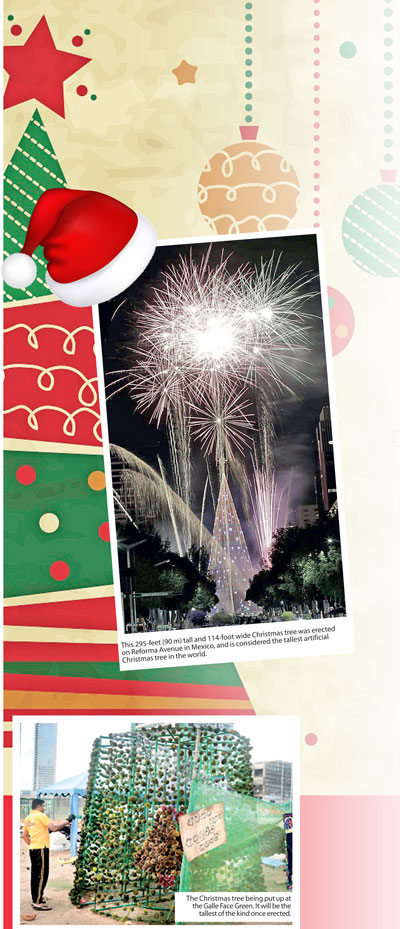 As early as in October, many newspapers spoke of another feature that will certainly adorn Christmas this year - ‘The tallest Christmas Tree in the World’ being put up at the Galle Face Green. The tallest tree, the biggest cake and also the longest Christmas chocolate are all modern expressions of Christmas that are associated with the business world - driven by profit or sidetracking people from the realities of society or even diverting them from the very essence of Christmas, thereby soon making Christmas a non-religious social event.
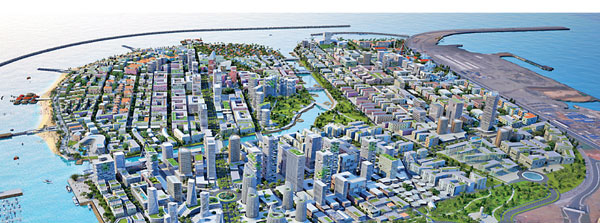
The irony is that the tallest tree is adjoining the Port City (now promoted as the ‘Financial City’), which literally stands as the most controversial and much-debated project of the decade. What is the tree trying to achieve? Certainly, it will be grandly illuminated, diverting the attention of the people from the not-so-bright lights flashing from the Port City construction site. Is it to cover up all genuine concerns of the ordinary people as far as the Port City is concerned, and to divert the attention to the tree so that we will fail to observe what happens beyond? Or is it conveying to the world that trees will have to be constructed hereafter as they cannot be grown due to the impact of the Port City Project on the people and the environment?
However, the challenge for us would be to seek the child Jesus amidst all these distortions. Where do we seek Him? How do we identify Him? How do we worship Him? are questions that seem to have no relevance at all.
How do we capture the true meaning of Christmas? The central message of Christmas is about God coming into the misery of the world to be identified with those suffering, so that all may have fullness of life that those who are in darkness will see light and those who are in the valley of death will have life.
The Angels proclaimed the Birth of Christ, to humble and poor shepherds who were in the open fields. The proclamation about a baby born during a journey now starts in a stable, wrapped in swaddling clothes and laid in a manger (Luke 2:7) -- the most unfortunate and miserable condition to be born in -- all because of a decree by the rulers for everyone to be registered in his/her own home town. That was God’s entry into the world in human form.
This birth is proclaimed by angels as good news to the poor and humble shepherds. The good news is not solely about a saviour being born (the long anticipation of the Jews), but that he is born in a manger amidst the oxen and sheep, amidst the odour of dung and urine and just wrapped in swaddling clothes. This immersion of God Almighty into the misery of poverty and vulnerability of ordinary people is the wonder of Christmas not only in terms of geographical area, but accessible, because of the poorness of the stable, the vulnerability of a child in a manger. The place would not be barred for the poor where others too are free and come of their own accord.
What are the signs given to identify the child? You will find the baby wrapped in swaddling clothes and lying in a manger (Lk 2:12). -- A sign intelligible to the shepherds.
Mangers and stables are intrinsically linked to the life of a shepherd. Swaddling clothes, the rags are too familiar to the poor, used to cover their nakedness. God Almighty has been immersed not only in the misery of human beings, but is now wrapped and laid on things that are part and parcel of the most vulnerable community.
However, the tallest Christmas tree is in contrast to the signs given to identify the baby in the manger - The Saviour of the world. It stands tall in the background of the Port City, which perhaps the poor will not be able to enter, nor will there be a need for them to do so. The Port City will pauperize the ordinary citizens of this country, where the poor will be driven to the mangers and stables for survival and be dependent on the swaddling clothes or rags that will be thrown out of the Port City to clothe themselves. The tallest Christmas tree will be surrounded by tourist hotels, where a tourist will pay at least $150 per night (an ordinary peasantry farmer’s or tea-plucker’s monthly income). The tree will be a delight to the tourists, a ‘free of cost offer’ which will have no semblance of the manger referred to in the Christmas story. The tree also stands tall just next to the seat of political power where decisions are made that continue to cater the rich, and the Gospel story clearly indicates that Jesus is not born in Herod’s palace. The tree stands amidst the politics and economics of the country, which continue to pauperize the poor and make them even more vulnerable. The birth of Christ in a manger stands in contrast to the social reality around the tallest Christmas tree in the world.
The shepherds followed the signs and worshipped the child and returned joyfully (Lk 2:16 & 20). How do we worship the Christ born today? What consists of true worship at Christmas? How do we worship God in human flesh? It is in simplicity, through acts of self-sacrifice, self-denial, self-emptying, which are essentially the virtues of the Baby we celebrate at Christmas. To recapture the meaning of Christmas, we need to learn from the spiritual values that have nourished the civilization of this country over centuries, values that promote simplicity and not extravagance, values that promote mercy and compassion not self-indulged pleasure, values of sacrifice and sharing for the sake of the poor and vulnerable, not high spending to satisfy our selfish desires.
The tallest Christmas tree should remind every Christian of the Babel Tower (Gen 11), which not only tried to hide the sins of the city but was built by the sins of the city – a symbol of disobedience of city dwellers against God. Symbolically-situated on the background of the Financial City, opposite the seats of political power, surrounded by pleasure and business hotels -- the fundamental question is, are we serving mammon or God (God or money) this Christmas?
We need to consciously travel through the miseries of our people and share their pain and hopelessness and become the beacon of hope and transformation in order to worship the child born in the manger. “… Let us go over to Bethlehem and see this that has happened, which the Lord has made known to us and they went with haste and found Mary and Joseph and the baby lying in a manger (Lk 2: 15 & 16).
Let us not miss the Christ, amidst a commercialised Christmas in the city and let not the tallest Christmas tree (an unbiblical symbol) blind our eyes from the baby in the manger, whom we are called to worship and witness.
03 Jul 2026 8 hours ago
03 Jul 2026 8 hours ago
03 Jul 2026 8 hours ago
03 Jul 2026 9 hours ago
03 Jul 2026 9 hours ago