14 Jun 2025 - {{hitsCtrl.values.hits}}
By Tommy Fernando
|
Joel Fernando |
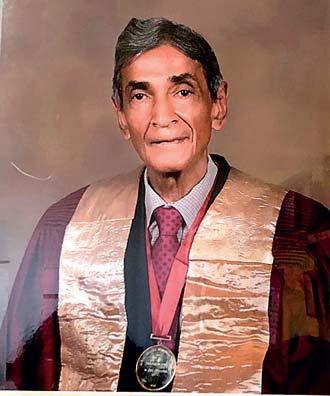
Joel Fernando was born in 1940 in the ancestral home of his maternal grandfather, lawyer Thomas Matthew Fernando JPUM, in the Colombo suburb of Mount Lavinia. He was the fifth in a family of ten children.
His father was Dr. Isidore John Fernando, a medical practitioner with post-graduate qualifications gained in Great Britain. His father was in charge of several general hospitals successively along the South-Western coastline of Sri Lanka during World War II. Thus Joel’s family home moved from Weligama to Hambantota, Matara, Panadura, and finally Negombo when in 1954 his father retired from government service and started a private medical practice, and the family moved permanently to Dehiwela.
Joel spent the greater part of his school years as a boarder in St Sebastian’s College, Moratuwa. His final school years were as a day-scholar at St Peter’s College, Wellawatte. He completed all his schooling in the English medium while the ‘swabasha’ medium was being gradually introduced in Sr Lanka.
During his two Higher School Certificate (HSC) years at St Peter’s College, Joel was among the top in his form academically. He was appointed as Head Prefect in the school, and was recognised for his debating skills. At about this time, he was attracted by the intellectuality and social commitment of left-oriented political parties’ leaders. He is known to have frequented their election rallies, and this was not looked on lightly by the principal of St. Peter’s College. He was compelled to secure a place in the final year of the HSC at St Benedict’s College, Kotahena.
Joel successfully completed his University Entrance Exams and started his graduate studies at the University of Peradeniya in 1962. He joined the first batch of medical students to attend that University, sharing a room with another student in Arunachalam Hall in the University campus.
Student leaders from the arts
At that time, it was well-known that student leaders usually belonged to the Arts Faculties, and science students were known to be less inclined to engage in extra-curricular activities. Also, at that time democratic standards and institutions were in their infancy in Sri Lanka. Similar to most university students worldwide, politically-committed students were predominantly left-oriented given the successful example of the Marxist-Leninist October Revolution in Russia in 1917.
Several nascent democracies in Latin American countries were awash with similar revolutionary tendencies. The names of inspirational figures such as the physician-turned-revolutionary Ernesto ‘Che’ Guevara were well known in Sri Lanka where the Communist Party, the Bolshevik Leninist Party, and the Lanka Sama Samaja Party had already made some headway in the densely populated South West of the country. All these shades of the left in politics found their supporters among the predominantly Sinhala-speaking student leaders at Peradeniya.
Joel’s broader approach to university student life as well as his budding commitment to leadership and values of social justice soon became apparent. During his first year as a medical student he became the President of the Peradeniya Medical Students Union. However, he refrained from belonging to any political party. Due to his schooling in the English medium, he was also primarily a good English speaker with hardly any competence in making Sinhala speeches in public. It was his special gift of being able to talk clearly, fearlessly, and convincingly that appealed to the more Sinhala-speaking and more politically-committed but divided student leaders at Peradeniya.
Visiting Nairobi, Kenya
They elected Joel as the President of the University Students Union. As President of the Peradeniya University Students Union, Joel did his first overseas trip in 1965 to attend an International Students Conference in Nairobi, Kenya. As President of the Students Union he is remembered for having successfully pleaded against the expulsion of some of his fellow students by the known disciplinarian, Vice Chancellor Nicholas Attygala.
From the perspective of a commitment to socialist politics that Joel had as a student leader, he launched his own clinical career rather prosaically. His first job at the Dissanayake Dispensary/Surgery in Negombo was a carefree time. He enjoyed work and leisure in equal measure, with no involvement at all in matters non-clinical. He had a part-time role as Medical Officer for the Ceramics Corporation. This gave him a first-hand insight into the economic problems of normal working people.
It was perhaps only after settling down into married life with his wife Anula in 1973 and enjoying a close-knit family life with their daughter Sunera and their son Jivi that he engaged once more in both self-improvement as well as in his wider non-clinical pursuits on behalf of Sri Lankan society. Sunera is now a medical practitioner with a doctorate in Psychiatry gained from the Australian University of Wollongong and Jivi is an electronics engineer engaged in information and communications technology work in Sri Lanka.
Class discrepencies
In 1976, Joel joined the Independent Medical Practitioners Association. He had a spell as a Medical Officer at the private Durdan’s Hospital in Colombo. During this period he came into close contact with the two-class clinical services provision that exists in Sri Lanka where better medical services are immediately available if only one had the money to buy them.
In 1982, Joel completed a Diploma in Family Medicine at the University of Colombo and, in the late 1980s, he settled down in a more long-term position as the in-house Chief Medical Officer for the Cooperative Wholesale Establishment (CWE) at its headquarters in Colombo. He was also witnessing at that time the blatantly obvious degeneration of the body politic in Sri Lanka.
Joel was a consultant to the Ministry of Health, NORAD (Norwegian Agency for Development Cooperation) , the Asian Development Bank, the World Bank, and the World Health Organisation on subjects such as drug logistics, primary care, community morbidity, management information systems, private sector health care, and health impact assessment of development projects. He was also a member of the National Standing Committee for the implementation of a National Medicinal Drug Policy.
Pioneer in digitalisation
As someone with a good communicator’s eye who saw the increasing globalisation of technology, Joel had the opportunity of lecturing to Diploma students on the same course that he had completed in Family Medicine. He pioneered the digitalisation of the Diploma in Family Medicine (DFM) by initiating the complete digital package that was required for handling the execution of the course programme online. He drafted the digital version of the course based on the needs of the lecture contents and the students. Having realised the digital execution of the course, he became in 2012 the coordinator for the course programme, with the support of the Post Graduate Institute of Medicine (PGIM) and his colleagues in the training programme.
His innovative approach to the handling of this particular branch of clinical training was appreciated globally. He visited Canada and the UK and talked to professional clinical audiences on the rationale of the training that constituted the Diploma in Family Medicine in Sri Lanka. In 2011, he was awarded the Prestigious College Oration by the College of General Practitioners of Sri Lanka in recognition of his pioneering work in initiating and conducting the On-line Diploma in Family Medicine (DFM) Programme.
From his very early days as a clinician, Joel was a firm believer in the holistic nature of medicine: in health care, a clinician should consider not just the human body but also all aspects of a patient that constitute human life. His strong social instincts made him distrust the profit-motivated Western pharmaceutical conglomerates. As a result, Joel was disliked by some of his financially well-endowed medical colleagues
Joel worked for the poor, even so far as to spend his time talking to beggars who came to his door. He helped them to amend their lives permanently rather than getting rid of them by handing over a few rupees. Joel was involved with the Roman Catholic SEDEC group in Sri Lanka. He led a team of charitable volunteers who went into remote villages to conduct healthcare programmes.
As a committed health activist, Joel was involved in raising awareness on health issues among citizens through programmes of professional bodies and non governmental organisations. He was a founder patron of the Peoples Movement for the Rights of Patients. He was recognised as a leading health activist in the Asian region and served as a member of the Governing Council of Health Action International Asia Pacific and as a founder member of the Asian Community Health Action Network (ACHAN) which are two international networks globally recognised for their campaigns on health for all, right to health, and health care. He worked closely with his teacher at Medical School, Dr Balasubramaniam. Both of them had been influenced by their eminent Professor of Pharmacology, Prof. Senaka Bibile.
The Sri Lanka Organisation of Professional Associations (OPA) with its comprehensively wide network of around thirty five professional organisations include the fields of medicine, engineering, law, agriculture, archaeology, banking, finance, and politics constituted an intellectual elite from a wide spectrum of gifted professionals that included both academic as well as corporate business environments. At a time when Joel had succeeded in building up his own network of similar-minded friends, the OPA became his focus of particular interest. His involvement in the OPA soon resulted in his being elected as its President in 1995-1996. From then on, the OPA has been a part of his life.
As a scholar, Joel has presented papers at several national and international meetings and has over thirty publications in reputed medical and non-medical journals. In recognition of his scholarly activities, he was conferred the title of Professor by the College of General Practitioners of Sri Lanka. He also served as the President of the Independent Medical Practitioners Association (IMPA) from 2013 to 2014.
Under Joel’s technical leadership, an OPA report on Good Governance was produced for the President of Sri Lanka. Just four days before Joel passed away, he had attended an OPA meeting which was followed by a social gathering. On the day before he passed away, he had been working as editor on the latest issue of the IMPA journal and completed it so that it was ready for publication.
Tommy Fernando is a retired British Chartered Telecommunications Engineer with a doctorate in Religious Studies from the Gregorian University of Rome. He is the elder brother of Joel Fernando.
13 Jun 2026 1 hours ago
13 Jun 2026 2 hours ago
13 Jun 2026 4 hours ago
13 Jun 2026 4 hours ago
13 Jun 2026 4 hours ago