24 Apr 2026 - {{hitsCtrl.values.hits}}
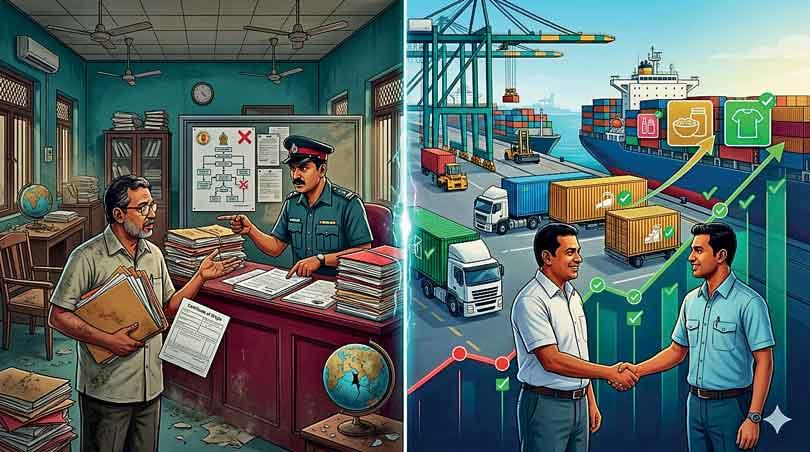
- “The agreement that was once expected to be a central pillar of growth is being used less frequently, with nearly 82 percent of total bilateral trade now conducted outside the ISFTA framework.”
- “For smaller exporters and SMEs, the administrative burden of verifying Rules of Origin often outweighs the actual tariff benefits, making non-preferential trade the more practical option.”
- “Firms report that the expected benefits of the agreement are frequently erased by practical difficulties, such as prolonged customs delays and complex product registration procedures.”
 Twenty-five years after the landmark India-Sri Lanka Free Trade Agreement (ISFTA) was signed, a startling divergence has emerged: while bilateral trade has surged to nearly US$ 6 billion, the agreement’s utilisation has plummeted. In 2021, only 18% of trade flowed through the ISFTA framework, with the majority of exporters opting for non-preferential routes to avoid “administrative nightmares.”
Despite two and a half decades of preferential market access, Sri Lankan businesses are increasingly trading with India outside the framework designed to help them most. A look at what the trading community actually faces tells a more complicated story than official positions suggest.
India-Sri Lanka trade has existed for several millennia, shaped by geography, culture, and centuries of maritime commerce. It expanded during the period of colonial rule, when both Sri Lanka and India were under British administration until the late 1940s. It was, however, formally established with the signing of the India Sri Lanka Free Trade Agreement on 28th December 1998, Sri Lanka’s first bilateral trade agreement, which came into operation in March 2000.
In the twenty-five years since, bilateral trade between the two countries has grown significantly. At the same time, a clear trend has gradually emerged over the years. The agreement that was expected to support this growth is being used less frequently.
A deal built on high expectations
The India-Sri Lanka Free Trade Agreement was introduced at a time of strong economic optimism. Sri Lanka, having begun trade liberalisation since 1977, was seeking to secure better access to one of the world’s fastest-growing markets. India, following its economic reforms in 1991, was gradually reducing the high levels of protection that had existed under its earlier policies. The agreement provided Sri Lankan exporters with duty-free access to India across a wide range of products, while also introducing tariff-rate quotas for sensitive goods such as tea and garments. In return, Sri Lanka agreed to reduce tariffs on Indian imports over a period of eight years, compared to India’s three-year period, taking into account the differences in the size and structure of the two economies.
The initial years showed positive outcomes of the bilateral trade. By 2004, it is estimated that nearly 90 percent of export to and nearly 30 of imports from India were undertaken on the ISFTA framework. At that stage, the agreement appeared to be functioning broadly in line with its intended objectives.
The numbers that tell a different story
The early momentum, however, was not sustained, and developments over time suggest a gradual shift in underlying trade patterns. Trade data from the period 2000 to 2025 indicates a steady divergence between overall trade growth and the use of the India–Sri Lanka Free Trade Agreement framework. Total bilateral trade, including both preferential and non-preferential flows, has increased significantly, reaching approximately US$ 5.97 billion in 2025. While this may appear to reflect a positive trajectory, a closer examination presents a more nuanced outcome.
In 2021, out of approximately US$ 4 billion in total bilateral trade, only about US$ 735 million, nearly 18 percent, was conducted under the ISFTA. This represents a notable decline compared to the bilateral trade scenario of 2004. It is observed that the agreement, which once played a central role in facilitating trade between India and Sri Lanka, now accounts for a relatively small share of total trade flows. At the same time, exports from India to Sri Lanka have increased considerably, with the bulk (about 95 percent) taking place outside the agreement. In contrast, Sri Lankan exports to India, although showing some growth, remain well below their estimated potential. India has also become the main source of imports for Sri Lanka, accounting for nearly 89 percent of Sri Lanka’s total imports from the South Asian region in recent years.
The trade balance, which has historically been in favour of India, appears to have become increasingly uneven over time. Meanwhile, Sri Lanka’s share of trade within South Asia, which remained around 5 percent of its total trade for several decades, has improved to approximately 15 to 20 percent in recent years. While this reflects a notable development, it may be observed that the contribution of the ISFTA to this increase has been relatively limited and gradually declining.
What the trading community says
Official explanations for this underperformance generally point to structural and macroeconomic factors, including trade asymmetry, differences in economic size, sensitive or negative lists, para-tariffs, and various administrative measures. These factors are well recognised and documented in policy discussions. However, insights from businesses in Sri Lanka that engage regularly with the India market suggest a more practical set of challenges at the operational level. Discussions with firms across sectors such as printing, trading, garments, agriculture, automotive, and construction reveal a consistent pattern of concerns.
One of the primary issues relates to Rules of Origin (ROO) compliance. In order to benefit from concessions under the ISFTA, exporters are required to demonstrate that their products meet specified origin criteria. While this requirement is reasonable in principle, it often creates a significant administrative burden in practice. The process of obtaining and verifying certificates of origin, and ensuring acceptance by customs authorities, involves both time and cost. For smaller exporters and SMEs with limited administrative capacity, these compliance requirements can at times outweigh the potential tariff benefits.
Another important concern relates to post-shipment clearance procedures in India. Some firms have reported delays and uncertainties in customs clearance, which affect the reliability of using the agreement. For instance, a Colombo-based printing company, despite having a substantial potential export capacity to the Indian market, had discontinued the use of ISFTA after experiencing prolonged delays in customs processing. While awareness of the agreement and its potential advantages remain, such experiences appear to have reduced confidence in the consistency of its implementation.
Non-tariff barriers represent a third and more widespread area of concern. Despite the formal reduction and removal of tariffs under ISFTA, factors such as sanitary and phytosanitary standards, labelling requirements, packaging regulations, and product registration procedures, particularly in sectors such as pharmaceuticals and processed foods, continue to create practical obstacles to trade. These requirements, while often justified on regulatory grounds, may limit the effective use of tariff concessions. For instance, a trading company engaged in agricultural products noted that delays in obtaining and verifying rules of origin certificates had significantly slowed its export operations, even where ISFTA access was available in principle.
Similarly, a garment manufacturer that routes a substantial share of its exports through the ISFTA reported that documentation requirements and logistical constraints in the Indian market have limited its ability to expand further. The firm indicated that, in the absence of such procedural challenges, it could potentially increase its export volume by a considerable margin.
The observations from these business interactions present a consistent pattern. Firms in Sri Lanka are generally aware of ISFTA and, in some cases, actively utilise it. However, there appears to be a common concern that the expected benefits of the agreement are often reduced by the practical difficulties associated with implementation, affecting its effectiveness in facilitating trade between Sri Lanka and India.
A paradox with implications
The experience of the India-Sri Lanka Free Trade Agreement reflects a notable paradox in trade policy. Bilateral trade between Sri Lanka and India has expanded beyond what might typically be expected based on factors such as economic size, geographic proximity, and population. However, the agreement that was intended to support this expansion appears to play a declining role in facilitating it. Trade between the two countries continues to grow, but increasingly through alternative channels, including investment linkages, supply chain integration, and the use of standard most-favoured-nation tariffs, which have been progressively reduced over time.
This development suggests that, for many Sri Lankan businesses, non-preferential trade routes have effectively become the more practical option. Where the procedural requirements associated with ISFTA involve higher time, cost, and administrative effort relative to the tariff benefits available, firms appear to opt for simpler and more predictable trading arrangements.
What reform looks like
The India–Sri Lanka Free Trade Agreement does not appear to be beyond improvement. However, any meaningful progress is likely to require practical and well-targeted reforms rather than general policy intent. Several priority areas can be identified in this regard.
First, the administrative procedures associated with claiming preferential treatment, particularly those related to the certification and verification of rules of origin, may need to be simplified and digitalised. The introduction of electronic certificates of origin, recognised in real time by customs authorities in India, could help address one of the most frequently cited constraints at relatively low cost.
Second, greater emphasis on the effective implementation of mutual recognition arrangements on product standards and testing procedures appears necessary. While such frameworks may exist formally, their practical application remains limited. Where exporters from Sri Lanka are required to undergo additional certification to meet Indian standards despite complying with international benchmarks, the cost of market entry remains relatively high. In this context, improved alignment of standards, particularly in sectors such as agriculture and food processing, may be beneficial.
Third, the proposed expansion of ISFTA into a broader Economic and Technology Cooperation Agreement framework presents an opportunity to review and update existing provisions. Extending the scope of cooperation to include services, investment, and technology could allow for a more comprehensive approach, while addressing some of the limitations observed in the current structure of the agreement. Negotiations on this matter resumed in 2023 following a period of inactivity. The extent to which these discussions lead to a more business-friendly framework may depend on whether the concerns of actual market participants are adequately reflected in the outcome.
Fourth, there appears to be a need for greater outreach and institutional support within Sri Lanka. A notable proportion of smaller businesses, particularly SMEs, remain either unaware of the specific provisions of ISFTA or uncertain about how to utilise them effectively. In this regard, institutions such as business chambers, the Department of Commerce, and the Export Development Board may play an important role in translating the agreement’s provisions into practical and accessible guidance for the business community.
Conclusion
The India-Sri Lanka Free Trade Agreement continues to remain, in formal terms, one of the most important trade instruments within Sri Lanka’s external economic policy framework. However, in practice, there are indications that businesses are increasingly opting for alternative trading arrangements rather than relying directly on the agreement. This divergence between the intended benefits of the agreement and the actual experience of traders appears to represent a key challenge in the evolving economic relationship between Sri Lanka and India. Sri Lanka’s share of trade within South Asia has improved notably over recent decades, with India playing a central role in this development. At the same time, the continued growth of bilateral trade alongside a decline in ISFTA utilisation suggests that trade expansion may be influenced by broader economic factors, including market size, proximity, and evolving commercial linkages. This may indicate that where policy frameworks do not sufficiently reduce practical constraints, businesses may increasingly rely on alternative channels that offer greater ease and predictability.
Observations from the trading community over time have highlighted these concerns in various forms. The extent to which these issues are addressed may depend on the responsiveness of policymakers in both countries to the practical challenges faced by businesses engaged in bilateral trade. This article draws on field interviews conducted with Sri Lankan businesses engaged in South Asian trade as part of academic research on Sri Lanka’s economic integration with the region, carried out in 2025.
The author is a postgraduate student at the Department of Economics, University of Colombo and can be reached at: [email protected]
12 Jun 2026 8 hours ago
12 Jun 2026 9 hours ago
12 Jun 2026 9 hours ago
12 Jun 2026 12 Jun 2026