28 May 2026 - {{hitsCtrl.values.hits}}
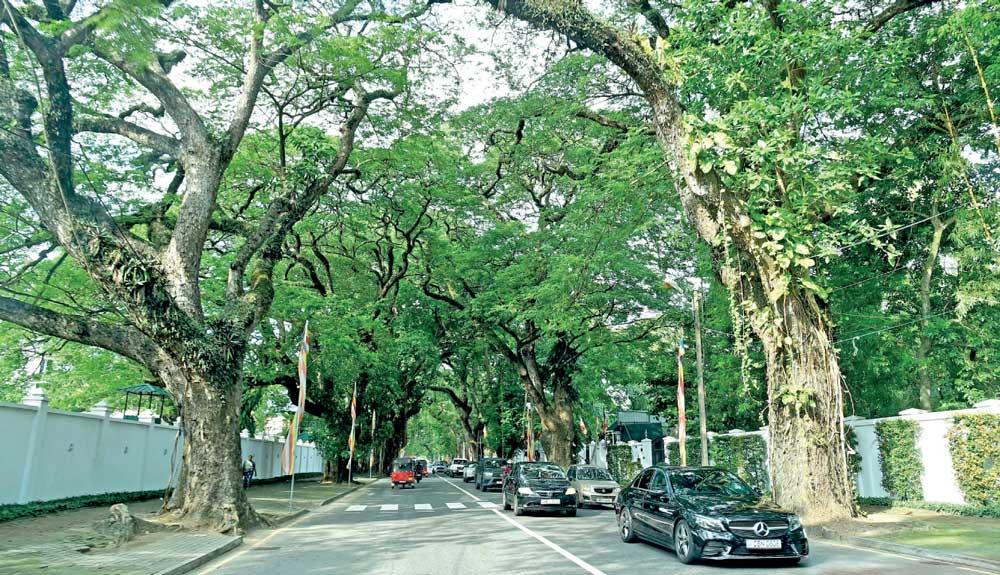
Centuries old trees continue to provide shade in many parts of Colombo, staying true to its coveted name ‘The Garden City of Asia’.
PIX BY Kushan Pathiraja

“In some countries these trees are being washed daily to get rid of dirt and dust. But here we plant a tree and remember the tree only when it’s old and about to be cut. Now, there are new equipment to check the age of a tree, to see if a tree is rotting and so on. So these could be used to ensure the health of trees”
- Prof. Siril Wijesundara, Research Professor (Plant taxonomy and conservation) at National Institute of Fundamental Studies, Kandy

“Trees serve as a buffer for heavy rain and wind and provide shade during hot hours. However the trees are a problem if they’re not maintained. Unlike cities like Singapore and Kuala Lumpur, Colombo fails to scientifically manage the city’s trees”
- Sunela Jayewardene, Senior Environmental Architect and Conservationist
“We have an environment committee which convenes once a month. Here we discuss the issues and decide about vulnerable trees. The committee comprises municipal councilors and officials from the environment unit. Our objective is to maintain Colombo’s tree cover as much as possible”
- Thilak Priyadarshana Perera, CMC’s Environmental Engineer
“There are several old trees in Colombo city which are over a century old. They have matured into extra-large trees so we need to take precautions by reducing their height to minimise risk on people”
- CMC’s arborist Palitha Mahanthegama
Once known as the Garden City of Asia, Colombo is a city blessed with an abundance of greenery. Successive regimes have drawn various plans to restore the beauty of Colombo, by adding the much needed green touch to a rapidly transforming urban landscape. But at present, while the authorities continue their efforts to maintain Colombo’s greenery, concerns are being raised about people’s safety around centuries’ old trees in some parts of the city and who is responsible for nurturing newly planted trees.
Is Colombo losing its garden
city vision?
Apart from a few areas with tree cover, Colombo generally makes less space for shade. Despite attempts to plant trees in commercial areas such as Wellawatte, much of these trees have either been removed by shop owners or tree branches have been cut to make way for signboards. The Daily Mirror learned that some people even throw hot water and damage trees planted by the CMC for personal gains. Pedestrians complain about having less shade when walking about in highly populated areas and urge authorities to take action against people who damage newly planted trees.
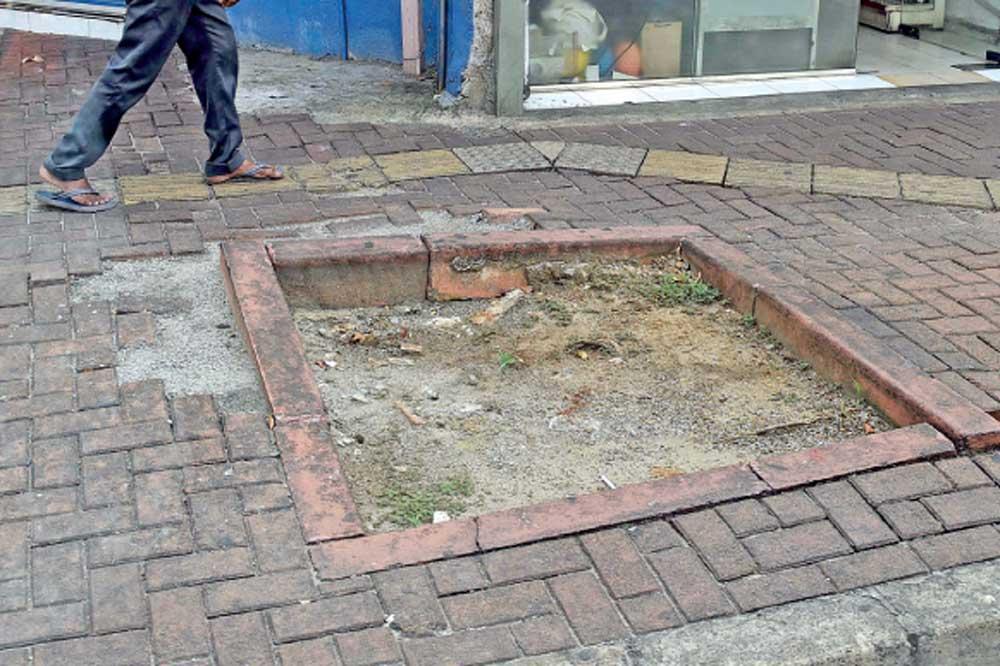
Most trees along the pavement in Wellawatte either don’t exist or are already dead.
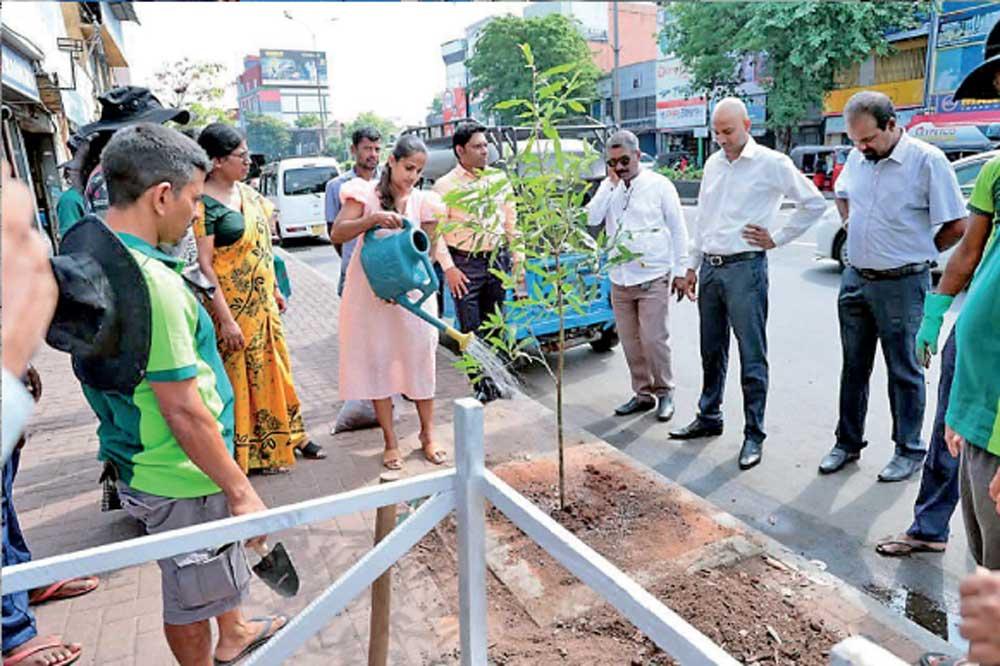
Trees being replanted along Sangaraja Mawatha in view of World Tree Day 2026. Image courtesy of CMC
In his recent article written to our sister paper The Sunday Times, multidisciplinary urban planner Dr. Sarath Mataraarachchi opined that across Colombo, the garden city vision is slowly diminishing. He noted that the streets once shaded by trees now radiate oppressive heat from impervious surfaces created by shiny buildings, tarmacs, parking areas, and purposeless paved areas. He explains how concrete and glass walls are now blocking natural breezeways that carried cool air through the city, trapping heat and polluted air within the urban fabric. “Rainwater that once soaked gently into the ground now rushes across hardened surfaces, overwhelming drains and flooding neighbourhoods. The living landscape that once cooled the city, absorbed water, filtered air, and supported everyday life is being systematically erased and replaced by an urban environment that stores heat, accelerates runoff, intensifies congestion, and disconnects communities,” he wrote.
Poor tree care and maintenance
According to Siril Wijesundara, Research Professor (Plant taxonomy and conservation) at National Institute of Fundamental Studies, Kandy tree care and maintenance is poorly done in Sri Lanka. “In some countries these trees are being washed daily to get rid of dirt and dust. But here we plant a tree and remember the tree only when it’s old and about to be cut. Now, there are new equipment to check the age of a tree, to see if a tree is rotting and so on. So these could be used to ensure the health of trees,” he noted.
Prof. Wijesundara further said that a tree care unit could be established at CMC to look after trees. “In a natural setting, trees would be looked after by other trees, but when it’s taken out from the natural setting it needs to be looked after, like foster parenting,” he said while adding that people including shop owners have a duty to look after trees growing by their shops rather than trying to get rid of them.
Why urban cities need greenery
“It’s essential to protect the greenery in urban cities such as Colombo, particularly as our urban drainage systems are inadequate,” said senior environmental architect and conservationist Sunela Jayewardene. “Trees serve as a buffer for heavy rain and wind and provide shade during hot hours. However the trees are a problem if they’re not maintained. Unlike cities like Singapore and Kuala Lumpur, Colombo fails to scientifically manage the city’s trees; a failure to monitor rotting trees, annually prune and secure branches before the monsoon leads to accidents and damage. Sadly Colombo’s municipality seems to have absolutely no method or plan to maintain or plant trees, so we lose our tree cover and also our much coveted name as the Garden City of Asia,” she noted.
CMC’s role in maintaining Colombo’s tree cover
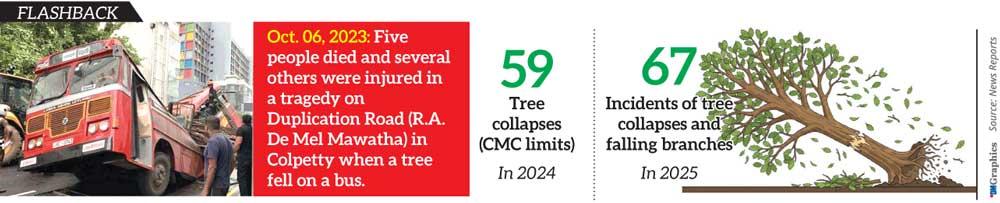
In recent times, much attention has been given to ageing trees that are sometimes unable to withstand heavy rainfall and strong winds. Following a tree collapse in R. A De Mel Mawatha that claimed the lives of five people in October 2023, the Colombo Municipal Council (CMC) has taken tree inspection seriously. It is after this incident that they identified many trees which are either ageing or required maintenance. In 2024, 59 tree collapses were reported from CMC limits. According to media reports, 67 incidents of tree collapses and falling branches were reported in 2025.
Speaking to the Daily Mirror, CMC’s Environmental Engineer Thilak Priyadarshana Perera said that most trees are removed after going through an institutional procedure. “We obtain a report about a particular tree prior to deciding on whether it should be removed. The arborist would first visit the site and officially inspect the tree to determine its condition. The arborist’s task is to identify vulnerable trees and determine whether they should be pruned or removed. Most trees need to be individually inspected because certain conditions are not visible to the naked eye. For example some trees have cavities in their interiors. Sometimes a tree may look healthy, but its roots may have worn off due to its age and various other factors. Therefore, such trees should be removed. Once trees are removed we conduct replanting as well. Some trees were replanted at Sangaraja Mawatha,” he added.
Perera said that they receive complaints from people as well as from municipal councilors regarding problem trees. “We have an environment committee which convenes once a month. Here we discuss the issues and decide about vulnerable trees. The committee comprises municipal councilors and officials from the environment unit. Our objective is to maintain Colombo’s tree cover as much as possible. It is because of these trees that we feel a bit cool. Otherwise this city will become a desert. It is easy to cut down a tree but difficult to nurture a tree because it has to be protected from vehicles and even people,” he said.
According to CMC’s arborist Palitha Mahanthegama, Mee (Madhuca longifolia), Ehela (Cassia fistula) and Karanda (Pongamia pinnata) trees are now being planted in urban cities including Colombo. “Karanda is planted using the rootball technique because it is an evergreen plant and it covers quickly. As a result of this technique the trees grow like a bush. Mee trees are unique because their roots go deep underground instead of spreading on the surface. However, there are several old trees in Colombo city which are over a century old. They have matured into extra large trees so we need to take precautions by reducing their height to minimise risk on people,” he further said.
CMC to initiate legal action against people who damage trees
When asked about incidents reported in Wellawatte, Perera said that they too are aware of incidents where people cause damage to trees. “Nobody has the right to damage trees owned and planted by authorities just because these trees obstruct their properties,” he added. “It is illegal and we can take legal action against these individuals. There’s one official who needs to be informed, but even then people cannot remove trees. They have to obtain our permission. In most instances people cut off branches because the signboards of their shops are being covered. But this too is illegal,” he underscored.
18 Jul 2026 39 minute ago
18 Jul 2026 1 hours ago
18 Jul 2026 2 hours ago
18 Jul 2026 4 hours ago
18 Jul 2026 4 hours ago