Reply To:
Name - Reply Comment
 “Ownership became more equitable. Productivity often did not.”
“Modern agriculture is no longer simply about growing crops; it is about building competitive value chains.”
“The issue is not whether we choose rice or exports, plantations or peasant farming... These are false choices. Successful agricultural economies combine all of them.”
“Our economic history reflects three production systems... and a third system yet to be built—a modern bio-economy. Too often we have attempted to improve the first two instead of creating the third.”

Vietnam’s emergence as one of the world’s leading coffee producers should give Sri Lanka pause.
Less than half a century ago, Vietnam was scarcely associated with coffee. Today it is among the world’s largest exporters. That transformation was not the result of geography alone, but of a sustained national effort to align land use, research, finance, infrastructure, processing and markets around a coherent long-term strategy.
Sri Lanka’s experience has been very different
Ironically, Sri Lanka was once itself a major coffee producer. When coffee leaf rust destroyed that industry in the nineteenth century, the British quickly reorganised production around tea, creating one of the world’s great plantation economies. Whatever one thinks of colonial rule, it showed the value of strategic focus: identifying products the world wanted and organising production, infrastructure and commerce around them.
Long before coffee and tea, Sri Lanka’s prosperity rested on cinnamon, the crop that first drew the Portuguese, Dutch and British to our shores. Across history, Sri Lanka prospered when it produced high-quality goods for international markets.
Alongside this export economy, however, Sri Lanka also developed a very different agricultural civilisation. For more than two thousand years, ours was a hydraulic civilisation built around village communities cultivating paddy through sophisticated irrigation systems. Rice became not merely a crop but part of our culture, religion and social organisation.
Traditions coexisted, but rarely integrated
These two agricultural traditions—the export plantation economy and the independent village farmer—coexisted, but rarely integrated.
The plantation economy required a permanent labour force dedicated to commercial agriculture. It did not emerge naturally from Sri Lanka’s village society, where cultivation centred on family-owned land and seasonal rhythms. This was one of the main reasons the British imported large numbers of indentured workers from South India to labour on the coffee, tea and rubber estates. That distinction remains relevant today. Sri Lanka’s rural culture continues to value independent farming rather than plantation labour. Any successful agricultural strategy must therefore build on this tradition rather than attempt to recreate nineteenth-century plantation labour systems. The challenge is to combine the entrepreneurial spirit of the small and medium scale farmer with the technology, finance, logistics and market access associated with larger commercial agriculture.
After Independence, Sri Lanka understandably sought to create a more equitable rural economy. Land reform addressed real historical inequalities and broadened ownership opportunities. But redistribution was not matched by the institutional, financial and market reforms needed to sustain productivity. Larger production units were often fragmented without creating the cooperative structures, access to finance, technology or supply chains required for competitive agriculture. Ownership became more equitable. Productivity often did not.
The plantation sector followed a different path
Nationalisation in the 1970s weakened commercial discipline, investment and managerial accountability. Productivity declined, replanting slowed and international competitiveness gradually eroded.
Later reforms introduced a hybrid model under which state-owned estates were leased to private companies for long-term management. That system continues today. It has produced mixed results—improvements in some estates, stagnation in others—but it has not delivered the structural transformation needed to restore the plantation sector’s long-term competitiveness. One reason is that the hybrid model has constrained long-term investment. Companies are understandably reluctant to commit substantial capital to assets they do not own or control under sufficiently long and secure lease arrangements.
Tea is a long-term crop, and decisions on replanting, factory modernisation, mechanisation, diversification into higher-value crops or even alternative land uses often require investment horizons measured in decades. Ownership—or very long-term, secure leases—provides the confidence to take such risks and invest for the future.
State ownership or complete privatisation offers all the answers
The lesson is not that either complete state ownership or complete privatisation offers all the answers. Rather, Sri Lanka needs pragmatic partnerships in which government provides policy direction, regulation and oversight while private capital, technology, innovation and management drive productivity. The objective is to combine commercial discipline with long-term national interests.
Perhaps the most ambitious attempt to rethink rural production came with the Mahaweli Development Programme. While remembered mainly for irrigation and hydropower, it represented a broader vision of rural transformation. Settler families were allocated irrigated land for paddy cultivation and separate higher land for fruits, vegetables and other commercial crops. The concept recognised an essential truth: rural prosperity required diversification beyond rice.
The vision was sound.
The supporting systems were not. Processing facilities, cold chains, logistics, aggregation and reliable market access developed only slowly. As a result, diversification achieved only mixed outcomes despite the commitment and hard work of thousands of farming families.
More recently, however, encouraging changes have begun to emerge. Supermarket chains, hotels, restaurants and private agribusinesses are building integrated supply chains based on contract farming, refrigerated transport, quality standards and direct market access. Commercial mango orchards linked to organised distribution networks demonstrate how agriculture becomes more productive when production is connected to markets. Similar models are emerging in vegetables, fruits and other high-value crops.
These developments point to an important lesson. Markets, when properly regulated and supported, are not the enemy of farmers. They are the means through which farmers gain access to finance, technology, logistics and consumers. The challenge now is to replicate these successes on a much larger scale.
Agriculture can no longer be viewed in isolation. It must be integrated with logistics, ports, airports, food processing, cold chains, digital technology, branding and export marketing. Modern agriculture is no longer simply about growing crops; it is about building competitive value chains.
Vietnam’s achievement was not really about coffee. Coffee became the catalyst for transforming an entire agricultural ecosystem. Farmers were connected to research, finance, processing industries, modern logistics and global markets. The result was not merely higher production but the creation of a globally competitive industry.
Sri Lanka’s challenge is similar. The issue is not whether we choose rice or exports, plantations or peasant farming, or large farms over small farms. These are false choices. Successful agricultural economies combine all of them.
The same principle applies beyond crop agriculture.
Sri Lanka continues to depend heavily on imported dairy products despite favourable climatic conditions and generations of farming experience. Livestock should be viewed not simply as milk production but as an integrated industry encompassing breeding, veterinary services, feed production, milk collection, processing, branding and distribution.
India’s Amul cooperative demonstrates how millions of small farmers can become internationally competitive when connected through efficient systems of collection, processing and marketing. The lesson extends beyond dairy. Small producers need not be displaced by commercial agriculture; they can become its greatest strength when supported by modern institutions and markets.
Sri Lanka should also reassess the commercial potential of buffalo milk, which forms a substantial part of India’s dairy industry but remains relatively underdeveloped here. A modern livestock sector would reduce import dependence, strengthen food security, improve rural incomes and create opportunities for value-added exports.
Sri Lanka’s greatest untapped food production asset, however, may not be on land at all.
It is the ocean.
Situated at the centre of the Indian Ocean and surrounded by rich fishing grounds, Sri Lanka possesses natural advantages that very few countries enjoy. Our tuna is among the finest in the world, yet fisheries continue to be viewed largely as a livelihood sector rather than the foundation of a modern blue economy.
Artisanal and small-scale fishing will always remain an important part of our maritime heritage. But they need not stand in opposition to larger commercial enterprises. Successful maritime economies combine both. Deep-sea fishing, aquaculture, shrimp farming, seaweed cultivation, ornamental fish, seafood processing, cold-chain logistics and export marketing can coexist with traditional fishing communities under sound regulation and sustainable resource management.
Much of the value from Sri Lankan seafood continues to be added elsewhere through processing, packaging and international distribution. Countries such as Thailand, Vietnam and the Philippines have demonstrated how integrated marine industries can generate employment, technology, exports and higher incomes. Sri Lanka has comparable natural advantages but has yet to organise them into a coherent national strategy.
Looking ahead, Sri Lanka must broaden its agricultural ambition. If Colombia and Kenya can build internationally competitive flower industries, and Ethiopia has transformed its coffee heritage into a globally recognised premium brand, why should Sri Lanka not become a recognised producer of specialty coffee, premium tropical fruits, floriculture, spices, organic produce and other niche agricultural exports?
Transformation, however, will require political courage.
More than eighty per cent of Sri Lanka’s land remains under government ownership. Greater security of tenure and more productive land use are essential if agriculture is to attract investment, technology and long-term capital. This should not become an ideological debate between large farms and small farms. The most successful agricultural economies combine both. Commercial enterprises, cooperatives and independent farmers each have an important role to play.
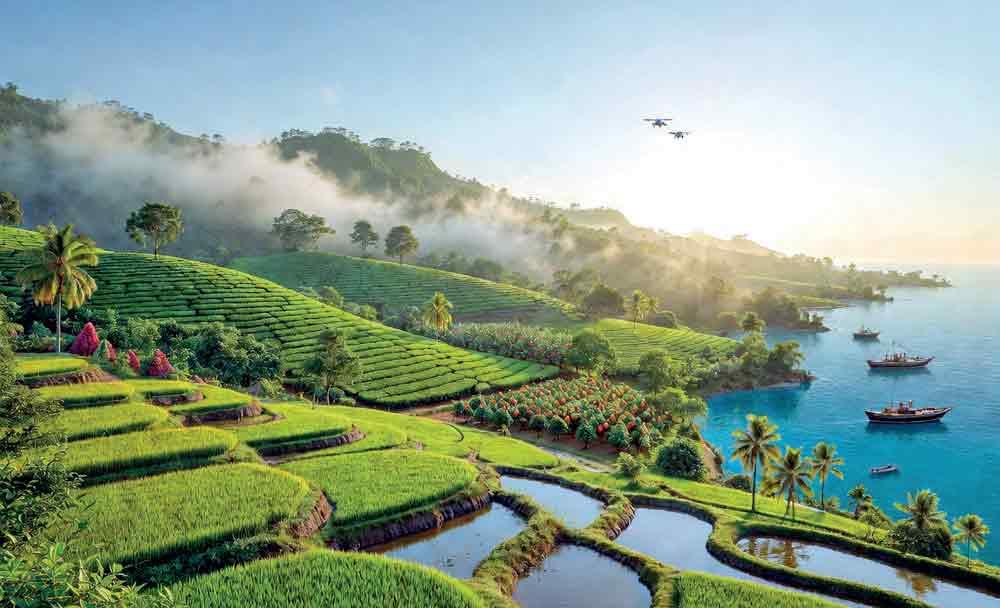
The real challenge is to overcome long-standing fears of markets, private investment and commercial scale. These should not be seen as threats to rural society but as instruments for increasing productivity, creating employment and expanding opportunity. A further reality must also be acknowledged. The labour force that once sustained labour-intensive agriculture no longer exists in the same form. Even during the colonial period, plantation agriculture depended upon imported labour because local labour was insufficient for estate cultivation. Today, mechanisation, precision agriculture, drones, artificial intelligence, robotics and smart irrigation are no longer optional. They are indispensable.
Equally important is renewed investment in agricultural research, seed technology, animal genetics, climate-resilient farming and stronger partnerships between universities, research institutions and the private sector.
Ultimately, Sri Lanka’s challenge extends beyond agriculture itself.
Our economic history reflects three production systems: the ancient hydraulic civilisation built around rice; the colonial plantation economy organised around coffee, tea and rubber; and a third system yet to be built—a modern bio-economy integrating agriculture, livestock, fisheries, science, technology and global markets.
Too often we have attempted to improve the first two instead of creating the third.
Sri Lanka possesses fertile land, abundant water, rich marine resources, multiple agro-climatic zones and a strategic location close to one of the world’s largest consumer markets. What has been missing is not opportunity but strategic consistency—and the confidence to embrace markets, private investment, technology and appropriate scale while ensuring that independent farmers remain central to the country’s future.
That requires five strategic commitments: reforming land policy and providing secure long-term tenure; building integrated value chains from producer to export market; investing heavily in research, mechanisation and digital agriculture; developing livestock and fisheries as modern industries; and adopting a national competitiveness strategy that survives changes of government.
Since Independence, successive governments have launched worthwhile initiatives, including the visionary Mahaweli Programme. Yet too often these have remained isolated experiments rather than components of a coherent long-term strategy.
The time for experimentation has passed.
The time has come for Sri Lanka’s Third Agricultural Revolution.
The writer, Milinda Moragoda, is the Founder of the Pathfinder Foundation. He Can be Contacted via [email protected])