06 May 2026 - {{hitsCtrl.values.hits}}
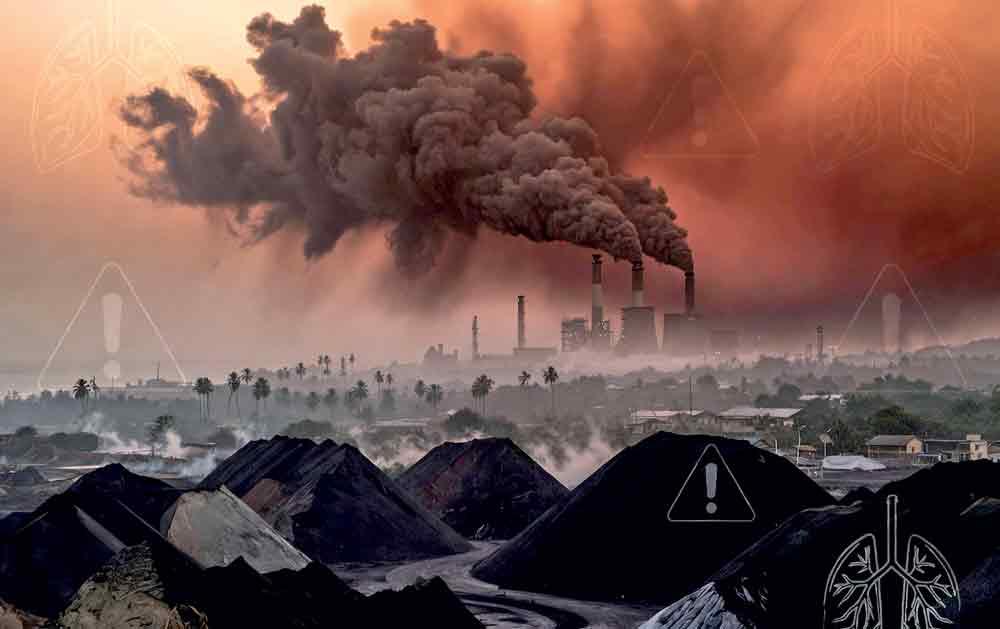
 Coal-fired power generation remains a central component of Sri Lanka’s energy mix, with the Lakvijaya (Norochcholai) Power Plant contributing a substantial share of national electricity production. Recent concerns regarding the importation and use of low-quality coal have raised critical questions about environmental emissions and associated public health risks
The health burden associated with coal-fired power plants is well documented, particularly in regions where low-grade coal is used and emission control technologies are inadequate
Exposure to particulate matter and sulfur dioxide has been associated with increased incidence of asthma, exacerbation of chronic obstructive pulmonary disease (COPD), chronic bronchitis, and reduced lung function
Global evidence demonstrates that such risks can be significantly mitigated through stricter fuel quality standards, effective emission control technologies, and robust regulatory enforcement

The Government has been facing major allegations almost every week since its inception. Before one issue is properly analysed and discussed, another emerges. While this should not be a reason for the Government to become complacent, it is, in fact, a matter of concern and even shame, as it reflects a pattern of incapacity and inexperience.
Just two weeks ago, the entire country was engaged in discussions about the importation of low-quality coal. Last week, attention shifted to the purchase of diesel at what was reported to be the highest price ever recorded globally. Now, this week, the focus has turned to the sudden and mysterious loss of USD 2.5 million from the Treasury.
The public may gradually forget issues discussed weeks earlier, overwhelmed by the sheer volume of controversies. However, such forgetfulness does not apply when it comes to the health and environmental consequences of these matters. A clear example is the importation of large quantities of substandard coal into the country. Even the Government has acknowledged that the coal imported did not meet required standards.
Authorities may attempt to reassure the public by claiming that financial losses will be recovered from the importer, with any remaining burden absorbed by the Treasury. However, it is evident that proper procedures have not been followed to secure full compensation. Moreover, Treasury funds are not the property of any individual or institution—they belong to the public.
While the Government may seek to close such matters by appointing committees or accepting the resignations of Ministers and officials, the health and environmental consequences cannot be addressed so easily. These impacts persist beyond administrative actions and require serious, evidence-based attention. This article aims to examine the health and environmental implications of low-quality coal.
Coal-fired power generation remains a central component of Sri Lanka’s energy mix, with the Lakvijaya (Norochcholai) Power Plant contributing a substantial share of national electricity production. Recent concerns regarding the importation and use of low-quality coal have raised critical questions about environmental emissions and associated public health risks. Here we discuss the global epidemiological evidence on coal-related pollution and evaluates its relevance to the Sri Lankan context, with particular emphasis on exposure pathways, health outcomes and policy implications.
Coal combustion is a major contributor to ambient air pollution worldwide. The health burden associated with coal-fired power plants is well documented, particularly in regions where low-grade coal is used and emission control technologies are inadequate. In Sri Lanka, recent reports of substandard coal imports to the Lakvijaya facility necessitate a rigorous assessment of potential health impacts on surrounding communities. Importantly, reductions in coal quality do not result in proportional increases in emissions; rather, even modest declines in fuel quality can lead to disproportionately higher pollutant emissions and consequently, greater health risks.
Low-quality coal is typically characterised by high ash content, elevated sulfur concentrations, the presence of trace heavy metals (such as mercury, arsenic and lead), and a lower calorific value. Combustion of such coal results in increased emissions per unit of electricity generated. Key pollutants include fine particulate matter (PM2.5 and PM10), which can penetrate deep into the respiratory tract; sulfur dioxide (SO₂), a precursor to secondary particulate formation; nitrogen oxides (NOx), which contribute to ground-level ozone and respiratory irritation; heavy metals with neurotoxic and carcinogenic properties; and fly ash, a complex mixture of mineral residues and toxic elements.
Populations residing near coal-fired power plants may be exposed to these pollutants through multiple pathways: Inhalation: Direct exposure to airborne particulates and gaseous pollutants Ingestion: Consumption of contaminated water or food, particularly through bioaccumulation of mercury in fish Dermal contact: Interaction with contaminated soil or fly ash Marine exposure: In coastal regions, bioaccumulation of toxic substances in seafood represents an additional and significant risk
A substantial body of scientific literature links coal-related air pollution to a wide range of adverse health outcomes. Exposure to particulate matter and sulfur dioxide has been associated with increased incidence of asthma, exacerbation of chronic obstructive pulmonary disease (COPD), chronic bronchitis, and reduced lung function. Fine particulate matter is also implicated in cardiovascular morbidity, including increased risk of myocardial infarction, stroke, hypertension, and systemic inflammation. Exposure to mercury and lead is linked to neurodevelopmental deficits and reduced cognitive function in children. Additionally, coal combustion releases carcinogenic substances such as arsenic and polycyclic aromatic hydrocarbons, thereby increasing long-term cancer risk, particularly lung cancer.
International evidence underscores the magnitude of these risks and the effectiveness of mitigation strategies. In the United States, a large-scale cohort analysis (1999–2020) estimated approximately 460,000 premature deaths attributable to emissions from coal-fired power plants; mortality declined significantly following the implementation of flue-gas desulfurisation systems, demonstrating the effectiveness of emission controls. In India, reliance on low-grade, high-ash coal has been associated with a substantial disease burden, including an estimated 720,000 premature deaths over a decade, exacerbated by weak enforcement of emission standards. In China, policy-driven closure of small, inefficient coal plants between 2006 and 2010 resulted in marked improvements in air quality and the prevention of approximately 46,000 child deaths, providing strong evidence of the reversibility of health impacts through regulatory intervention.
The Lakvijaya Power Plant has recently come under heightened scrutiny regarding coal quality and ash management practices. Key concerns include increased ash generation associated with substandard coal, potential elevation in mercury emissions, and reports of environmental contamination in surrounding areas.
Analysis of recent coal shipments to Norochcholai indicates an ash content exceeding 21% on an air-received basis—nearly double the Lanka Coal Company’s specified standard of 11%. For a typical shipment of approximately 60,000 metric tons, coal with 21% ash content would generate around 12,600 metric tons of ash, compared to approximately 6,600 metric tons from coal meeting the 11% standard. This represents an excess of over 6,000 metric tons of industrial waste from a single shipment. Furthermore, emission data from selected dates in February 2026 indicate elevated levels of carbon monoxide, nitrogen oxides, particulate matter, and sulfur dioxide during periods when these coal shipments were utilised.
Data from the Public Utilities Commission of Sri Lanka (PUCSL) further indicate a substantial increase in fly ash discharge. Average fly ash emissions rose to approximately 0.093 kg/kWh when using coal from the current supplier, compared to approximately 0.046 kg/kWh under the previous supplier—an increase of about 102%. Although comprehensive epidemiological studies specific to Sri Lanka remain limited, these findings closely mirror conditions observed in high-burden regions globally.
The dispersion distance of pollutants may vary according to local environmental conditions, including wind velocity and direction, ash characteristics, and precipitation patterns. Recent reports indicate the occurrence of unusually dark cloud formations in parts of the North Western, Western, Central, and North Central Provinces over the past several weeks. In parallel, clinicians have observed a notable increase in exacerbations of asthma, COPD, and allergic respiratory conditions in these same regions over the past few months.
Given the relatively short distance between the Norochcholai coal power plant and major population centres—approximately 140 km to both Colombo and Kandy—the potential for the transport of toxic pollutants through atmospheric dispersion and rainfall cannot be overlooked. These observations warrant systematic scientific investigation to assess possible environmental exposure and to determine any causal links with the reported health outcomes.
The continued use of low-quality coal in power generation presents a clear and preventable public health risk. Global evidence demonstrates that such risks can be significantly mitigated through stricter fuel quality standards, effective emission control technologies, and robust regulatory enforcement. For Sri Lanka, the situation at the Lakvijaya Power Plant represents a critical opportunity to integrate public health considerations into national energy policy.
The writer can be reached at [email protected]
18 Jul 2026 39 minute ago
18 Jul 2026 1 hours ago
18 Jul 2026 2 hours ago
18 Jul 2026 4 hours ago
18 Jul 2026 4 hours ago