02 Oct 2025 - {{hitsCtrl.values.hits}}
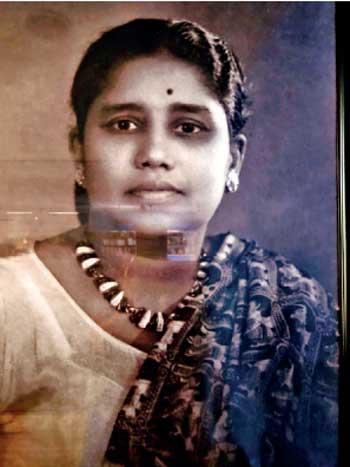 |
| The late Vipuli Jayasuriya, whose vision carried Sri Lanka’s flag heritage to global stages such as Paris and Stockholm |
By Rajitha Weerakoon
The colourful collection of flags, which will go on display at the Lionel Wendt after fifty-two years, relates the fascinating story of Vipuli Jayasuriya’s love for ancient Sri Lankan flags—a love that led her to reproduce the vanishing cultural treasures in Batik art. She could thus preserve them for future generations.
The story unfolds in the late 1960s with extensive travel to historic Raja Maha Viharas in search of them, when she found Temple flags tucked away in old “pettagamas” and temple chests. These she found faded and fragile. The ravages of time and weather had taken their toll on these flags made of cloth, while locally produced dyes used to draw the symbolic and aesthetically pleasing designs were fading.
The late Jayasuriya, having mastered the art of Batik, copied each design of the flags she found in the temples and returned home to reproduce them into an enchanting collection of over a hundred flags in Batik art, which will go on display at the Lional Wendt Memorial Hall from October 3rd to 5th.
Her maiden exhibition of these flags titled “Flags of Lanka, Batik Textile Art and Cultural Exhibition” was held in 1968 at the Lionel Wendt. Later, the flags got wider exposure at world capitals such as Paris and Stockholm. Vipuli Jayasuriya, the wife of the late Professor F.R. Jayasuriya and the mother of four, passed away in 2005 at the age of 89, having given her precious collection to her elder daughter, Priya. Priya, currently in Sri Lanka, is exhibiting these flags at the Wendt.
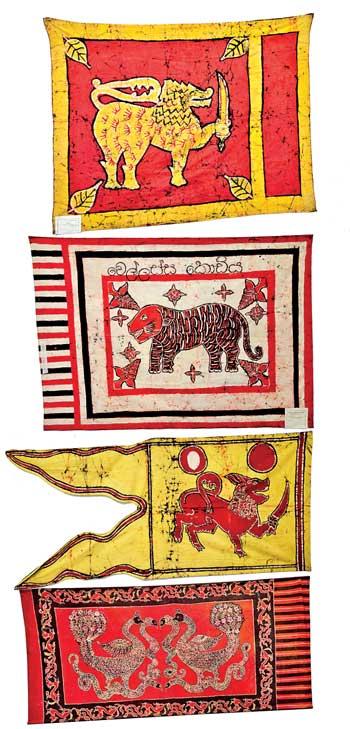 |
| From battlefields to processions, flags carried divine blessings, political power, and cultural memory, now revived in Batik form |
Writing the Foreword in the booklet published to mark Jayasuriya’s maiden exhibition held in 1968, A. Ratnayake, the then President of the Senate, had written, “It is on a voyage of exploration and discovery that she has embarked. The public will remain greatly thankful to her for this cultural revival in textile art, which she has initiated.”
The Message of S.C. Shirley Corea, the then Speaker of the House of Representatives, reads that Jayasuriya “in this era of hurry and bustle, has paid these originators of our cultural traditions the silent tribute of bringing these forgotten flags, banners and emblems back to life using intricate and laborious processes of Batik textile art”.
Flags had played multiple roles in Sri Lankan society. But flags of Temples and Monasteries had played a significant role with their special flags and banners, as Jayasuriya’s reproductions eloquently express. These carried symbols such as the sun, the moon, Bo leaves, the conch shell, the lion and mythical animals indicating divine protection or celestial blessings.
Flags of Temples had been carried when sacred relics were paraded. Flags had also been strung along processional routes. A glorious sight to behold, even now, is the large number of fluttering flags carried by pennon bearers at the Kandy Perahera.
The history of the Sri Lankan flag, considered one of the world’s most historically profound national flags, is richly symbolic. It traces its origin to the arrival of Vijaya. Chronicles attribute Vijaya’s lineage to a lion, and the symbol of the lion, therefore, has played a major role in the island’s identity and history.
The first flag to be mentioned in history is the banner carried by Dutugamunu’s soldiers in the famed war against Elara, which featured the lion holding a sword in its right paw. Adorned with the symbols of the sun and the moon, it had since been used to express political power. History mentions many Kings thereafter continuing to carry the flag to the battleground with the lion on it. Flags of Rajasinghe I and that of the last king of Kandy, Sri Wickrema Rajasinghe, featuring the depiction of a lion, are on display at the National Museum.
Each of Sri Lanka’s twelve provinces in the past had been allotted a flag. The lion, the bull, the elephant, and the fish had adorned the district flags of ancient kingdoms. Weapons and deities had been used as emblems. While flags of Royalty and dynasties used by kings and Royal families signified sovereignty, lineage, and divine authority, military flags carried into battle represented kingdoms, regiments, or commanders. These had acted as rallying strategies during warfare and to keep the troops’ morale high.
An interesting fact is that with hereditary chieftains of Districts having been allotted a flag, the chieftains, whenever they participated in ceremonial processions or even while privately touring, probably on elephant back, had carried their family pennant!
13 Jun 2026 2 hours ago
13 Jun 2026 2 hours ago
13 Jun 2026 4 hours ago
13 Jun 2026 5 hours ago
13 Jun 2026 5 hours ago