06 Feb 2017 - {{hitsCtrl.values.hits}}
It is my strong belief that my motherland is a paradise lost owing to poor statecraft. Erasmus, a Theologian, (c. 1466 – 1536) had endorsed that people should at all costs avoid belligerent nationalism, denounce war as the greatest of evils and distrusted kings. Erasmus had been concerned that for the liberties of the people, he had favoured a government in which people would be in control.
English humanist Thomas More had produced the most outstanding work of political thought - UTOPIA, a Greek word meaning ‘nowhere’, in Latin in 1516. He had also outlined that a Nation could be improved, liberated and strengthened if we respect and observe the ideals of humanism, concerns for education and devotion to public welfare. More had emphasised on the need to have sympathy with the plight of the poor and had argued that the governments should provide employment/work so that no man would be driven to theft by the pressure of want etc. They had argued citizens should not  be made destitute – lacking means of subsistence, lacking food, clothing and shelter.
Both had emphasized good rulers should obey the law and that God punishes the tyrant, the ruler who is cruel and oppressive. They had also believed that bad rulers were sent by God to punish the people’s sins. They had however contended that kings owed their position to recognition by the people, and that they must be punished if they abuse their power, even though they were considered as god’s lieutenants. It had also been believed that the kings were the lowest of the three levels in human society, the other two being the people and the priesthood, both of whom kings are instituted to serve. Accordingly, they had opined that the people should rebel against the king, their servant, if they act irresponsibly in immoral manner and had propounded the doctrine of government by the consent of the people. They had also endorsed that a government could be overthrown if it did not serve the ends for which it had been instituted and particularly if it hindered the people in the attainment of their salvation. It was therefore considered lawful to resist a tyrannical ruler who was oppressing or destroying a State.
Politicians in Sri Lanka have been greedy for power, prestige and money. Doesn’t that mean that they had only focussed on external gratifications instead of inner satisfaction to serve the people. Nevertheless, former President Mahinda Rajapaksa was an exceptional leader who provided good leadership to win the war with the LTTE. MR unlike his predecessors used the JR’s hybrid – the Executive Presidency and a devalued Parliament to his advantage for the first time, which JR himself had pathetically failed. However, why did he fail to understand the need to give leadership to a devastated country from peak to peak, after the war was over. How did he lose the grounding? Did he also reject the honest critic who spoke the truth? Furthermore, was he surrounded by sycophants who lied creating stories he liked to hear. Did they use power, charisma and communication skills to make the countrymen believe distortions, causing the government to lose touch with the reality by making serious omissions. Why is it that our political leaders fail to realise that they are ultimately responsible for the distressful lives and misfortunes of the people at present?
Being a Buddhist, let me add Gauthama Buddha was a social reformer. Emperor Dharmasoka had based himself on the teachings of the Buddha to run a government loved and respected by the people. However, Sri Lankan politicos are disparagingly no better than despotic rulers that had emerged in the African continent because they had failed to run statecraft through avoidance of conflict, war and violence rationally.
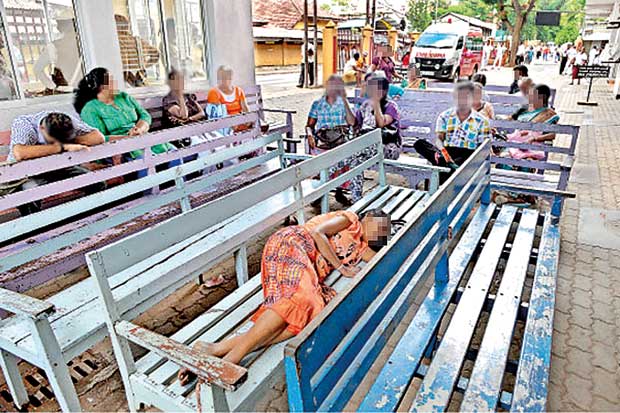
Why do the masses come to the main roads in Sri Lanka in processions for demonstrations and block and cause massive disruptions to people on the roads to find solutions to various demands etc? How does the Government Medical Officers Association (GMOA) successfully paralyse and resort to so called trade union action in government hospitals without attending to the patients? The government also seem to be incapable of handling the GMOA. How do they disregard blatantly their duties in the name of trade union rights and cause endless sufferings to the hapless public? GMOA members also fleece patients mercilessly while doing private practice without any regard to humankind having been beneficiaries of free education. Shouldn’t they ensure greater discipline and be of selfless service to people without destroying their reputation like politicians? They should not forget that they have skeletons in their cupboards too.
Governments must not fail therefore to assert the position that Sri Lankan citizens must also have their private medical college as in the case of Nepalese and Bangladeshis and the like for the benefit of future generations. An attempt to establish a similar private medical college in Ragama was prevented due to weighty opposition previously too. The President must therefore stand up on behalf of the government and emphasise that it is the government that decides policy and not the GMOA or the student bodies of various universities.
President should use his communication skills to emphasise that the establishment of a private medical college is essential as in the case of all other fields such as law, engineering, marine sciences etc. We must not forget how Chinese leadership – Deng Xiaoping made an announcement before they had to deal with the issue with firmness in Tiananmen Square. Our rulers should remember statecraft is difficult and the people expect a better deal from the present government.
The Buddha could be considered the foremost enlightened classical philosopher, who revolutionised and introduced changes including ‘radical egalitarianism’ and accepted gender equality – women too as spiritual equals etc. in the world. Buddhist teachings and social, political philosophy could therefore be considered as the most suitable form of governance in Sri Lanka, which had proved to be immensely successful during the times of ancient kings too. These policies and principles could be utilized by the present rulers to establish a well-managed democratic welfare state, with a deep sense of social responsibility with compassion, consideration, love, equality, with the hope that they would attend to statecraft to ensure law and order, and social harmony.
Gauthama Buddha had emphasized that the ruler was ‘a democratic conception of state and law based on the principle of equality’ chosen by the people, a great elect, (Maha Sammatha), who is empowered to rule based on the principle that they exercise authority only by the social contract as a compassionate ruler, which had been set out in the Sihanada Sutta – Dhasa Raja Dharma.
Furthermore, having been able to contain the LTTE in 2009, if we do not successfully contain other political manipulations and numerous other issues, distortions etc. including unjust GMOA trade union action, irresponsible and misguided youth activities in a futuristic, fair-minded, open transparent manner, for the benefit of the countrymen, the delivery of aspirations of countrymen would be a distant dream. The government must be careful and should not permit GMOA to overstep their legitimate boundaries for any reason. GMOA too should support patriotically to create a more democratic society in which everybody gets equality, justice, fair-play without being abused so that future Sri Lankans could feel proud as a nation.
03 Jul 2026 6 hours ago
03 Jul 2026 6 hours ago
03 Jul 2026 6 hours ago
03 Jul 2026 6 hours ago
03 Jul 2026 6 hours ago