25 Feb 2026 - {{hitsCtrl.values.hits}}
 Professor Nobukatsu Kanehara outlines Japan’s “Free and Open Indo-Pacific” (FOIP) strategy and its relevance to Sri Lanka
Open sea lanes and maritime security are essential for global trade and regional stability
Sri Lanka’s strategic location makes it a pivotal hub connecting India, Africa, the Gulf, and Europe
Modernised ports, containerization, and AI-driven logistics are key to leveraging economic opportunities
|
Nobukatsu KANEHARA |
 |
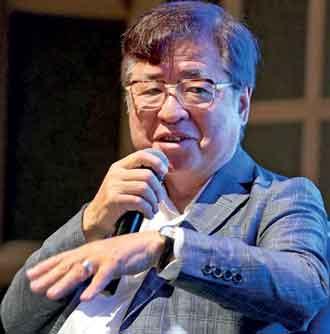
Renowned Japanese scholar Professor Nobukatsu Kanehara, who previously served as Assistant Chief Cabinet Secretary to then Prime Minister Shinzo Abe, takes questions from Daily Mirror regarding Sri Lanka’s strategic importance in the Indo-Pacific region. He is also the Executive Director of Sasakawa Peace Foundation and serves as a national security expert. During his tenure, Shinzo Abe was the primary architect of Japan’s “Free and Open Indo-Pacific” (FOIP) vision. He was in Sri Lanka to attend the Indian Ocean Security Conference organised by Pathfinder Foundation. Excerpts:
Q What do you actually mean by free and open Indo-Pacific?
One is Abe’s thoughts- the liberal international order that should be extended to the Indo-Pacific.
The freedom or democracy, and the rule of law are European-born ideas. But it can be extended to the Indo-Pacific simply because institutions are European-made- Parliaments, independent judiciary, the plural political party system. These are important in the industrial age.
But beneath that, you need deep spirituality and morality. Europeans have Christianity, but we have Buddhism, Hinduism, Muslim or Confucius. We have deep spirituality. It is very important to make the institutions function, simply because the great civilisations share the basic idea. You can find God only inside you. Truth is inside. That’s Buddhism. Truth is inside you. You have to find it. Buddhists call it compassion. These values are universal.
You can name it whatsoever, but we do share that. Then we can make the European-made institutions function. It is necessary. The interests are complex, and society changes very fast. We need institutions. But beneath that, we have to share the basic morality and ethical emotions. Therefore, we can make the liberal order- not only the Atlantic order, but also the Indo-Pacific order. It can be global. That was the basic idea. The liberal international order must be extended to the Indo-Pacific. We can do it because our values are universal.
Secondly, the Global South is now rising. In the last century, the Global South was only 20 per cent of the world economy. The G7 occupied 80 per cent of the world economy. Now the size of G7 nations is less than 50 per cent of the world economy.
To sustain this liberal order with us, the G7 nations should share economic prosperity. The best way to do so is free trade, simply because the investors in the advanced nations can get a much higher return by investing abroad. Then, technology flows out. Factories are transferred. Money is transferred. Then, the second-tier, third-tier nations grow very fast and become industrialised. That’s how the world economy grows at 4 per cent, 5 per cent per year.
These advanced nations transfer technology, money, and factories to the second-tier nations. But they absorb the products produced by these nations. Markets are still very big in the advanced nations.
This is how the world economy is functioning. For that purpose, free trade is very important. Japan and the EU are promoting free trade.
Japan concluded the EU–Japan Economic Partnership Agreement with the European Union. It also took leadership of the Comprehensive and Progressive Agreement for Trans-Pacific Partnership after the United States withdrew, and later the United Kingdom joined the pact.
Japan is also part of the Regional Comprehensive Economic Partnership, together with the Association of Southeast Asian Nations (ASEAN), China, South Korea, Australia and New Zealand. Meanwhile, the European Union has trade agreements with Latin American blocs such as MERCOSUR, as well as with countries like India and Indonesia. We continue to push forward the free trade system. To promote free trade, the oceans must remain open and secure. Among the advanced nations, navies must cooperate, suppress piracy and keep the choke points open- Suez and Panama, Hormuz, Malacca, Lombok, Cape Town. These places must be open to everybody. Particularly in Sri Lanka, sea-lanes must be open for free trade. The free trade system must be sustained by the open sea. These are the basic ideas of the Free and Open Indo-Pacific.
Q Professor, you mentioned that liberal democratic values of the Western world, or Europe for that matter, should be extended to the other side of the world. In Asia, we have our own values and culture. Didn’t Prime Minister Abe advocate the incorporation of these values also into that system?
Western institutions are transplanted. But we are not transplanting their values. Values are ours. We have a much longer history than Europe. We have deep spirituality. We have a sharp morality, because of Buddhism, Hinduism, and Muslim, and Confucius.
The core message is one. You have God in you. You have the truth in you. You have to find it. As for the teaching of Buddha, he never said, this is the truth.
He never said, this is the value. He never said it. He said, “find it yourself”. Jesus Christ said, God’s kingdom is inside you. You have to find it. The same message is heard everywhere by the great leaders of religions. The core essence of the value is consciousness at the level. The name is different. Buddhists call it compassion. Christians say it is love. Confucius said it is love in Chinese. We do share universal values. Names are different. But the core values are the same. It’s not a transplantation of European values. We can simply say our values are the core. They are the same as Europeans.
Q How free and open is the Indo- Pacific now in today’s context?
The ocean is free. We are cooperating to suppress piracy. Piracy is now going away. The sea is open.
Q Still, countries like Sri Lanka face problems. Sri Lanka is under pressure from the Western powers over Chinese involvement. How challenging is it for a country like Sri Lanka?
Sri Lanka is in the second tier, advancing very fast. The last century was the East Asian century. Japan jumped out in the 19th century. In the 1990s, the ASEAN nations rose. In this century, China just jumped out. China was our size in 2010. Today, China is four times bigger than us. But now we picked out. South Korea is picking out.
China is picking out. Their growth will slow down- no longer 10%, maybe 1-2% per year. This century is the century of West Asia. India will be a superpower in the future. There are now 1.5 billion people, bigger than China’s. The Chinese are 10 years senior to Indians. We are 48 years old on average. We, the Japanese, are very much a silver country now. China is now 38 years old. Indians are 1.5 billion people, 28 years old. Amazing, isn’t it? They still believe that tomorrow is far better than today. They work hard.
The Japanese don’t work hard any longer. But the Indians can work seven days, 24 hours, because they believe that tomorrow is better than today. The full energy is being unleashed in India. The next big economic explosion is in India. Sri Lanka and Bangladesh will absorb the energy from the rise of India.
We waited for a long time for China to rise. In 1998, they were still miserable. In the 1990s, they were working hard. In 2010, after they joined the World Trade Organisation (WTO), they jumped out. They became very big very quickly. This is the saturation point for expansion. It comes suddenly.
Nobody can tell when it will come. But it comes for sure. When it comes, it’s skyrocketing in this way. In West Asia, we will see that soon.
Q Prime Minister Abe also visited Sri Lanka in 2014. What was his major intention at that time?
There are some. First of all, his grandpa, Prime Minister Nobusuke Kishi. He was the founder of post-war Japan, along with Yoshida Shigeru. These two were the main founders of post-war Japan. Prime Minister Kishi made the grand strategy of Japan. We lost to China. We are in alliance with the United States. But we have to help Asia rise. He went to India. He went to Sri Lanka, Australia and many ASEAN nations. He came here. I think he (Abe) wanted to follow grandpa’s path.
He went to Kelaniya Temple. His grandpa went there. Two, Sri Lanka is a very important strategic island. This is the pivot of India and Russia. When you want to go to, say, Suez, to Europe, Hormuz, the Gulf nations, you have to come here. When you wish to go to, say, Mombasa, Kenya – the eastern coast of Africa, you have to come here. This is vitally important. It’s the pivot of India and Asia. Strategically, it’s very important.
Q How can Sri Lanka leverage its strength as a strategic point for its economic advantage? You can refurbish your ports. You have to know the container. Containers are a great invention of Americans. Inventors became bankrupt. Containers are everywhere. It must be all computerised. At the port, a huge number of containers come. With the cranes and computers, you have to reload it again very fast. You should know that when India grows, the number of containers will be very big. That’s happening to China. That’s happening to South Korea. That will happen to India.
That means these ports become more and more important. You have to make ports modern. You have to make many claims - automated claims with AI. With modern digital transformation, you have to make your ports very modern and very big.
QHow important is it for a country like Sri Lanka to join RCEP? Can Japan help Sri Lanka join it?
Why not?It should get all the members’ consent. As for the free trade zone, the bigger the free trade zone, the more beneficial it is for the parties in that framework. We should expand its membership.
Q Is there any possibility for Japan to help Sri Lanka in this case?
I believe so. From an academic point of view, free trade must be bigger and bigger. The more the participants are, the more beneficial this framework is.
Q As far as the free and open inter-Pacific is concerned, do you mean to say that the countries should follow UNCLOS (United Nations Convention on the Law of the Sea)?
Yes. UNCLOS is the basis of the border of the ocean. Americans are not yet there, but it’s a very basic constitution for the stability, for the use of the oceans.
Q In Sri Lanka, China has also invested a lot. China has secured the Hambantota port. They have invested in Colombo Port City. How do you view these projects, actually?
The great powers have big navies. The freedom of the ocean is not only for the merchant ships. It’s also for the navies. Navies must cooperate to keep the ocean open and to suppress piracy. We have common interests to keep the ocean open. But during wartime, they fight against each other.
They try to destroy the enemy’s fleets. They try to destroy their bases- remote bases in the highlands. That’s war fighting. The naval industry is a bit different because they always prepare for war. They want to know the deep-sea, topographic deep-sea ships, and how the submarines can go through. They want to get the noise of the sea to distinguish enemies’ submarines. The navies do that. Therefore, pay some attention to that.
We don’t accept Chinese. In our territorial sea, we never accept Chinese survey ships to make a survey. Even though they are commercial, even though they are not military, we don’t accept that simply because we have to keep our territorial sea to ourselves. It’s not open to enemies’ vessels. But beyond the territorial sea, it’s an open sea. For military activities, it’s open. For scientific purposes, the countries must notify the coastal states. But basically, it’s open. You can’t stop it. But in Sri Lankan territorial waters, you should not open it to anybody. You have to keep it to yourself.
Especially for research activities, it should not be open to any country. We don’t do that.
21 Jul 2026 3 hours ago
21 Jul 2026 4 hours ago
21 Jul 2026 4 hours ago
21 Jul 2026 4 hours ago
21 Jul 2026 6 hours ago