11 Nov 2025 - {{hitsCtrl.values.hits}}
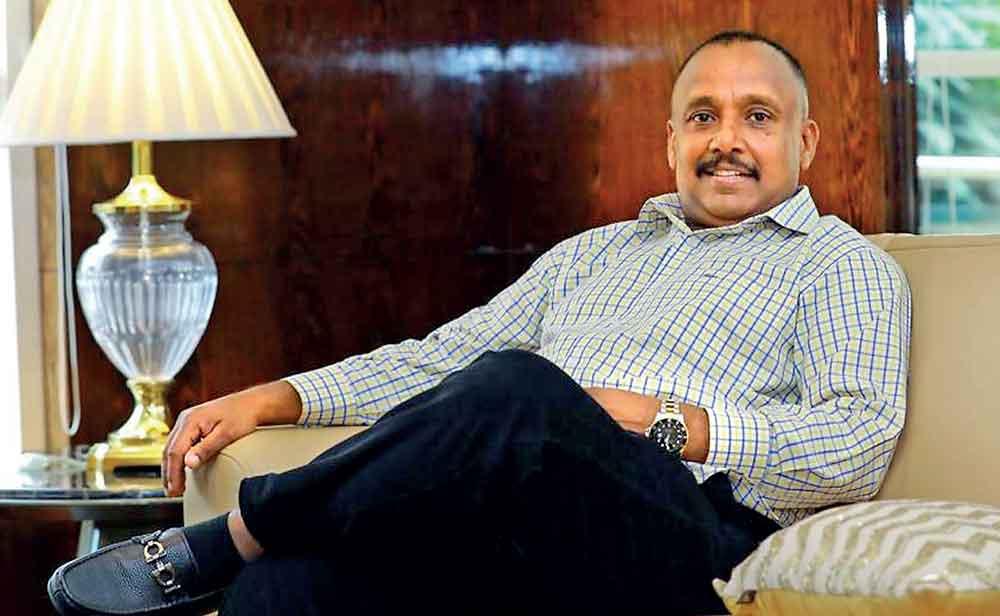
 Ambassador Kananathan — a businessman-turned-diplomat speaks to DM on how Sri Lanka can attract greater foreign direct investment (FDI) and reposition itself as a competitive destination for global investors. Excerpts:
Q How would you describe the current economic landscape in Sri Lanka from an investor’s perspective?
Sri Lanka is now at a critical turning point. After weathering a severe economic crisis, we’re seeing stabilization —debt restructuring is progressing, inflation has eased, and confidence is gradually returning. Yet, foreign investors are still cautious. They want consistency, predictability, and clarity. The fundamentals are improving, but policy credibility and execution speed will determine how fast we can truly attract long-term capital.
Q What are the biggest obstacles foreign investors face when considering Sri Lanka?
The challenges are mostly procedural and institutional rather than resource-based. Sri Lanka offers strategic location, skilled labor, and access to major markets, but investors face a maze of approvals —permits, environmental clearances, and sectoral licenses—that often require running from ministry to ministry. This not only delays projects but also creates uncertainty.
Q You’ve mentioned bureaucracy. How can the Board of Investment/Investment Authority help cut through that red tape?
The BOI must evolve into a true “one-stop investment center.” That means not just branding itself as one, but functionally integrating representatives from every key ministry —finance, environment, power, ports, customs, Immigration and labour—under one roof.
If the BOI is empowered to issue all clearances and permits after inter-ministerial coordination, an investor wouldn’t need to visit ten different offices. That’s the model followed in countries like Singapore, Vietnam, Kenya and many African countries where approval time has been cut from months to weeks.
Q Beyond administrative reforms, what can the government do to make Sri Lanka more attractive?
Consistency in policy is key. Investors can tolerate high taxes or even strict regulations, but they cannot tolerate sudden change. The government should:
1. Announce a Ten-year investment policy framework that remains stable across political cycles.
2. Strengthen legal protection for foreign investors, including dispute resolution mechanisms and investment guarantees.
3. Offer sector-specific incentives—not blanket tax holidays, but targeted support for high-value industries like renewable energy, logistics, IT, and agro-processing.
4. Promote Public–Private Partnerships (PPPs) in infrastructure and logistics, ensuring transparent bidding.
Q How should Sri Lanka position itself in the eyes of global investors today?
We need to rebrand Sri Lanka in line of Economic Diplomacy beyond beaches and tea. The world must see us as a strategic investment hub—a bridge between South Asia and Southeast Asia.
For example: The Colombo Port City could serve as a financial and services hub. The Eastern and Northern regions could focus on green energy and logistics. The Southern belt could become a manufacturing and IT corridor.
An integrated national investment promotion strategy—driven jointly by the BOI, the Export Development Board (EDB), and the Foreign Ministry—can showcase this diversity.
Q Transparency has often been cited as a concern. What mechanisms could help improve it?
A total digital transformation of the entire investment process is crucial. Investors should be able to submit, track, and receive approvals online, with real-time dashboards showing where each file is pending. This builds accountability. Also, publishing investment approval timelines and performance metrics for ministries creates public pressure for efficiency. In short, technology and transparency go hand in hand to restore confidence.
Q Neighbouring countries like Vietnam, Bangladesh, and India are aggressively attracting FDI. How can Sri Lanka compete?
By offering speed, stability, and specialization.
We may not match their market size, but we can be faster, more transparent, and more strategic. If we focus on niche sectors—renewable energy, logistics, IT-BPM, Apparels and food processing—and provide plug-and-play infrastructure, investors will come.
A “one-day business registration” system and a genuine one-stop BOI clearance process can be our competitive edge.
Q Many critics say Sri Lanka’s overseas missions have failed in bringing tangible investments viz-a-viz Inward as well as outward to date. Why is that?
That’s an uncomfortable but accurate observation. Most of our missions are focused on consular, protocol, and cultural functions — passport renewals, national day events etc etc; Economic diplomacy, which should be their core modern mandate, remains peripheral.
In most missions, there is no defined investment target, no reporting framework, and no performance evaluation linked to economic outcomes. As a result, ambassadors and staff are not accountable for inward/outward investments or trade linkages.
This has to change. Our missions abroad must transition from being ceremonial offices to economic frontlines.
First, through clear targets and key performance indicators (KPIs). Every Head of Mission should receive annual FDI and targets — measurable, time-bound, and aligned with Sri Lanka’s national investment strategy.
Measuring the success of investment and trade promotion efforts involves tracking several key performance indicators, including the number of investment leads generated (both inward and outward), the total value of projects facilitated, the number of trade partnerships established, and the volume of investor delegations organized or hosted to engage potential partners and drive economic collaboration.
Secondly , we must embed investment professionals BOI and Export Development Board (EDB) officers in regular coordination with missions tasked with promoting Sri Lanka as an investment destination.
Thirdly , missions should report monthly to BOI a body to be chaired jointly by the Ministry of Foreign Affairs, the Treasury, EDB and the BOI. Their performance must be reviewed and publicly benchmarked.
Accountability begins when results are measured and compared.
Q How can Sri Lankan envoys support our business community in expanding overseas and encouraging outward investments
Sri Lankan envoys should play a key role in supporting our business community to invest overseas by providing market information, connecting our investors with foreign partners, assisting with legal and regulatory procedures, and promoting Sri Lankan products and services abroad. They can also encourage proper repatriation of profits back to Sri Lanka through formal banking channels.
Already, many Sri Lankan outward investments have successfully taken place in several African countries such as Kenya, Tanzania, Uganda, Ethiopia, and Mozambique. In these countries, Sri Lankan companies are involved in manufacturing, renewable energy, Information technology, agriculture, apparel, trading, and services sectors. Many Sri Lankans are also employed in these overseas establishments, gaining valuable income and experience.
As a result, our business people are doing well in these countries , and importantly, the profits and worker remittances from these ventures are being sent back to Sri Lanka, helping to strengthen our foreign exchange reserves and support the national economy.
Our Ambassadors aren’t meant to be cocktail diplomats. An ambassador should be the country’s chief marketing manager — not just someone warming a chair and attending cocktail parties on taxpayers’ money. Their job is to sell the nation, attract investors, open markets, and bring tangible economic results back home
Q How important is the Sri Lankan diaspora and strategic partners in this investment drive?
Extremely important. The diaspora is not only a source of remittances but also of trust and connections. They can be our brand ambassadors. Meanwhile, strategic partners like India, China, Japan, and the EU can bring in capital, technology, and export markets.
We should explore bilateral investment corridors and special economic zones (SEZs) tailored to these partnerships.
Q Finally, what’s your vision for Sri Lanka’s investment environment five years from now?
Ideally I see Sri Lanka as a “plug-and-play investment destination”—where an investor can arrive with an idea and leave with an operational project in 60 days.
A strong BOI-led one-stop center, digital approvals, policy stability, and transparent governance can make this vision real. Once that happens, capital will flow naturally—because investors always go where there’s clarity, speed, and trust.
“Sri Lanka has everything to succeed — location, talent, and opportunity. What we need now is efficiency, unity, and the courage to simplify
Ambassador Kana Kananathan is a businessman and Diplomat, with over four decades of experience on the African continent. A long-time resident of Africa, he served as Sri Lanka’s envoy to Kenya, with concurrent accreditation to 22 African Nations and was the permanent representative to UN Habitat and UN environmental Programme. Over the years, he has been the Elections Monitor across the continent, worked closely with African governments, and built enduring partnerships with African leaders. He also served as Economic and investments Advisor to former President Professor Alpha Condé of the Republic of Guinea,
21 Jul 2026 6 hours ago
21 Jul 2026 7 hours ago
21 Jul 2026 7 hours ago
21 Jul 2026 7 hours ago
21 Jul 2026 9 hours ago