07 Feb 2026 - {{hitsCtrl.values.hits}}
 In 2023, we held the first Global Buddhist Summit, which was inaugurated by Prime Minister Modi himself. We also organised the Asian Buddhist Summit, which was opened by the President of India. When summits of this nature are attended at the highest level …at events organised by the International Buddhist Confederation that bring together the global Buddhist community, it speaks for itself
His famous teaching- Paticha Samupada, which is basically about interconnectedness. It’s metaphysics. Every object is connected. When you understand Buddha Dhamma, you realise this is not religion. This is philosophy
|
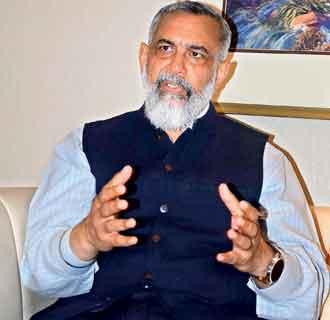
Director General of International Buddhist Confederation (IBC) Shri Abhijit Halder |
 |
Director General of International Buddhist Confederation (IBC) Shri Abhijit Halder, who arrived in Sri Lanka along with the delegation that accompanied the Devnimori relic which was on exposition for public veneration at Gangaramaya temple, shared his views on the mission and Buddhist heritage in India.He has nearly four decades of service in the Government of India, which he concluded in January 2022. Shri Halder has served in different capacities in India and aboard and has long fostered connections with global Buddhist communities. Notably, in 1989 he visited the Buddhist Republics of Russia, navigating religious restrictions during the Soviet era to strengthen cultural and spiritual ties.
QCould you kindly give us a broad historical overview of these Buddhist relics found in Gujarat?
You see these holy relics of the Buddha were found in 1960 in a place called Devnimori. It is a place which, unfortunately over a period of time, was submerged. There is a lake which is created there. The relic was found from below the lake in a place where it was kept very secure deep down.
After the relic was taken out, it was kept with the University of Baroda. There are scientists and archaeologists in the university who are very familiar with the handling of the relics. They have been maintaining the relic. At the same time, there is a grand plan in the future to create a Buddhist site in Devnimori.
You will see, in the next or three years, a massive site. It will be one of the largest Buddhist sites in the world. We are going to create a bridge and access the centre of the lake where the relic was actually found on the earth. We are going to place the relic there.
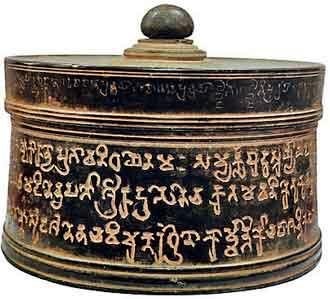
The same relic which has come to Sri Lanka will eventually be placed in the centre of the lake from where it was found. Therefore, it has a lot of historical significance. The casket which was found with the relic mentions very clearly that these are ‘Dashabala Sharira Nilaya. It basically means the body relics of the Buddha. We have brought the casket also along with us. If you see the relic, you will find the relic in a small bottle along with a casket.
QWhy is it in a bottle?
 The bottle was found exactly like that. It is a very ancient glass work. We don’t want to tamper with it. Our experts feel if it is taken out and put in a beautiful container to meet the requirements of the modern day, it may be a little unhealthy and not correct. That is why we have not touched that relic. We have kept it in that same bottle. We have brought the casket from where it was found. These are basically body relics.
This was found in the area called ‘Devnimori’. Mori is not very far from the place where our Prime Minister Shri Narendra was born. There is a symbolic connection.
The Prime Minister himself has been very closely associated with this holy relic. He was very keen that these relics go out of the country and the world should get to know about them. We have other relics which we have been taking to different countries, but this particular (3:55) holy relic we decided to bring out first time out of the country- out of the Gujarat state.
For the first time, it has come out of the place. It is now travelling to Sri Lanka because when the Prime Minister was here, he had made a commitment that he will send the Devnimori relic. There was a reason. It is from his state. That is why we have complied with this request and brought it over here.
QWhat does it mean symbolically because Buddhism itself is also a gift from India to Sri Lanka?
There are two aspects. One, we have a lot of respect for the fact that Sri Lanka has very carefully maintained, nurtured and developed Theravada Buddhism in a beautiful way.
Every country goes through ups and downs. Sri Lanka has also gone through different phases of ups and downs. From the time of Arahat Mahinda Thera who had come here- the son of Emperor Ashoka, Sri Lanka has also gone through ups and downs. But, unlike any other country, Sri Lanka has very carefully nurtured, maintained and secured Buddha Dhamma- the teachings of the Buddha.
We have tremendous respect for this aspect of how Buddhism has been kept secure in Sri Lanka- especially Theravada Buddhism and the essence of the Pali language which is very important to understand Buddha’s teaching. Secondly, our Prime Minister himself is very aware and conscious about the Buddha’s teachings and Buddhism.
He is personally associated with a lot of scriptures which are out of Buddha’s teachings. At a time when he was not in politics, he would travel from place to place which are basically Buddhist sites and spend a lot of time there.
He would stay for weeks in Saranath, Vaishali. The place of Enlightenment of Buddha which is in Bodh Gaya. This had profound awareness in him and also his knowledge. Sri Lanka is a great place where Buddha Dharma has grown and nurtured so nicely.
QIt can be considered as a special gift for Sri Lanka. What are your feelings?
I personally feel that this is indeed a special gift. I don’t want to get into too may historical aspects but history cannot be denied.
If we look at history—not only in India or other Buddhist countries, but even in China, particularly during the 2nd, 3rd, 4th and 5th centuries AD—periods of political instability often prompted rulers to invite large numbers of monks from India. Many of these monks travelled extensively, especially to China, where they eventually settled and played a pivotal role in transmitting and establishing Buddhism.
When Buddhism went to these places, there was a lot of peace, a lot of democratic values, a lot of soothing understanding in the community about life, non-violence, wisdom and compassion. This is a fact. This is the reason why Buddhism exists in that country.
The sacred relics of the Buddha are as good as the Buddha himself in body and soul. When he arrives in a particular country, for Buddhists, it is like the Buddha has arrived. Wherever we have taken these sacred relics in different countries, the headline was that the Buddha has arrived and blessed our country.
There is a symbolic thing which we notice. Not only that we brought him on a day when your country is celebrating in a big way, it also speaks of democracy, good blessing, and healthy future, a bright and stable political atmosphere. The beautiful thing which my people told me was that it rained on February 4. That adds value to the blessing of the Buddha.
We always look forward to it. We don’t in advance say anything to people that this happens on this good day or that happens, because it may not happen. It was sunny on that day. Somebody came and told me that it had started raining.
QWould you consider this initiative part of India’s broader heritage diplomacy in the region? How important is it for India and Sri Lanka to strengthen such cultural and civilisational engagement alongside economic cooperation and wider people-to-people exchanges?
Statecraft and diplomacy are all aspects of bilateral relations, multilateral relations. What is more critical is human feeling and human emotions. Nothing can beat that aspect. Touching the heart and the soul of the people and in a genuine way. I would not use the word diplomacy here because when we take the relic, it is more spiritual, religious. It is a blessing to the people belonging to a particular faith by bringing the Buddha to them. We are fortunate that we are the land of the Buddha. He got his Enlightenment and Parinirvana there.
His several discourses were there. The knowledge base of Buddha Dhamma or Buddhism and its richness are available with us. We really want to share it in the most sort of transparent manner across the world.
When you land in a particular country, we have seen very unusual situations. In Vietnam we saw 100 to 103 year old men and women being lifted by their family members to come to the relic to get blessings. I have seen a photograph of 20 monks on the tarmac- just flat lying down - blessing the aircraft.
It is an air force aircraft. You know, it probably is doing some military duty in a different time and zone. But now that it is bringing the relic. They are just bowing down and praying to the aircraft that brought the Buddha. I think this transcends all diplomacy or any aspect that you can think of. It is just pure human emotions.
Once we took the relics to Mongolia. It is a far out country, remote area with minus 20 degrees Celsius. People travelled for four to five days from remote corners of Mongolia to reach the capital to pay homage to the holy relic. That gave us a feeling that it is more of emotions and what a feeling we get when we do something like this.
In Mongolia there were people touching me. I was feeling uncomfortable. I asked the interpreter why they are doing that. They are trying to get the feeling of a man from the land of the Buddha. That emotion is something very difficult to explain.
I think our Prime Minister very rightly took a decision. Such strong sentiments people have. We must give them what we have in our country- the Buddha’s blessings.
QThough Buddhism was born there, it disappeared from the land of India. How is it evolving now?
We have taken the holy relics to so many countries. This is a complete government of India initiative. That is why the relic is given the treatment of the head of state. Not only that it is flown in an Air Force aircraft, the entire government participates in it.
A minister or a governor accompanies the relic. There is a lot of work which we are doing in terms of promoting Buddha dharma. India is a huge country with a lot of religions, a lot of ethnic groups, and a lot of practices.
I always refrain from calling Buddhism a religion. I just always say it’s a philosophy. It’s a philosophy which transcends all religions. Whatever religion you follow, you can follow Buddhism.
It doesn’t change you. Some people tell me that there is conversion taking place sometimes. I immediately stop them and say there is no conversion.
Conversion happens when you are doing a religion to another religion. But this is a philosophy. I can be a Hindu or whatever, I can practise the philosophy of the Buddha because that is basically to do with the human body and mind and life around you.
His famous teaching- Paticha Samupada, which is basically about interconnectedness. It’s metaphysics. Every object is connected. When you understand Buddha Dhamma, you realise this is not religion. This is philosophy.
The Americans, for instance, follow their own religion. They have literally got into Buddha Dhamma as a philosophy and are doing lot of good work.
I believe India has seen a significant push in this area since Prime Minister Narendra Modi assumed office. A wide range of initiatives has been undertaken during this period.
In 2023, we held the first Global Buddhist Summit, which was inaugurated by Prime Minister Modi himself. We also organised the Asian Buddhist Summit, which was opened by the President of India.When summits of this nature are attended at the highest level—by both the President and the Prime Minister—at events organised by the International Buddhist Confederation that bring together the global Buddhist community, it speaks for itself.
It reflects how committed the Indian government is and how seriously it is seeking to advance the Buddhist narrative internationally.
I would also like to highlight an important episode related to Buddhist heritage. The Government of India was able to retrieve certain reliquaries—mainly jewellery—dating back to 1898. During the British colonial period, a British landowner named William Peppe discovered a mound on his estate, which was subsequently excavated. The excavation led to the discovery of original relics of the Buddha, now known as the Piprahwa relics .
Following the discovery, the bone relics were gifted by Peppe to Thailand, while the jewellery was divided into two parts. One portion was handed over to the Indian Museum in Kolkata, while the rest followed a separate trajectory.
The other portion of the jewellery was taken to London and remained with Peppe’s family. His great-grandson later decided that there was no reason for the family to retain these reliquaries and approached Sotheby’s to sell them. The items subsequently appeared for auction in Hong Kong.
When the auction came to our attention, we immediately intervened and informed Sotheby’s that such relics could not be treated as commodities. These are the soul of the Buddha. One can imagine how senior monks and Buddhist communities across Buddhist countries would react—it would be perceived as the Buddha himself being auctioned. As a result of these efforts, the auction was halted just two days before the scheduled date.
Thereafter, the relics were successfully brought back. A well-known Indian conglomerate, Godrej, which also operates its own museum, acquired the relics and subsequently handed them over to the Government of India for safekeeping for a stipulated period, while allowing them to be shared for public viewing.
This episode stands as a classic example of the extent to which the Government of India has gone to reclaim and preserve the country’s lost Buddhist heritage. On January 3 this year, the relics were placed on public display in Delhi. On that occasion, the Prime Minister attended the exhibition and spoke with great pride, remarking that he was beginning the year with the blessings of the Buddha—his first address of the year, just days after the New Year.
Such words, spoken while inaugurating a relic exhibition and reflecting on the teachings of the Buddha and Lord Rama, clearly demonstrate the importance India places on its civilisational heritage and the reverence it accords to these traditions.
21 Jul 2026 3 hours ago
21 Jul 2026 4 hours ago
21 Jul 2026 4 hours ago
21 Jul 2026 4 hours ago
21 Jul 2026 6 hours ago