07 Aug 2025 - {{hitsCtrl.values.hits}}
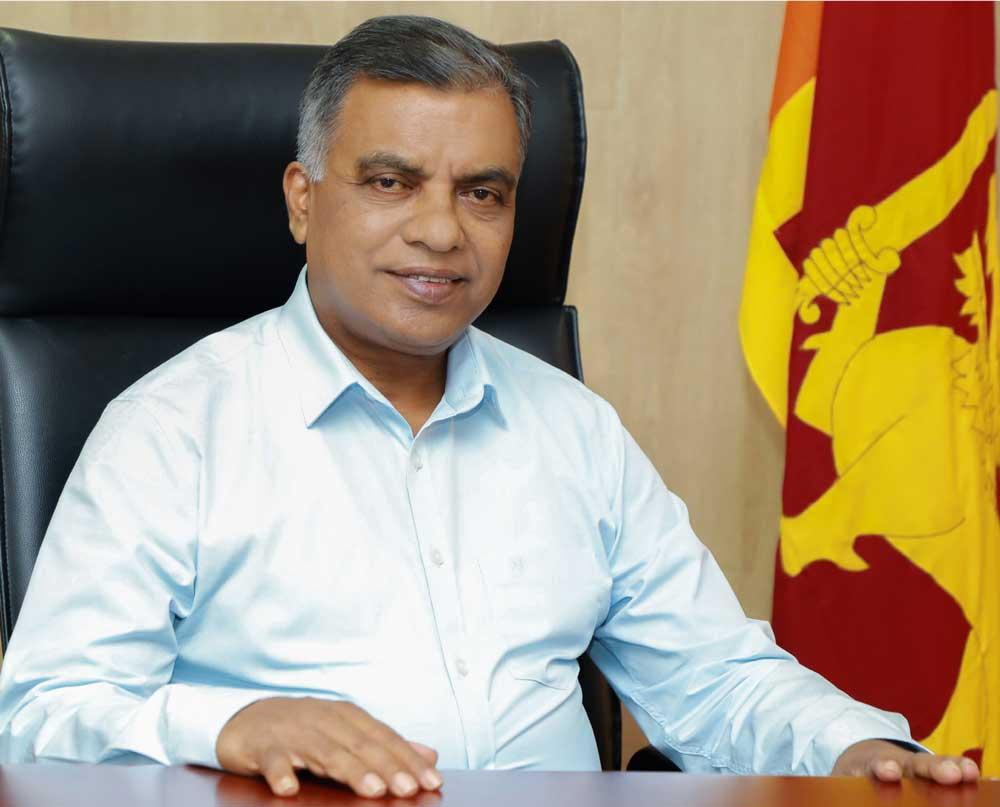
 R. M. Jayawardhana, Deputy Minister of Trade, Commerce and Food Security, takes questions from Daily Mirror on the current crisis in brown sugar manufacturing and the high prices of essential items. Excerpts:
QThe cost of living went through the roof during the economic crisis. Prices of essential items are still high. What are the plans by the government to bring them down?
By the time we got into power, prices remained high. Political instability had resulted in economic instability. With the election of President Anura Kumara Dissanayake to office, political stability came in. The stable government, which was formed after the general election, acts now with a consistent set of policies. The world responds to it positively, eventually resulting in economic stability. We improved all economic indicators. For example, our export sector growth is high compared to last year. Previously, successive governments failed to achieve revenue targets fully. However, we have acted otherwise. We have targeted revenue on several counts-excise, customs, earnings from tourism, and remittances from expatriate workers, etc. We have realised the targets of revenue from these sources fully during the first half of this year. Next, we saw our rupee value getting depreciated against the U.S. dollar. Now it is stable.
QIf I interrupt you, I can say that macroeconomic fundamentals were taking shape before the new government came into being. I am asking about your government’s steps to reduce prices of essential items such as rice, milk powder, sugar, etc. What have you done in this case?
We did a comprehensive study on rice farming. Farmers were abandoning paddy cultivation because of the high production cost. We realised that it would take a long time to reduce the production cost. We sensed that it would be a major food crisis if rice farming were abandoned by farmers. We ensured a reasonable support price for paddy. Otherwise, we have to flood the market with rice imports to make retail prices competitive. Then, it will have a bearing on local rice growers. That is why we introduced a minimum support price for farmers to retain them in the field.
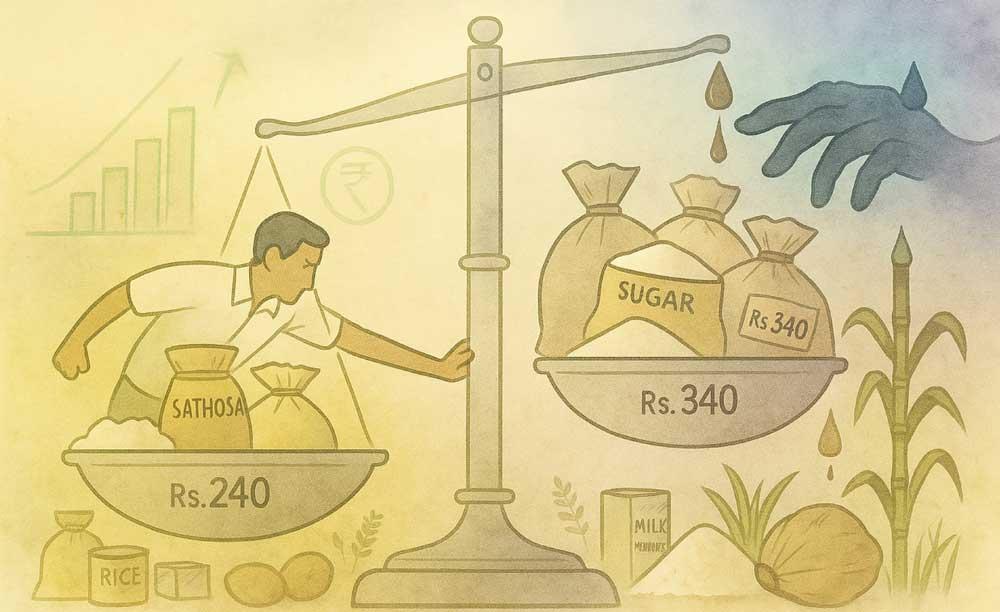
Sugar is a different story. We manufacture only 11 per cent of the local requirement. Sugar imports have been taxed since before we came to power.The price of brown sugar remained at Rs.340-360 a kilo at that time. Now, it has been brought down to Rs.240-260 a kilo.
We have been unable to reduce the prices of coconut oil and coconut yet. The reason is insufficient production in the country. We produce coconuts. At the same time, the coconut-related industry has developed. Various coconut–related products are manufactured using nuts otherwise available for household consumption. We are planning for coconut cultivation in 38,000 acres to boost production.
We maintain currency stability to lower the prices of imported items. Prices of essential items, bar a few, have come down under our government.
QYours is a government that relies more on local production. But the local sugar production is now in a crisis. Isn’t it ironic?
There is a long story. Only 20 per cent of consumers use brown sugar. We manufacture only 11 per cent of the total sugar requirement. Therefore, a selling crisis is unlikely to happen. In 2024, around 55,000 tonnes of sugar had been manufactured at the factories in Pelwatte and Sevanagala. Only 25,000-26,000 tonnes had been sold out, though. The ethanol production at these two factories had also not been sold out fully. Then, the crisis remained by the time we took over. The two factories were run at an operational loss. In the years preceding 2024, there were profits recorded. Yet, profits had been calculated regardless of payments in arrears.
We are in the process of studying as to why we are unable to sell off the remaining stocks. We have stopped sugar imports. Brown sugar is not imported through licensed importers now. Still, we suspect there are some stocks hoarded elsewhere. These stocks are getting released to the market in quantities by errant traders. We believe whether there was a stock of brown sugar imported along with white sugar and hoarded elsewhere, or white sugar is being made brown through a chemical process. It is challenging for us to find those responsible. Yet, we have already deployed a team to find it out. We have informed the Sugar Research Institute, Customs and the Consumer Affairs Authority (CAA) in this regard.
QIs this the reason for you not being able to sell off the stocks with the two sugar factories?
Previously, only private businessmen had been involved as agents selling the sugar stocks that turned out at these factories. However, we did not give in to their demands. We were not prepared to work according to their whims. Instead, we tried to appoint our representatives at provincial levels to sell sugar. They purchased sugar from us at Rs. 230 a kilo and sold at Rs.235-236 a kilo to wholesalers. There is a well-orchestrated plan to sabotage our activities. Recently, even a piece of rock was found concealed inside a stock of sugarcane meant for processing. It is a planned act of sabotage.
When we release our sugar stocks at reasonable rates, some errant traders release hoarded stocks from their stockpiles at competitive rates. It has triggered a crisis for our agents as a result. Errant traders compete with us in trading. We also lowered prices in competition with them. We cannot run businesses like this. Starting from next week, we will release stocks directly from our storage according to a different plan.
QThe whole crisis has been triggered by the state involvement in trading in a world where market forces prevail. What is your view?
Brown sugar production is done only in Pelwatte, Sevanagala, Gal Oya and Ethimale factories. When there is a restriction on imports, there cannot be another source of brown sugar other than these four factories.
We take up the challenge posed by some businessmen, along with others. Otherwise, we did not have any intention to run businesses. There is a challenge before us. We accept it. We plan for wholesale trading.
QIs it economically viable to devote such a large extent of land for local sugar cane cultivation for the fulfilment of mere 11 per cent of the total requirement?
Your argument is correct if you apply it only to sugar manufacturing. We have to think of Ethanol production for liquor manufacturing. We get revenue from excise. There are many other by-products. We manufacture fertiliser and generate electricity using waste. In the overall context, this argument is not valid. Otherwise, allocation of 14,000 hectares for sugar only is not economically viable.
Otherwise, there are 7,000 employees in the industry. Besides, the presence of Sevanagala sugar factory is a reason for the development of Embilipitiya town. A lot of people have also secured indirect employment opportunities from this factory.
QThe government has imposed restrictions on certain essential items such as cowpea. It was done at one point in the past to boost local production. What is the policy of the new government?
When we took power, green gram was sold at Rs.800 a kilo and cowpea at Rs.1200-1300 a kilo. Yet, because of steps taken by us, the green gram price dropped below Rs.800 a kilo in the retail market. We found that farmers, after their rice crop, cultivate green gram and cowpea in their fields as supplementary crops. Once we lifted import restrictions, these farmers’ crops could not fetch a good price. Wholesale traders started purchasing these crops at Rs.300 -350 a kilo. It affected local production. If we impose import restrictions again, it will be for the benefit of these people. Otherwise, we don’t want to leave consumers in the lurch. We want to protect both farmers and consumers alike. We want to stabilise prices.
QWe, Sri Lankans, pay indirect taxes more than direct taxes. The ratio is very high. Indirect taxes mean taxes on essential items being consumed by ordinary people. What is the plan by the government to cushion the burden on people in this case?
We are planning to increase our revenue from direct taxes in main. In the past, it remained only 20 per cent of the total. It is better if we can reduce the indirect tax component to 40-60 per cent. Then, that cannot be done overnight. We want to broaden the direct tax base. Then we believe our indirect tax component can be reduced to 50 per cent. We plan to achieve this in the span of five years.
QWhat is the role your government envisages for the state sector to control prices?
We don’t believe that the government should be heavily involved in trading activities. Still, we believe in the government’s involvement in controlling market forces to a certain extent. For that, we intend to maximise the use of Lanka Sathosa and Cooperative Establishments. We plan for the increase of Sathosa retail outlets from 454 to 1,000 in three years’ time. If we can make 20 per cent intervention in the market, we can make an impact. We intend to strengthen the Cooperative Movement with a focus on the development of the agriculture sector. We aim to export agro-products more and more. We will build 1,000 manufacturing cooperatives. We will use the same movement for distribution as well.
We are also planning to upgrade the Economic Centres with the infusion of new technology, both for wholesale purchasing and retail trading. That is to build a direct nexus between farmers and consumers.
Sathosa warehouses will be used for import storage.
21 Jul 2026 8 hours ago
21 Jul 2026 8 hours ago
21 Jul 2026 9 hours ago
21 Jul 2026 9 hours ago
21 Jul 2026 21 Jul 2026