25 Feb 2025 - {{hitsCtrl.values.hits}}
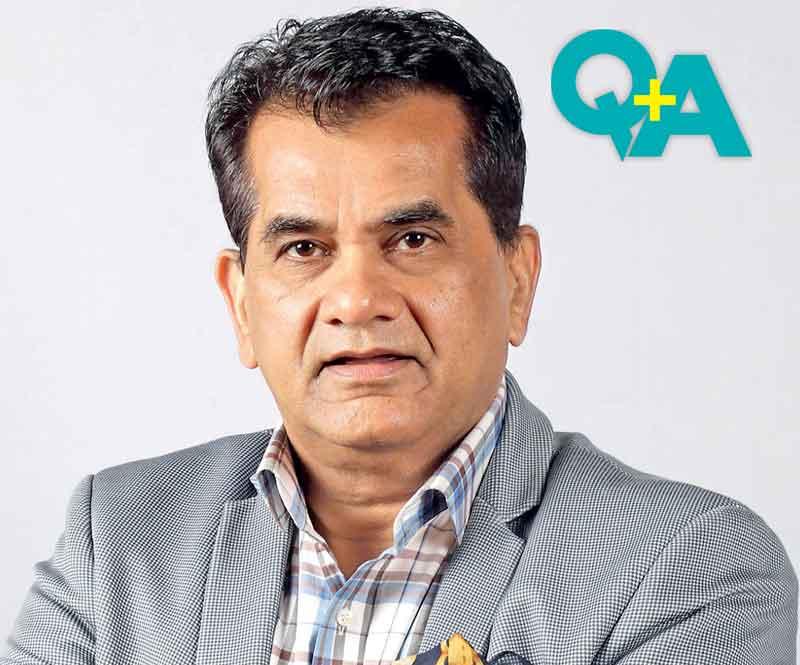
The maestro behind famous campaigns like “Incredible India” and “Made in India”, Amitabh Kant delves into the many way in which Sri Lanka can spearhead growth by prioritising innovation and competitive sectors
Pro-business bureaucracy a pillar of economic Success
Private sector drives growth, bureaucracy must facilitate – Lessons from India
India is the only country which is making eight airports, three metros every year, 30 kilometres of roads and 12 kilometres of railway line every day and makes 50 percent of the real-time fast payments in the world today
Bureaucracy must function within certain rules and regulations but they should be
pro-innovative
The Government’s job is to ensure that a solid primary education is provided, positive health outcomes and expectional nutritional standards are provided
Amitabh Kant—the key driver of Made in India, Startup India, Incredible India, and God’s Own Country—shares his views with Daily Mirror in an interview during his visit to the country.
He has spearheaded the Ease of Doing Business, the Aspirational Districts Programme (ADP), Production-Linked Incentive Schemes (PLI), the liberalisation of Foreign Direct Investment (FDI), Private-Public Partnerships (PPP) in infrastructure, and Asset Monetisation programmes and policies for the Government of India. He has led the national effort to accelerate India’s transition to cleaner energy, spearheading sustainability initiatives such as the Green Hydrogen Mission and the National Mission on Transformative Mobility and Battery Storage, and pushing ambitious climate finance reform through the Green Development Pact in the G20 New Delhi Leaders’ Declaration.
 How do you describe India’s global relevance and its importance for Sri Lanka?
First and foremost you know India is the only large country in the world which is, today, a four-trillion-dollar economy. It grew at about 8.2 percent last year. It is the fifth largest economy in the world. In the next three years, it will overtake Japan and Germany to be the third largest economy. Prime Minister Narendra Modi set a vision, that by 2047, India should be a fully developed nation, which means that our aim is to take our economy from US $4 trillion to US $30 trillion.
We have a very ambitious growth path in a range of areas. India is the only country which is making eight airports, three metros every year. India makes 30 kilometres of roads and 12 kilometres of railway line every day. India makes 50 percent of the real-time fast payments in the world today.

I’m not in favour of the government getting into commercial businesses. Government should not get into the area of business. That’s not the government’s job

What does it offer for Sri Lanka in case it ties up with the Indian economy or integrates with it?
I think, to my mind, there are certain areas of partnership in which India and Sri Lanka need to work. The first and foremost area I would say is that India’s digital transformation has been enormous in the last few years. For instance, the Bank of International Settlement has said that India achieved in seven years what it would have normally taken 47 years. That is through its process of digital public infrastructure. India does fast payments, credit, insurance, stock market transactions, education, health—all through its digital public infrastructure.
I think there’s a need for a close-up partnership between India and Sri Lanka in all these areas, which will enable Sri Lanka to technologically leapfrog. For instance, I think there is a great convergence of interest in tourism.
Sri Lanka has a unique tourism project and tourism product. This unique tourism product still needs to be discovered by a vast majority of Indians who travel to Thailand, Malaysia and Singapore. I would prefer that they come and discover the rich heritage, culture and architecture of Sri Lanka instead.
You mean the places related to the Ramayana trail?
No, all products, not merely that. You have great heritage sites, beaches, architecture, culture, and golfing. Everything needs to be discovered. Sri Lanka needs to be rediscovered by Indians. We have 20 million Indians travelling abroad.
Given Sri Lanka’s positioning, how does India actually look at Sri Lanka as a gateway to the Indian market?
We look at Sri Lanka as a very very beautiful destination. We look at Sri Lanka as a very resilient nation. We look at Sri Lanka as a nation with a very advanced human development index. We look at Sri Lanka as a destination which has a very high physical quality of life because of education and health. We admire Sri Lanka in many ways. I think a closer relationship will help Indians discover the unique strengths of Sri Lanka.
Now you talked about the importance of partnership in areas like the digital sector, digital transformation. What are your views on connectivity between the two countries in terms of two grids, clean energy?
One of the big achievements of India has been its achievement in going green, of building up 200 gigawatt of renewable energy. That has been India’s green grid achievement. It has all been done through the private sector. It’s been done through policy, technology and finance, which enabled a vast amount of private capital to come into India for sustainable growth.
India not only built 200 gigawatt of renewable energy, but has been able to provide 130 million women with gas connections, which enable them to move on from firewood cooking to gas, and transform their lives. India has been able to provide electricity connection to 40 million households. India has been able to procure 500 million LED bulbs and bring down the price of them to 15 percent of its original price. India has done things in size and scale. We will be very happy to share these learning experiences with Sri Lanka because our view is that net zero is net positive. Our view is that there are certain things on clean energy and sustainable growth. India is able to do that, not at a premium, but at a discount using the size and scale of India. We can work in partnership with Sri Lanka so that they can also benefit from the size of India.
Sri Lanka also has a lot of potential in this area because its wind power potential is enormous. How can India actually cooperate?
We should co-operate in three areas. One is the spread of solar and wind energy. Also, we should work with Sri Lanka on solar rooftops, which we are doing now. In my mind, The third area is that we should assist and work in partnership with our startups to make Sri Lanka go 100 per cent electric on two-wheelers and three-wheelers. All its buses should go electric. That will be the sustainable road to development and sustainable road to growth for Sri Lanka.
There is the proposed multi-product petroleum pipeline between Sri Lanka and India with the involvement of the UAE (the United Arab Emirates) as a partner. How important is it?
It’s very important that we look at the UAE as a partner. We work on a relationship between UAE and India and ensure that we are able to do this in partnership among India, Sri Lanka and UAE and accelerate the process of its implementation.
How will this connectivity in the energy sector help propel growth in the region?
All growth is a function of either energy connectivity, transport connectivity or people’s connectivity and to my mind connectivity will enable many of these gas, and LNG products to be able to be supplied at a cheaper cost from the UAE.
You mentioned your Prime Minister’s vision to make India a fully developed nation by 2047. For you to achieve that, you need political stability, changes in governance structure and improvement in bureaucracy. How do you see the importance of those two aspects - governance structure and bureaucracy?
That is a very important question you’ve asked. First and foremost is that India scrapped a lot of rules and regulations. It has scrapped 1700 laws. It has focused on ease of doing business It believes that the private sector is critical to India’s growth. It is also done with asset monetisation.
Government assets were not sold out, but they were given to the private sector to operate and maintain for a limited period of time— around 30 and 35 years. The ownership remains within the government. It has led to greater productivity efficiency in the system. We are now coming out with a second pipeline of asset monetisation. These are areas where Sri Lanka can benefit from.
Thirdly, we are a large country. We made our states compete with each other. We started ranking them. We started putting their rankings in the public domain. We started naming and shaming them.
In Sri Lanka also, it’s very important to work on outcomes. Outcomes are critical.
How important is it to make sure that bureaucracy is apolitical?
So the important thing is that bureaucracy must work within certain rules, regulatory procedures but they should be pro-innovative. They should assist and support the growth of the private sector. They should not hurt the sentiments of the private sector.
The countries which have grown in the post-World War II period, have all grown on the back of the private sector. Countries don’t grow because of bureaucracy. Countries grow because of wealth creation by the private sector. But the bureaucracy’s job is to facilitate that, to assist and support that. That’s how Japan grew post-World War II. That’s how South Korea grew in the 1960s to 1990s. That’s how China has grown in recent times. And that’s the only way India will grow for a three-decade period. If India has to grow at 9 to 10 percent, our aim is that we should scrap rules, regulations, and bureaucracy, and become an aid and assistant to wealth creation in the country.

India also has certain public sector enterprises which intervene in the market. We used to have state trading corporations etc., which have been done away with but the ideal thing, to my mind, would be that instead of making public enterprises compete all the time, incentives should be given to the private sector or rules, regulation should be made in such a manner that no monopolies are created

How has India made progress in that regard in making bureaucracy ‘private-sector friendly and efficient’?
Our selection process is very rigorous. Through the Union Public Service Commission, we make selections which is based on merit. We do spend a lot. We put in a lot of training resources. Thirdly we now have a knowledge commission which constantly upgrades the knowledge and information of bureaucracy. Fourthly, our prime minister’s focus has been to create a pro-innovative culture in the country.
For any country, bureaucracy is important to ensure policy consistency. Despite changes in governments, bureaucracy remains. They have to ensure that policy consistency remains. What are your views?
No country can grow and progress without predictability and consistency of policies for a long period. First, you need integrity which is to my mind, is very important. Secondly, you need policy predictability and consistency over a long period of time. Thirdly, you have to cut out procedures, rules, regulations so that the private sector can create wealth. All these three are important. And in all this, it’s important that the bureaucratic mindset must be a progressive mindset.
In doing business, what is actually the role of India’s government?
The Government’s job is to ensure that a solid primary education is provided, positive health outcomes and expectional nutritional standards are provided. That’s the government’s job. Their role is primary education, primary health, and primary nutrition.
It means when it comes to tertiary level or education level, it has to be through the private sector?
No, it can be through the government also. But the government’s focus must be on primary education, health, and nutrition.
In a large country like India, our aim was to ensure that every child gets a school education, gets a positive health outcome, and gets expectional nutritional standards. Those, to my mind, are the jobs of the government.
Now in Sri Lanka, for example, there are government ventures involved in commercial activities. What are your views in this regard?
No, I’m not in favour of the government getting into commercial businesses. Government should not get into the area of business. That’s not the government’s job. The Government’s role is to frame policies, ensure its predictability and consistency over a long period of time. The earlier the government gets out of commercial businesses, the better it is.
In Sri Lanka, we are facing a crisis in rice supply, because there is a private sector oligopoly and the government is now involved. So can you offer some insights from Indian experience in this regard?
India also has certain public sector enterprises which intervene in the market. We used to have state trading corporations etc., which have been done away with but the ideal thing, to my mind, would be that instead of making public enterprises compete all the time, incentives should be given to the private sector or rules, regulation should be made in such a manner that no monopolies are created in the sectors.
The important thing is that you should be able to create competition within the private sector to bring down any kind of monopolistic tendency to ensure that you create a culture of competition and don’t allow monopolies to happen.
Government getting into commercial businesses creates huge inefficiencies.
When India opened up to the world, India invited foreign investment but at the same time made sure that the local manufacturing base was also developed to compete with it. How important is it for a country?
It’s very important that you do not become totally an importing nation. There are certain competitive strengths of Sri Lanka. You may have strength in plantations. You may have strength in agriculture. You may have strength in textiles. Whatever your areas of competitive strength become the world’s best in those and create a ‘Made in Sri Lanka’.
In those areas where you have your competition. You may not be able to produce everything in the world.
21 Jul 2026 6 hours ago
21 Jul 2026 7 hours ago
21 Jul 2026 7 hours ago
21 Jul 2026 7 hours ago
21 Jul 2026 9 hours ago