21 Feb 2025 - {{hitsCtrl.values.hits}}
|
The eight stages of the 4th Industrial Revolution are as follows: the digitalisation stage, the technology stage, the economic stage, the environmental stage, the bio revolution, the consumer stage, the fusion revolution and the quantum revolution. The Sri Lankan government has a difficult time coping with the rapid changes of the 4th industrial revolution Every young man from 16 to 18 years old should become a young monk. In Germany and South Korea, there’s a system called local banks which give loans for agriculture The females are the backbone of this society and the males are somewhat lost. Most women get an education and marry when they are 25 or 26. |
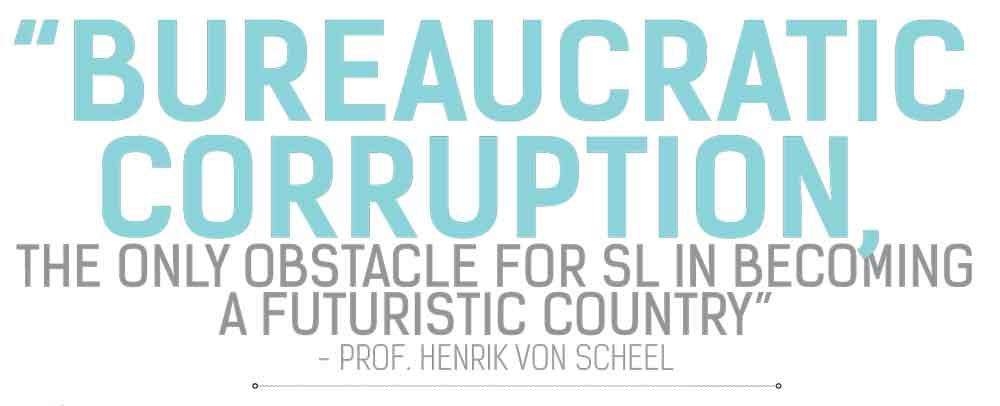
Sri Lanka has been recognised as a country with the potential to become its own brand. However, strategic experts opine that in order to become a futuristic country, Sri Lanka should first eliminate corruption in the bureaucracy. These are the remarks made by Prof. Henrik von Scheel who is known as one of the most influential futurists of this century. He is the architect of the 4th Industrial Revolution and his work has been applied to over 24 national economies which has influenced GDP growth and has shaped the performance of fastest-growing companies including 23% of the Fortune 500. In a candid interview with the Daily Mirror, Prof. von Scheel shed light on how Sri Lankans should strike a balance between their roots and the future, the importance of capitalising on agriculture and why it is important to end corruption in the bureaucracy.
Excerpts ;

 Tell us about your visit to Sri Lanka.
I have been sitting together with some of the leaders in industries to discuss with them the future of intelligence, AI, smart automation, smart packaging etc. Some of these leading CEOs are quite aggressive about what they want to do. But I also feel that they are restrained by the government in many ways. I think that was one of the best masterclasses I had. I’m doing two of these masterclasses for Sri Lanka, Mumbai and Islamabad. I’m doing this for Sri Lanka because I’ve never been here before and it’s a beautiful country.
 Let’s talk about your work as a strategist and a futurist.
In 2008, I did a strategy for Germany because the world was in recession and Germany was also in recession at the time. Every time you have the challenge to grow you need to focus on productivity. Normally, strategies are straightforward. The trends have an effect on you for the next 5-10 years. This is the first time we realised that it’s not just one trend but five trends that are colliding together – the internet, social media, and the mobile phone all collide in digitalisation. The phone you have today is not the phone you had in 2008. So together with Prof. August-Wilhelm Scheer we wrote the Digital Agenda which the European Union accepted and that became the Digital Theme you know today. After half a year we realised that it wasn’t just five trends but 77 trends colliding together until 2050! They are changing every aspect of our lives; how we live, how we interact, how we consume, how our economy and society work and so on. Then in 2011, we coined the term 4th Industrial Revolution (4IR) and it emerged in eight stages – the digitalisation stage which is the revolution; then we have the technology, economic, and environmental stages. Then we have the biggest one coming now which is the bio revolution. The following stages include the consumer stage, the fusion revolution and the quantum revolution. Sri Lanka plays in none of them except in one which is in the bio revolution; they play in terms of the food revolution and smart materials. This is quite significant but until now Sri Lanka has been the consumer and not the producer.
What was the idea behind coining the term 4th Industrial Revolution?
Well, it’s because it changes everything in your life. An Industrial Revolution emerges when it changes trade etc. Since 2011, this has changed your life fundamentally. You are under constant disruption and everything is changing fast. I think the Sri Lankan government has a difficult time coping with it. This is actually one of the reasons for me to be here and help them find their own way. In reality, Sri Lanka is being colonised without them even realising that they are being colonised. When you talk to people, the young generation is leaving. So basically you’re educating people and exporting them. The older generation that has made what you are today is suffering. You have 40% of people to be leveraged out of poverty. We talk about governments being corrupt, but what is actually challenging is the underlying bureaucracy. That is corrupt and that is the element that is unable to be managed. Sri Lanka has a bad marriage because they have a history of what happened to them and they are sensitive to it. They are locked in a deadlock where they can’t fire government employees. This is the key issue. If they cannot fire anybody they become unproductive.
Which means we can’t be a part of this revolution unless we get rid of corruption and bureaucracy?
Yes, But it’s very different. Sri Lanka needs to find its own way. Until now you have looked at what everybody else does. But you shouldn’t do that. Sri Lanka should focus on four main things – one is to cut the element of government employees. There’s no place anywhere in the world where you cannot fire people. If you don’t fire people they become lazy and they do nothing and they engage in corruption because they know that they won’t be fired. Secondly, you have to become an economic pillar in yourself. Thirdly, they need to focus on what makes Sri Lankans an authentic brand. This can be looked at in two ways – one thing is agriculture, the world needs food and spices. The Chinese have spilled the Port and that’s the trade route for the Silk Route right in your garden! You should leverage this opportunity. This means you need to have the Noah’s Ark on food, spices and you can develop them. Sri Lanka is connected to agriculture and soil and you should reconnect to this element and make it possible to raise people out of poverty, decrease inflation and you should have absolutely no tax. There’s no reason why you have tax. This is because you have an idea that you need to do what other people do. Then you need to implement two main things that are quite radical. The first is that every Sri Lankan should take one month a year to go back to agriculture. They need to connect to the family, to the soil and every family should have agriculture because that’s their pension. You can invest in agriculture, smart farming, smart fertilising and develop smart materials. The second element is that you need to create a backbone of what you are. You are currently disconnecting from what you are. Every young man from 16 to 18 years old should become a young monk. They should get into robes, sleep on the ground, serve people and connect to the old generation. Because the old generation has something to teach and the link between the old generation and the young generation is missing. Everybody wants money but before that, they need to serve other people. They will learn that what they want is nothing when compared to what somebody else wants. So it’s important that you connect to your roots.
Could you give a few examples from other countries?
For example, in Germany and South Korea, there’s a system called local banks. They have a central bank and local banks. The local banks are only allowed to give out loans to agriculture, to local people and to local farms. They are not allowed to invest in big things. That’s why Germany has a big manufacturing industry because the manufacturers get an inventory loan. I met entrepreneurs here and they get no money. You need to invest in what is there.
Do you think going forward we could become a futuristic country?
Yes, but I think that it should come from Sri Lankans themselves. The first thing we have to solve is the corruption in the bureaucracy. Bureaucracy doesn’t get elected but it is working against your vote every year. Most people in Sri Lanka are good, they are very kind. I sense that females are the backbone of this society and the males are somewhat lost. Most women get an education and marry when they are 25 or 26. So you lose a whole generation but you also lose this opportunity to mirror yourself.
Let’s talk about AI and how it could be integrated into various sectors.
In terms of AI, the government should do the first thing. The menu is not the meal. The US is giving us something to buy but they are stealing the intellectual capital of everybody here. What is the first thing that the Sri Lankan government should do? Every information you gather from a Sri Lankan should be on a Sri Lankan server. The information must be here. This is our IP, our information and these are our people. The companies I have spoken to firstly need robotic process optimisation. These are some of the basics. Then they can mature the operations, then go into digitalisation and so on. But you have to develop your own version of AI to realise that the menu is not the meal. Another concern is that you need to encourage young tuk-tuk drivers for example to become entrepreneurs. Sri Lanka is importing far too much. You need to produce everything locally, from toothpaste to all other essential commodities. This is how you create an industry. With new economic pillars and tariffs, Sri Lanka is vulnerable and heading towards a nightmare if you can’t control its imports and exports.
Any closing remarks?
I believe that the future that we have is good. We are the most blessed generation. We have more food, a better life, a better healthcare than any previous generation. The changes are even stronger now than ever before. But we are about to lose values and many things. In Sri Lanka, the wives and mothers need to protect the values of being a Sri Lankan. The future resides in every woman and the future path is created by every man. The future for Sri Lanka looks bright but you need to fight corruption in bureaucracy and find your own way back to the roots.
21 Jul 2026 5 hours ago
21 Jul 2026 5 hours ago
21 Jul 2026 6 hours ago
21 Jul 2026 6 hours ago
21 Jul 2026 7 hours ago