23 Jul 2025 - {{hitsCtrl.values.hits}}
 Our first challenge is transition to democracy- not in name, but in real sense - so that Fascism doesn’t come back
The basic macroeconomics is the same for all countries. Fiscal responsibility is that you don’t spend more than what you have
With Adani, the deal was not done in a transparent manner... We are engaged in discussion with the Adani group to resolve those issues
I personally do not think that extremism will hold water in the long run... there’s a lot of hype around this issue of extremism
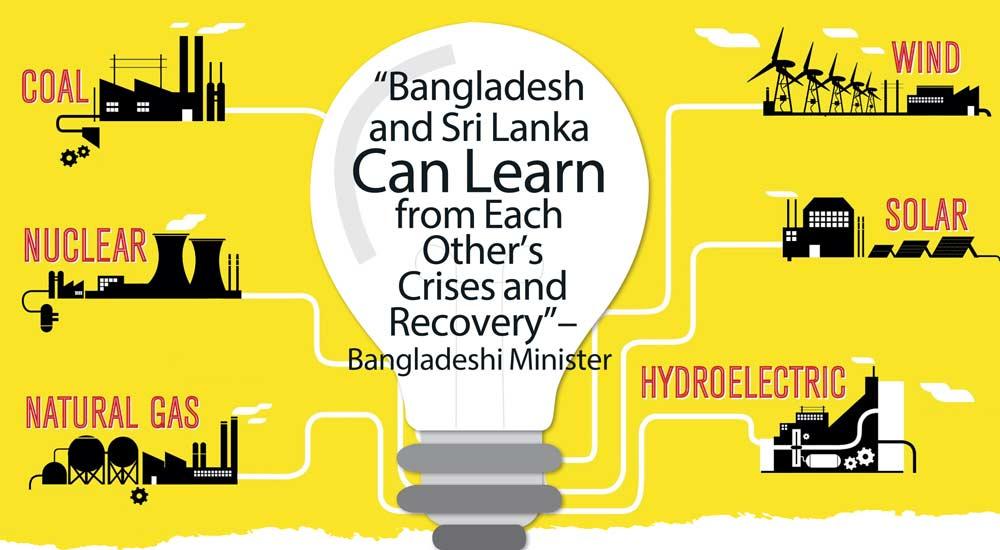
Clarifies Bangladesh’s position on Adani power deal and U.S. tariff talks
|
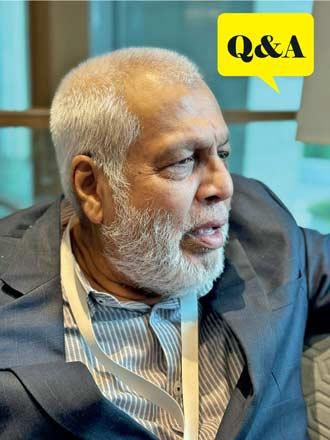
Bangladeshi Ministry of Power, Energy and Mineral Resources Muhammad Fouzul Kabir Khan |
Bangladeshi Ministry of Power, Energy and Mineral Resources Muhammad Fouzul Kabir Khan who was in Sri Lanka to attend the International Solar Alliance (ISA) summit spoke to Daily Mirror about the current status of his country, bilateral ties with Sri Lanka and the way forward. He is a well-known economist, government official and former secretary. He has worked as a consultant for various international organizations including World Bank, ADB, JICA, UNDP, besides teaching at various universities in the United States, Singapore and Bangladesh. He assumed responsibility as an Adviser to the Ministry of Power, Energy and Mineral Resources; Ministry of Road Transport & Bridges; and Ministry Railway of the Interim Government of Bangladesh on August 16, 2024.
Mr. Muhammad Fouzul Kabir Khan joined Bangladesh Civil Service in 1979. He laid the foundation for the private sector Infrastructure Development Finance Corporation (IDCOL) by serving as its first full-time CEO from 1998 to 2007. From 2007 to 2009, he served as the Secretary of the Power Division of the Ministry of Power, Energy and Mineral Resources.
Q Both Bangladesh and Sri Lanka experienced similar situations, though the contexts actually were different. How can the two countries cooperate given the commonalities?
Let me come to the Bangladesh situation first! You see this whole upheaval was due to the fascist regime that we had for 17 years, an unelected government that we had for the past years.
Our first challenge is transition to democracy- not in name, but in real sense - so that Fascism doesn’t come back. The other thing that has happened is that not only the fascist government was ousted, but also we inherited the economic crisis.
It was not only a political crisis, but also an economic crisis. We are also trying to overcome that economic crisis. Our reserves were down. Our inflation rates were high. We are adjusting them.
So, in that respect, we are sort of similar. Our experiences are similar. We had a political crisis, and that led to an economic crisis. We inherited the political crisis. So, we are trying to come out of the political crisis. We are trying to come out of the economic crisis. Then, we can learn from each other.
I think Sri Lanka has done a remarkable job in terms of economic recovery, and we are also doing the same, because our reserves have gone up. It came down to $18 million, now it is $27-28 billion. Then our inflation was above double digits. This has come down, and is showing a downward trend.
So, the macro-economy, overally, is looking up, paving the way for investment and further growth.
Q How do you look at Sri Lanka’s experience because Sri Lanka’s case has been even praised by the IMF?
Actually, I’d be curious. That’s why I was requesting a meeting with the finance minister. I was told that he is not available. But you see, the basic macroeconomics is the same for all countries.
Fiscal responsibility is that you don’t spend more than what you have. So, that’s one. I’m sure Sri Lanka is also doing the same. We are also doing the same.
So, we have brought down our budget deficit considerably. I’m sure Sri Lanka must have done the same thing. Then you also have what you call a good monetary policy.
The targets of monetary policies are two-fold. One is the stability of the exchange rate and it. So, I think Sri Lanka has achieved that to a considerable extent. We also achieved that to a considerable extent.
The exchange rate has become stable. There was about 30 percent depreciation of taka against the US dollar. Now it is stabilised. We have now left it to the market to determine the exchange rate.
The other key responsibility of monetary policy is to have low inflation rates. Inflation is kind of a tax. It unfairly taxes a poorer section of society.
With the inflation rate coming down, we’ll be able to reduce the interest rate, the Central Bank’s policy rate. Then, people will be able to borrow at a lower cost of funds. So, that will also spur investment. These are the basics across the country.
This is true about Sri Lanka. This is true about Bangladesh. It’s probably true about other countries as well.
Q Earlier, we, in Sri Lanka, viewed Bangladesh as a case activity. In fact, Bangladesh was viewed as a country that remained a country of food deficit and became a country of food surplus. How are you trying to regain that trust internationally?
You see, our agriculture remains strong as before- the growth rate of the agriculture sector. What has happened is that there has been a considerable degree of crop diversification. So, earlier we did not have much commercial production of sunflower.
Now, we have sunflower production - high quality sunflower oil. When it comes to fruits, they are now producing dragon fruits in the country.
They are producing strawberries in the country. And also, you see there are some seasonal vegetables. Now, they are growing the same vegetables around the year. Tomatoes used to be seasonal. And now they are no longer seasonal. So, our agriculture remains robust. In fact, it is the backbone of the economy.
Q You are here for this International Solar Conference. What future do you envision for Bangladesh given that Bangladesh is rising in demand for energy?
At one time, Bangladesh was an example for solar in the early 2000s. We implemented the most successful solar home system programme. Six million households and small businesses were connected.
But then what happened was that we had this kleptocratic regime. They neglected solar energy or renewable energy. They emphasized fossil fuel-based generation capacity.
So, excess capacities were created. They contracted high electricity prices. So, what this interim government is trying to do now is to move away and place emphasis on solar.
We have taken an initiative to get about 3,000 megawatts of electricity from solar within the next six months.
QBangladesh had some issues with India’s Adani Company. How did you address it?
Okay, with Adani, the deal was not done in a transparent manner. As an international deal, it should have been otherwise. Adani is a coal-fired power plant. So, the contract that we have with this is cost-based, but they’re not providing evidence in terms of the prices of coal.
At the same time, there are also other issues like plant factors. Those are unresolved. We are engaged in discussion with the Adani group to resolve those issues.
If those issues are resolved, then their tariff would come down considerably.
Q We are facing these U.S. tariffs imposed by U.S. President Donald Trump. Now the countries look at alternatives to strike fresh trade agreements and to look at each other’s strengths. How is Bangladesh approaching this issue?
The negotiations with the U.S. authorities are ongoing.
They made good progress on negotiation. This will continue in the coming weeks because they said that, if not extended, the new tariff report will become effective from August 1. So, in the meantime, we are trying to reach an agreement.
We are hopeful that we’ll be able to get a tariff that is competitive with our competitors- those who compete in the U.S. market, trying to sell the same kind of product like Vietnam and China in particular.
QSri Lankan investors have been in Bangladesh for decades. They have contributed a lot to the development of Bangladesh’s economy as well. How is the current investment climate there for Sri Lankan investors, given the change of government?
Actually, it’s better in the sense that we have a clean government. So, there is no deal behind the deal. There is only one deal. So, it’s all transparent and open. Then, that has yielded results. So, in the last few months, we received investment. Foreign Direct Investments (FD) has doubled into the country. The same applies for Sri Lankan investors. They are also welcome to invest in Bangladesh.
Q Another major concern being expressed in some parts of the world is that with the change of government, the rise of extremism is there in Bangladesh. How do you respond to that allegation?
There are two parts of this. I’ll apply two parts. One is that actually there’s a lot of hype around this issue of extremism. One, you see Bangladeshis by nature are middle-of-the-road people.
We are not attracted to extremism. If they try to pull us to the right, we drift to the middle. If they pull us to the left, we drift to the middle.
So, I personally do not think that extremism will hold water in the long run. Having said that, the government is extremely careful. Although, as I said, with the large majority of people, extremism is not an attractive proposition.
There are fringe groups to which extremism could be attractive. That is why the government is actively monitoring their activities and then will root out, stamp out any kind of extremism.
Q How does Bangladesh see regional cooperation between South Asia and even beyond?
You see, regional cooperation is the way forward. There is no dispute about it. For example, think about this electricity trade. In Nepal, during winter season, their electricity demand is very high because of heating needs. But on the other hand, our Bangladeshi electricity demand comes down by about 20-30% because the temperature is low. So, what we are doing now is that we are importing electricity from Nepal during the summer months.
We are also planning to discuss with Nepal about the possibility of exporting our surplus electricity in winter months. So, this is an example of complementarity of the regional economies. So, this is not only true about electricity, but it is true about other sectors as well.
Going South Asia, we are also promoting ties with China. Our chief advisor has visited China. I was a member of his visiting team.
We met the Chinese President, Chinese Vice President, and the Chinese Prime Minister. We met groups of Chinese investors. So, we want to take this level of economic and investment cooperation to the next level.
We want to upgrade it.
Q How does Bangladesh play a role in regional cooperation involving all the countries, India, Sri Lanka, Bangladesh, Pakistan, and Bhutan?
The forum for that was SAARC. As you know, SAARC was promoted by Bangladesh and accepted by all the South Asian countries. Unfortunately, because of the acrimonious relationship between India and Pakistan, SAARC did not progress. Bangladesh, Sri Lanka, Bhutan, Nepal were all interested in SAARC. As you know, the SAARC Secretary is in Nepal. So, I hope that the political climate in South Asia will improve. And again, we would be back with a SAARC-like organisation. So, SAARC is basically inactive and dormant now.
21 Jul 2026 5 hours ago
21 Jul 2026 5 hours ago
21 Jul 2026 6 hours ago
21 Jul 2026 6 hours ago
21 Jul 2026 7 hours ago