05 Feb 2025 - {{hitsCtrl.values.hits}}

 Sri Lanka has set ambitious targets for tourist arrivals over the years, often without a strong foundation of research or analysis. Many such goals appear to be based more on optimism than practical realities.
Tourism is a people-centric industry, driven by the evolving needs, trends and external global influences. To add to this, the complexity of the global environment also plays a major role on the decision to travel. Hence, tourism forecasting is by no means an easy task.
This article examines the importance of adopting research-driven, context-specific approaches to setting tourism targets for Sri Lanka, while taking into account the country’s carrying capacity and global tourism trends.
Introduction
Sri Lanka tourism has certainly been on a rollercoaster ride for the past three to four decades. From the heady days of the 1980s, it suffered setbacks from the long-drawn-out civil war with the industry just managing to keep its head above the water during this time. Additional external shocks such as SARS, Bird Flu, 9/11 and more recently Covid, dealt further blows to the growth of Sri Lanka tourism. Just when some steady growth was seen, the deadly Easter attacks occurred, where several tourists were targeted and lost their lives. Although many thought that this was the death knell of the industry, Sri Lanka did bounce back sooner than expected, only to face the Covid pandemic, which affected world tourism right across the spectrum. Despite these adversities, Sri Lanka’s tourism sector showed resilience, only to be hit again by the economic crisis.
Given this volatile environment that Sri Lanka has been exposed to, it is no surprise that proper forecasting of tourism growth remains a daunting task. Authorities have often set ambitious targets such as three million tourists by 2025 and even 10 million by 2030, without sufficient analysis of the country’s capacity to sustain such numbers.
While these goals sound promising, one fundamental factor is often overlooked: the carrying capacity of Sri Lanka. Can an island of just 65,000 km² accommodate such large tourist volumes without significant environmental and cultural consequences? If sustainability is to be the foundation of Sri Lanka’s tourism strategy, realistic arrival targets must be established, so we can safely accommodate the visitors without damage to the environment and our culture.
Too many tourists?
Overtourism refers to the phenomenon of excessive visitor numbers that create human, environmental and social challenges. It is characterised by the high concentration of tourism activities and the negative impacts it has on destinations. Hence, all forms of mass tourism eventually would lead to overtourism.
Many global destinations are now experiencing significant backlash from local communities due to uncontrolled tourism growth. Popular destinations such as Barcelona and Amsterdam have faced declining appeal due to overcrowding and its associated negative impacts. Terms like ‘anti-tourism’, ‘touristification’ and ‘tourismphobia’ have emerged in response to these challenges.
To avoid similar pitfalls, there needs to be proper planning. Firstly, relevant authorities must determine the optimum carrying capacity the destination can accommodate. Subsequently, the necessary infrastructure and management strategies must be developed to properly handle these tourist numbers to sustain the carrying capacities.
Understanding carrying capacity
Tourism carrying capacity (TCC) is defined by the World Tourism Organisation as “The maximum number of people that may visit a tourist destination at the same time, without causing destruction of the physical, economic, socio-cultural environment and an unacceptable decrease in the quality of visitors’ satisfaction”. It should encompass environmental, social, physical and economic aspects of the destination.
Given all these impacts, the estimation of the TCC is a very complex task. The estimation of the TCC, even for a specific tourism attraction, is complicated and hence estimating the TCC for the entire country is so much more complex and challenging.
Proposed method of estimating ideal tourist arrivals
While we do not claim to be experts in this area by any means but are prospering a simple rudimentary method to arrive at some benchmarks.
The study proposes a comparative analysis of global tourist destinations to establish benchmarks for sustainable tourism. It firstly examines tourist footfall (arrivals per km² of land area) in various countries. It will then assess the impact of tourism on these countries as to what extent tourism has affected them. This information will be derived through social media feedback, academic studies and news reports. Conclusions will then be drawn as to what would be the threshold carrying capacity in relation to the land mass of a country.
Tourist footfall per unit area of country
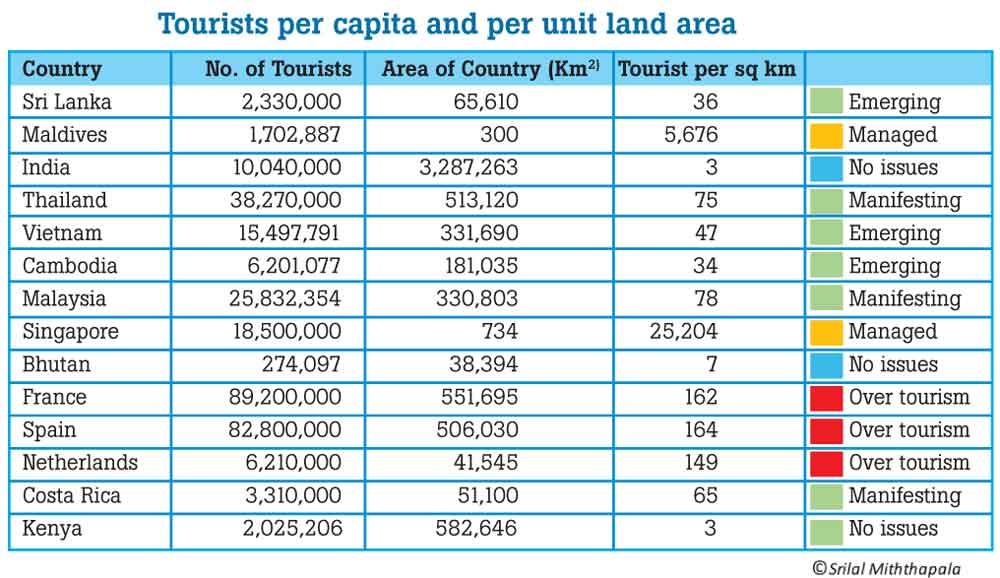
A list of mature tourism destinations has been selected for the study and their total annual tourism arrivals for 2018 (the best year on record for arrivals to Sri Lanka) are compared to their respective land area.
The current available feedback on the status of tourism in each of these countries is then recorded from various social media posts, news reports and academic writings. Based on the current status as seen from these sources, the countries that are facing serious overtourism problems have been highlighted in red. On the other hand, those countries that are not having any serious problems (under tourism) have been identified and highlighted in blue. The countries with emerging issues are marked in green.

Country-specific analysis of study
Costa Rica
Costa Rica is considered a leader in sustainable tourism but is now facing overtourism challenges. Efforts to disperse tourists across the country are underway.
Maldives
The Maldives tourism development is unique because it is widely spread over some 200 islands with their regulation of ‘one island one resort’ concept limiting overtourism. (164 resort islands from a total of 1,200 islands) However, bottlenecks at Male’s airport indicate potential future challenges. It is currently on the brink of facing overtourism issues with various schemes being undertaken to the issue.
(https://www.ttgmedia.com/news/costa-rica-to-up-focus-on-tourist-dispersal-in-bid-to-cut-overtourism-threat-49025)
France and Spain
Both countries have the largest land mass in the sample set studied but also are very popular tourism destinations with high tourist arrival numbers. They are facing severe overtourism issues, with local communities voicing opposition. Governments have introduced measures such as tourist taxes and visitor limits.
(https://www.france24.com/en/france/20230619-france-lays-out-strategy-to-combat-overtourism
https://www.theguardian.com/news/2024/sep/13/third-spanish-people-local-area-too-many-foreign-tourists-survey)
Singapore
Despite its very high footfall, Singapore, being a very small country, has still managed to have such a large number of tourists without major issues, even though the area of the country is very small. It effectively manages tourism through excellent infrastructure development and planning. However, future challenges may arise.
Netherlands
A country small in size but with high visitor numbers and is toady labelled as one of the countries facing severe overtourism issues. The Dutch government has imposed several restrictions on visitors in a bid to curb the influx.
(https://www.responsibletravel.com/holidays/the-netherlands/travel-guide/overtourism-in-amsterdam)
Vietnam and Cambodia
The footfalls in these two countries are less than 50 per km2 and hence it could be assumed that the issues of overtourism are not really prevalent. However, the research indicates that they should not be complacent as problems of over crowing are beginning to emerge in certain popular tourism hot spots.
(https://www.tripadvisor.com.au/ShowTopic-g293921-i8432-k14918135-Concerned_about_over_tourism-Vietnam.html)
(https://www.good-travel.org/blog/) .
Kenya
A country with a fairly large land mass and relatively low arrival numbers (about nine times the size of Sri Lanka but having the same number of tourist arrivals) gives it the lowest footfall (along with India) among the sample set. So, although the small footfall indicates that there is no overtourism, there are some reports that some popular attractions such as the wilder beast migration in the Masai Mara is facing over visitation threats.
(https://big3africa.org/2024/09/03/over-tourism-threatens-the-serengeti-and-masai-mara-during-migration/)
Bhutan
Bhutan follows a ‘high-value, low-volume’ tourism strategy, charging substantial fees to limit tourist numbers and protect its environment and culture. It is one of the only countries in the world that has a negative carbon footprint and has one of the lowest footfalls. Bhutan has managed its tourism extremely well over the years and is a world leader in sustainable tourism development.
(https://www.weforum.org/stories/2023/09/bhutan-sustainable-tourist-destination/)
India
India has a vast land mass and tourism is widely dispersed among many states who promote their own brand. Hence, the footfall of tourists in India is small and does not experience overtourism issues.
(https://www.responsibletravel.com/holidays/india/travel-guide/responsible-tourism-in-india)
Malaysia and Thailand
Although both have large land mass, tourism is not as widely and evenly spread, with large arrival numbers resulting in relatively high with footfalls. There is evidence that pockets of over crowing are already taking place and hence, these two countries are at the brink of overtourism.
(https://www.thailand-business-news.com/environment/146424-is-thailand-facing-an-overtourism-crisis#) .
https://www.dailyexpress.com.my/read/5808/tourists-welcome-but-beware-over-tourism/
Sri Lanka
While Sri Lanka’s overall tourist footfall (36 tourists/km²) is moderate compared to some other destinations, overcrowding at hotspots such as the Yala National Park and Sigiriya is already affecting visitor experiences. Poor management of these locations is leading to localised overtourism, indicating that the country must proactively address potential future challenges.
Conclusion: Optimal number?
From our analysis it is clearly seen that in general an average tourist foot fall of about 65-70 tourists per km2 is the threshold that a country can accommodate safely, without experiencing overtourism. Applying this benchmark to Sri Lanka (65,000 km²), the estimated maximum carrying capacity would be 4.2 to 4.5 million tourists annually.
Of course there may be variations due to geographic dispersion (e.g., the Maldives’ one-island-one-resort model), exemplary infrastructure development and management (e.g., Singapore’s case) and good destination management policies (e.g., Bhutan’s high-value, low-volume approach).
Rather than pursuing high arrival numbers, Sri Lanka should prioritise increasing tourism revenue through value-added services and premium experiences. Implementing a well-researched carrying capacity framework will help the policymakers balance economic benefits with environmental and social sustainability.
A shift from mass tourism (quantity) to quality tourism is essential for ensuring long-term success in Sri Lanka’s tourism industry. Additionally, Sri Lanka must implement policies that encourage geographic dispersion of tourists, regulate visitor numbers at sensitive locations and enhance sustainable infrastructure development. Strengthening community-based tourism models and incorporating conservation efforts into tourism planning will further enhance the industry’s resilience and long-term viability.
(Srilal Miththapala is a tourism professional with over 30 years’ experience. He has been a past president of the Tourist Hotels Association of Sri Lanka and now works as a consultant to one of the leading international funding agencies.
Dewni Aluthwatte is an experienced professional in the development sector, specialising in project and programme management. She currently works as a consultant for a prominent multilateral development bank)
(The views expressed in this study are specifically of the authors’ only and in no way reflect the views of the respective authors’ employers, companies, institutions or other associated parties they may be associated with)
18 Jul 2026 2 hours ago
18 Jul 2026 4 hours ago
18 Jul 2026 4 hours ago
18 Jul 2026 5 hours ago
18 Jul 2026 7 hours ago