30 Apr 2025 - {{hitsCtrl.values.hits}}
 People’s Bank CEO/GM Clive Fonseka has strongly refuted concerns raised by Fitch Ratings regarding capital vulnerabilities in the state-owned banks, maintaining that his institution remains financially robust despite the recent challenges. Speaking to Mirror Business in an exclusive interview, Fonseka said the narrative of systemic fragility within the state banking sector does not reflect the actual ground situation and emphasised that even after allocating Rs.25 billion as a special reserve, People’s Bank continues to maintain healthy capital levels. He noted that despite the provisioning, the bank retains a capital buffer of about 3 percent above the minimum regulatory requirement, describing it as a significant margin of safety. His remarks come in response to Fitch’s recent assessment highlighting potential capital weaknesses in Sri Lanka’s state banking sector, despite significantly higher profitability, due to a large share of profits being allocated to a special reserve that is excluded from capital adequacy calculations. Following is an excerpt from the interview.

 Were you surprised by the statement from the rating agency or was it something you had already anticipated?
It wasn’t the overall statement that surprised us — it was the broad generalisation in Fitch’s commentary that caught us off guard. In the case of People’s Bank, we had fully complied with the Monetary Board’s directive to allocate and lock-in 15 percent of our foreign currency exposure to state enterprises, mainly to Ceylon Petroleum Corporation (CPC), which were later transferred to the Finance Ministry and restructured.
|
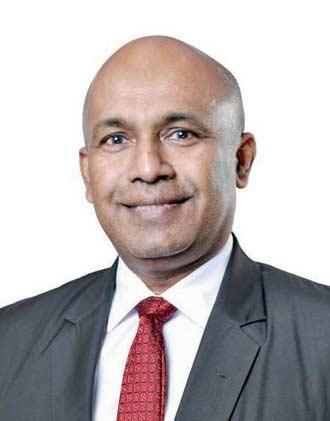
People’s Bank CEO/GM Clive Fonseka |
We had already provisioned the full amount — Rs.25 billion — into a special reserve. Even after that, as of December 31, 2024, our Tier 1 Capital Adequacy Ratio stood at 10.9 percent and our Total Capital Adequacy Ratio at 16.5 percent. This clearly provides us with a capital cushion of around 3 percent above the minimum regulatory requirement.
Additionally, our solvency position was further strengthened through the successful issuance of Rs.13.5 billion in Basel III-compliant Tier II debt during the final quarter of 2024. Therefore, I categorically refute any suggestion that People’s Bank is in a vulnerable capital position due to the special reserve. As the numbers show, we remain strongly capitalised even after applying all required prudential deductions in full.
So, to be clear — are you saying that People’s Bank has no capital adequacy issues as suggested by Fitch and that you have no immediate need to raise capital from your sole shareholder, the government?
I’m asking this because there have been media reports that another state bank was seeking a capital infusion from the government — although that bank has since publicly denied those reports.
Yes, as I just said, our capital base remains robust. At People’s Bank we have never even contemplated going to the government and asking for capital. I can say that with certainty. In fact, in its existence of 64 years, the government has infused only Rs.12.2 billion into People’s Bank, which is the lowest for the systemically important banks–both state and private. In comparison, People’s Bank has paid over Rs.28 billion to the government as dividends in the last 10 years. So, I can confidently say, at this moment, People’s Bank has no requirement for taxpayer money.
Our strong core banking operations, operational efficiency and rather conventional approach to banking have enabled us to maintain strong capital positions. I must give the due credit to the People’s Bank staff for their hard work and dedication. We have improved efficiency significantly despite the number of our staff decreasing. While all our peers have expanded their staff strength over the last eight years on a net basis, we have not. But we have been able to scale our business significantly through digital initiatives. As at end-December 2024, our staff strength was little over 7,600 and our total assets stood at nearly Rs.3.3 trillion.
How is it that the state banks are perceived to be in a precarious capital position, even though you assert that People’s Bank is not? And given that Fitch hasn’t flagged any similar capital adequacy concerns for large private banks, why is there this difference?
Well, if you recall, even before the debt restructuring, the entire banking sector — including some private banks — was under significant pressure due to their exposures to International Sovereign Bonds. During 2023, they had to set aside large provisions from their profits to cover those risks. Yet, at that time, we didn’t see the rating agencies flagging major capital adequacy concerns for those banks. So, it is puzzling why the state banks are now being singled out after establishing a special reserve, which was done purely as a prudent measure to mitigate the settlement risks tied to the restructured foreign-currency exposures to the government.
At the same time, state banks like People’s Bank serve a dual role. While we operate as commercial entities, we also have a national responsibility. When the country was facing an economic crisis, it was the state banks that stepped up — scrambling to find the foreign currency needed to pay for essentials like fuel, cooking gas and coal shipments, to keep the country running. That’s the reality behind these exposures.
In that sense, do you feel that the state banks are being disproportionately burdened by the directive to establish a special reserve — effectively being penalised for stepping up and serving the national interest during the crisis?
I don’t think it’s the right way to look at it. When People’s Bank was established in 1961, its core mission was to mobilise rural savings and channel them toward national development. That foundational responsibility is something we cannot — and will not — deviate from. At the same time, the Central Bank’s directive to establish a special reserve was a prudent regulatory step to manage the settlement risk associated with the restructured exposures. It’s about safeguarding the stability of the system, not punishing the state banks.
But with the special reserve requirement limiting state banks like People’s Bank more than the private banks, will you be forced to cut back lending, see a hit to your performance and rethink funding state enterprises in the future?
Setting aside part of our profits for the special reserve could, in theory, slow our growth a little. But because we prepared for this early and stuck to strong prudential measures, the actual impact on our performance will be minimal. I don’t see it getting in the way of growing our lending portfolio.
When it comes to funding the state-owned enterprises (SOEs), we’ll continue to provide timely support where it’s needed. That said, with the IMF programme and new legislation now in place, there are much stronger checks and balances — both on how the state enterprises borrow and how the state banks lend to them. For example, as of December 2022, around 56 percent of our loans and advances were to the SOEs. By December 2024, we had brought that down to about 35 percent and we plan to reduce it even further in the coming years. The Central Bank and Finance Ministry are working closely with the banks to ensure the financial system remains stable.
People’s Bank recorded solid results for 2024. Could you give us a glimpse of the performance of the first quarter of this year?
The results for the first quarter of 2025 aren’t out yet, so there’s not much I can share at this point. Our financials will be published within the next two to four weeks. That said, what I can tell you is that for the first quarter, we’ve recorded the highest-ever after-tax profit for a quarter in the bank’s history. This strong performance was driven primarily by our core banking operations, with only minimal support from provision reversals.
14 Jul 2026 6 minute ago
14 Jul 2026 12 minute ago
14 Jul 2026 1 hours ago
14 Jul 2026 1 hours ago
14 Jul 2026 5 hours ago