10 Feb 2026 - {{hitsCtrl.values.hits}}
By Nishel Fernando
Sri Lanka secured approximately US $ 1.48 billion in foreign development financing during the financial year ending December 31, 2025, as the major multilateral partners ramped up budget support to stabilise the economy and respond to the devastating impact of Cyclone Ditwah.
The International Monetary Fund (IMF) and Asian Development Bank (ADB) were the dominant financiers, collectively contributing nearly 80 percent of the total disbursed liquidity for the year.
The surge in foreign inflows, particularly in the final quarter, reflects a dual dynamic: a “stability dividend” following the peaceful conclusion of the 2024 elections and an urgent mobilisation of emergency funds to address the destruction caused by Cyclone Ditwah in late November 2025.
The disaster, which displaced thousands and caused widespread infrastructure damage, triggered immediate liquidity support from the donor agencies, heavily influencing the year-end disbursement figures.
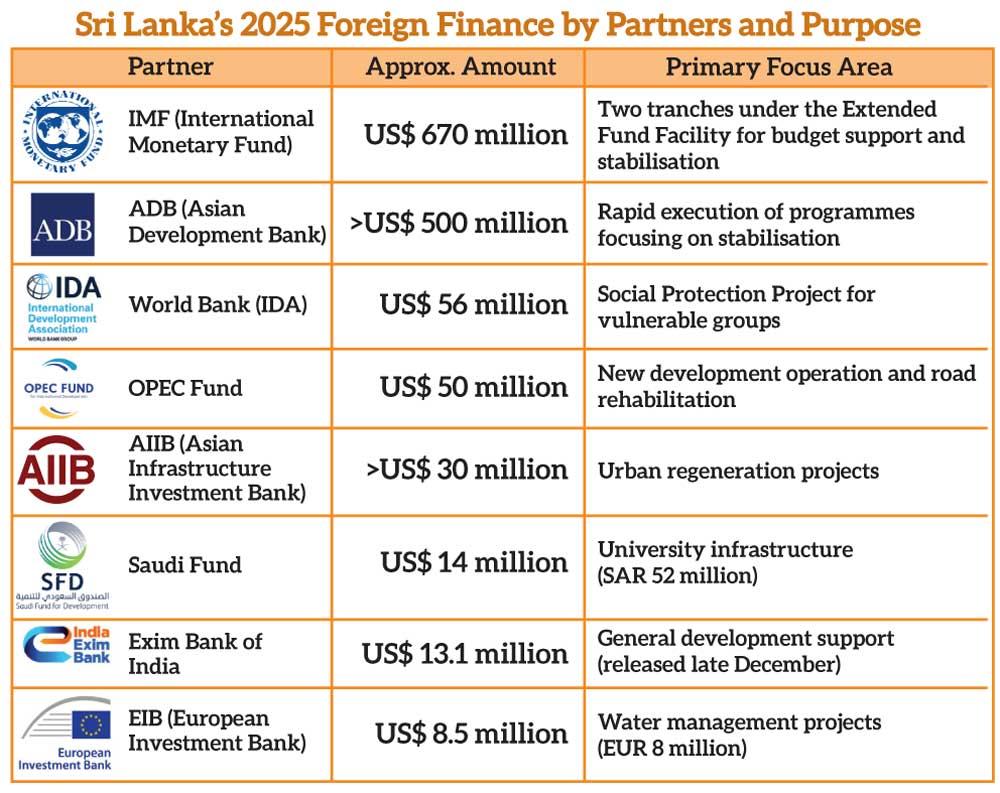
The IMF effectively doubled its contribution in 2025, releasing two full tranches totalling SDR 508 million (approximately US $ 670 million) in March and July. This consistency contrasts with 2024, where the disbursements were more sporadic. The ADB also accelerated its engagement, shifting from stabilisation commitments to rapid execution. The lender disbursed over US $ 500 million during the year, with a massive US$ 428 million released in December alone.
While these funds supported the key policy pillars like financial sector stability and power sector reforms, the timing and scale of the December releases also provided critical fiscal space for the government to manage the post-cyclone recovery, without derailing its reform agenda.
Beyond the two major giants, a diverse group of development partners maintained critical support for infrastructure and social safety nets. The World Bank, through the International Development Association, disbursed over US $ 56 million for the Social Protection Project, aiming to shield the vulnerable segments during the adjustment period.
The OPEC Fund significantly stepped up, disbursing US $ 50 million in two tranches for a new development operation and also provided funding for road rehabilitation.
As a key multilateral partner, the Asian Infrastructure Investment Bank contributed over US $ 30 million for urban regeneration projects, complementing other multilateral development bank efforts.
Among the bilateral partners, the Saudi Fund disbursed over SAR 52 million (approximately US $ 14 million) for university infrastructure, while the Export Import Bank of India released US $ 13.1 million in late December. Finally, the European Investment Bank provided nearly EUR 8 million for water management projects.
The 2025 disbursement data highlights a maturing of Sri Lanka’s economic recovery. While 2024 was defined by crisis management and resumption of paused projects, 2025 marked a shift toward high-value, policy-based financing. The successful completion of the IMF reviews, underpinned by political stability and adherence to fiscal targets, unlocked higher volumes of concessional financing.
However, the unexpected impact of Cyclone Ditwah in the fourth quarter necessitated a rapid pivot, with the development partners acting swiftly to ensure the country’s hard-won stability was not compromised by the natural disaster.
04 Jul 2026 4 hours ago
04 Jul 2026 4 hours ago
04 Jul 2026 4 hours ago
04 Jul 2026 5 hours ago
04 Jul 2026 5 hours ago