Reply To:
Name - Reply Comment
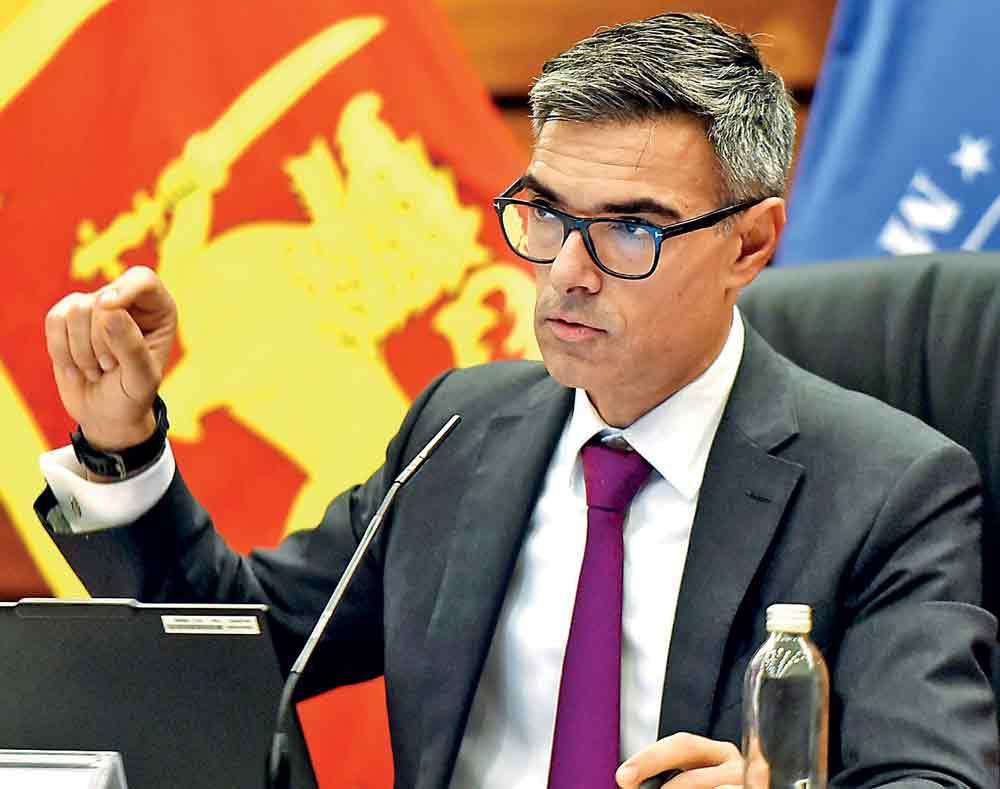
Evan Papageorgiou
Pic by Nisal Baduge
Sri Lanka’s economic recovery has remained resilient despite the fallout from the Middle East conflict, with strong revenue collection and growth helping cushion the impact of external shocks, although significant reform challenges remain, the International Monetary Fund (IMF) said yesterday.
Concluding a week-long staff visit to Colombo, IMF Mission Chief for Sri Lanka Evan Papageorgiou said the economy had come under pressure from higher energy prices, softer tourism growth and slower reserve accumulation following the outbreak of war in the Middle East, but fiscal performance had remained broadly encouraging.
“From the indications that we have and from the information we have seen, both from the published results and the discussions, there is indeed good outturns on revenue. It tends to be broad-based and we are pleased by that,” Papageorgiou told journalists.
Inflation accelerated from 1.6 percent in February to 5.5 percent in May following energy price increases linked to the conflict, prompting the Central Bank to raise policy rates by 100 basis points and introduce macroprudential measures to contain emerging risks.
Despite those headwinds, the Fund said government revenues and economic activity had remained robust.
“We are taking good note that despite the initial shock from the cycle from late last year and into early 2026, it seems that revenue has been quite robust, and so is growth, of course, as we have seen in recent economic outturns,” Papageorgiou said.
The IMF described the performance as a “very welcome development” and a sign that Sri Lanka’s recovery remains intact, even as global uncertainty continues to cloud the outlook.
However, the Fund warned that maintaining reform momentum would be critical to preserving fiscal and external stability. It said authorities remained committed to returning to a primary budget surplus of 2.3 percent of GDP in 2027 after a temporary fiscal easing this year.
The IMF urged the government to continue efforts to improve tax compliance, broaden the tax base and strengthen public financial management, while preventing the re-emergence of expenditure arrears.
The Fund also identified state-owned enterprise reforms and cost-reflective pricing for fuel and electricity as key priorities to reduce fiscal risks, while stressing the need to protect vulnerable households through well-targeted social safety nets.
With sovereign debt restructuring nearing completion, the IMF said Sri Lanka must also accelerate efforts to strengthen the Public Debt Management Office, deepen domestic debt markets and prepare for an eventual return to international capital markets.
The Fund further called for continued exchange rate flexibility, gradual removal of balance-of-payments restrictions and reforms to improve governance, trade competitiveness, labour market efficiency and the overall investment climate.
Sri Lanka’s performance under the IMF-supported Extended Fund Facility will be formally assessed during the programme’s seventh review, the timing of which will be announced later. (SAA)