11 Feb 2026 - {{hitsCtrl.values.hits}}
By Nishel Fernando
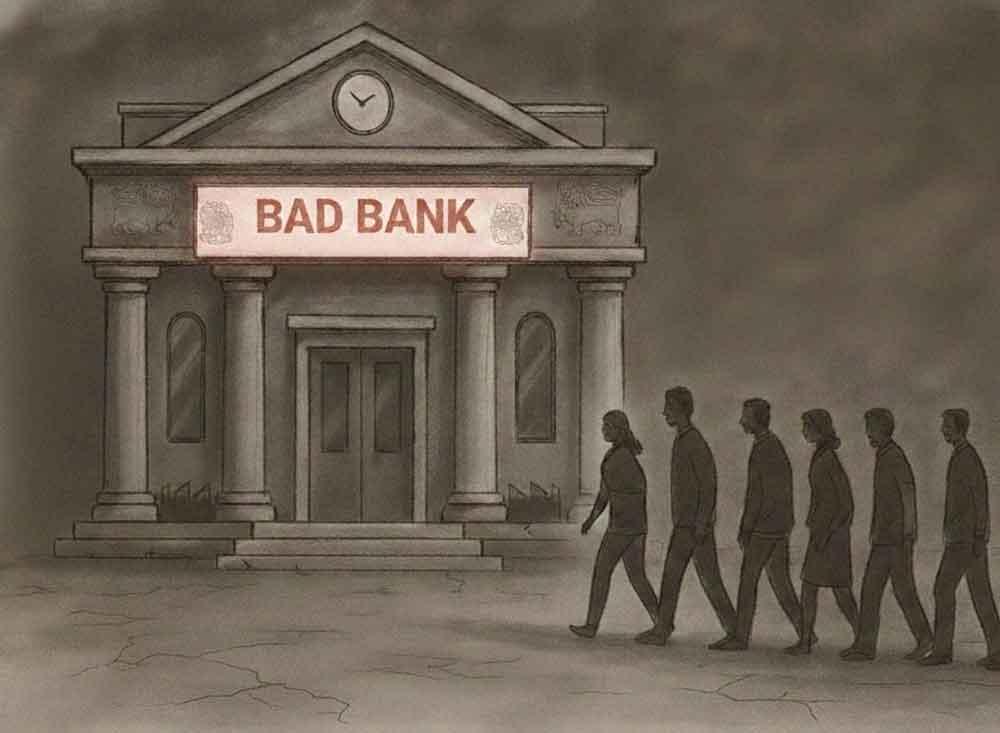
The Sri Lanka Chamber of Small and Medium Industries (SLCSMI) has unveiled a comprehensive blueprint for a Rs. 300 billion “Bad Bank” to rescue the nation’s embattled small and medium enterprise (SME) sector.
The proposal, which aims to absorb toxic assets and restructure an estimated Rs. 460 billion in non-performing loans (NPLs), calls for a mixed funding model that notably includes a levy on commercial bank profits alongside unutilised balances from the Employees’ Provident Fund (EPF) and Employees’ Trust Fund (ETF).
Chamber officials, led by President Prof. Rohan De Silva and Senior Vice President Colin Fernando addressing media in Colombo yesterday, emphasised that the mechanism is critical to unfreezing the sector, which currently contributes 52 percent to the GDP. Immediate Past President Mohideen Cader revealed that the “Bad Bank” concept was originally tabled at a recent meeting of the Committee on Public Finance (COPF), chaired by Dr. Harsha de Silva.
According to the Chamber, the proposal received principal agreement from all participants at the COPF discussion, including officials from the Central Bank, who acknowledged the necessity of a specialized vehicle to separate bad assets from the commercial banking system.
The proposed entity would function as a rehabilitation unit, taking over “frozen” loans and offering viable enterprises a five-to-ten-year window to restructure their debts without the looming threat of parate execution. Under the proposed funding structure, the Rs. 300 billion capital would be sourced through a combination of low-cost international funding, a portion of the significant profits currently recorded by the banking sector, and idle balances within the EPF and ETF.
Cader argued that this approach mirrors successful industrial rehabilitation funds established during the presidency of J.R. Jayewardene, which were instrumental in insulating strategic local industries from market volatility and fostering the initial wave of post-liberalisation industrial growth.
The Chamber argued that a similar state-backed intervention is now essential to prevent the systemic collapse of family-run businesses that have been battered by consecutive external shocks, ranging from the Easter Sunday attacks to the recent economic crisis to destruction caused by Ditwah cyclone. Officials noted that while banks are currently liquid and profitable, they remain risk-averse, leaving thousands of entrepreneurs blacklisted by the Credit Information Bureau (CRIB) and unable to access fresh capital for revival.
Beyond the debt crisis, the Chamber raised alarm over the looming impact of the proposed reduction in the Value Added Tax (VAT) threshold. With the government moving to lower the VAT registration threshold to Rs. 36 million per annum effective April 1, 2026, officials warned of a “death blow” to micro and small enterprises. The Chamber pointed out that pulling smaller businesses into the complex VAT net would not only increase their compliance costs but also drive up prices for consumers, further dampening demand in an already sluggish market.
The media briefing also highlighted persistent infrastructure bottlenecks, particularly the absence of accredited local testing laboratories. The Chamber officials noted that manufacturers of export-oriented products, such as footwear, are currently forced to send samples to India for certification, incurring delays of up to six months. The SLCSMI urged the government to establish testing facilities within local universities to expedite approvals and reduce costs by 50 percent, a measure they described as a low-hanging fruit for boosting export competitiveness.
The Chamber reiterated that the Rs. 300 billion funding requirement is an investment in national stability rather than a bailout. With over 45 percent of the national workforce employed by SMEs, officials warned that failure to implement these restructuring mechanisms would lead to irreversible economic scarring.
04 Jul 2026 4 hours ago
04 Jul 2026 4 hours ago
04 Jul 2026 4 hours ago
04 Jul 2026 5 hours ago
04 Jul 2026 5 hours ago