11 Mar 2025 - {{hitsCtrl.values.hits}}
By Nishel Fernando
|
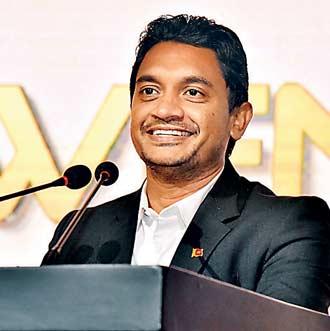
Chathuranga Abeysinghe PIC BY KITHSIRI DE MEL
|
The government called on the industrialists to embrace digital supply networks under a unified industrial strategy or risk being left behind in an increasingly interconnected global economy.
Industry and Entrepreneurship Development Deputy Minister Chathuranga Abeysinghe asserted that the traditional linear supply chain model—raw materials, transportation, manufacturing and distribution—is no longer viable in a world dominated by digital supply networks.
“The world has moved on. Supply chains are no longer linear; they are interconnected ecosystems driven by data,” he said.
He made these comments while addressing the TWENTY 30 and BEYOND forum and award ceremony, organised by COYLE in Colombo last week. The event celebrated Sri Lanka’s entrepreneurial excellence, bringing together industry leaders and entrepreneurs to discuss the future of the country’s industrial landscape.
Abeysinghe highlighted how modern supply chains operate on real-time data, with demand signals sent directly to farmers, suppliers and manufacturers. He argued that this transparency is dismantling inefficiencies and profit accumulations that have long plagued the traditional value chains.
“Consumers today demand transparency. They want to know where their products come from, who made them and at what cost. Blockchain technology is enabling this and the businesses that fail to adapt will be irrelevant,” he stated.
Abeysinghe painted a vision of a future where every step of the supply chain—from sourcing to retail—will be visible to the consumers. “If you don’t digitalise your processes, there is no data. If there is no data, there is no AI. It’s that simple,” he said.
He acknowledged the challenges of this shift, noting that many organisations resist working with data because it exposes inefficiencies and went on to urge the businesses to integrate their systems with the global supply chains, warning that failure to do so would render them obsolete.
“If your ERP system isn’t connected to your retailer’s ERP system, you’re done. This is the reality of the global market,” he said.Abeysinghe also outlined Sri Lanka’s slow adoption of industrial advancements over the years.
“We missed the First, Second, Third and Fourth Industrial Revolutions. Now, we’re talking about the Fifth, without getting our basics right,” he lamented.He called for a fundamental shift in mindset, emphasising that the Sri Lankan businesses must think globally.Abeysinghe also highlighted the absence of mid to long-term strategies in most local industries.
“I’ve asked many industries about their targets for reducing manufacturing costs or energy consumption. Most don’t have any. We need to double our productivity and capacity on the same land footprint. Sri Lanka doesn’t have enough land to waste,” he said.Moving forward, he stressed that the local industries cannot continue to operate in isolation.
“We have been driven to work in isolation. We have old feasibility studies, old business plans but have we ever put it as one industry? I’ve asked many industries, ‘Tell me your workforce demand.’ I still haven’t gotten an answer. How much skill? What type of skill? What is the projection for the next five years? Many industries still fail to predict and project their growth plans in detail for the next five years and beyond,” he said.Within the next six months, Abeysinghe noted that there will be a common strategy for industry and government.
“So, we can share the pains and the gains, take a timeline and solve it quarter by quarter, review it quarter by quarter, as we do in our own businesses. Because the goal is very clear: US $ 45 billion. It’s not an easy game,” he said.Abeysinghe assured the government’s commitment to supporting the businesses through this transition, despite the fiscal constraints.
21 Jul 2026 3 hours ago
21 Jul 2026 4 hours ago
21 Jul 2026 4 hours ago
21 Jul 2026 4 hours ago
21 Jul 2026 6 hours ago