Reply To:
Name - Reply Comment
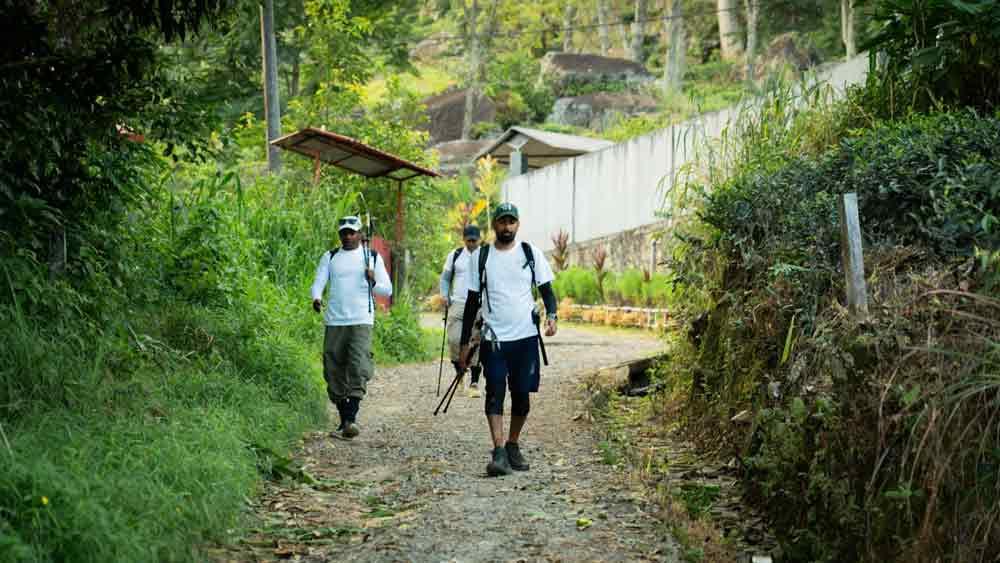
Caption: 500,000 steps. 323 km. One unforgettable journey across Sri Lanka’s iconic Pekoe Trail. HealthRecon Connect, 2025.
By walking 323 kilometers in unforgettable relentless days, Arjuna Nayanaka Samarakoon and a team of corporate leaders didn't simply complete one of Sri Lanka's toughest endurance challenges. They issued a challenge to the nation itself.
The 500K Steps Campaign was conceived to raise LKR 20 million for the Pekoe Trail, funding better signage, safer infrastructure, biodiversity conservation, and community-led tourism across Sri Lanka's Central Highlands. But beneath the blisters, exhaustion and mountain ascents lay a far bigger question:
Can Sri Lanka transform one of the world's most celebrated hiking trails into a model for national development?
The trail already enjoys global acclaim. It has been recognized by National Geographic, TIME, CNN Travel, and Lonely Planet as one of the world's premier hiking experiences. Yet significant sections still lack basic infrastructure needed to meet international visitor expectations. The 500K Steps Campaign was created to close that gap, not merely through fundraising, but by changing the national conversation.
As campaign leader Arjuna Samarakoon put it, "This walk is about reconnecting with the land, with people, and with purpose. We want to use each step to inspire belief in Sri Lanka's potential and turn that belief into lasting, measurable outcomes."
The campaign leaves behind five lessons that extend well beyond the Pekoe Trail.
Lesson One: Endurance Is the Real Currency of Reform
Sri Lanka has spent years searching for dramatic solutions to deeply rooted economic problems. But what if the answer isn't speed? What if it is endurance?
Walking 323 kilometres over five consecutive days offers no shortcuts. Every ascent demands patience. Every descent requires discipline. Progress is measured not by bursts of energy but by sustained momentum.
That mirrors what development economists have argued for decades.
The World Bank's country transition framework consistently demonstrates that countries do not move into higher income categories through isolated reforms or temporary interventions. Development is driven by years of policy consistency, institutional strengthening and investment that survives political cycles. Economic transformation, in other words, is cumulative—not episodic.
Samarakoon repeatedly framed the trail as a metaphor for this reality.
"The Pekoe Trail shows what happens when planning, patience and community alignment come together," he observed in discussing the trail's broader significance. "It is a path that balances economy and ecology."
The message is difficult but necessary. Sri Lanka will not walk out of crisis in a single budget, one election cycle or one investment summit. Like the trail itself, recovery is measured one disciplined step at a time.
Lesson Two: Tourism Is Not About Landscapes. It Is About People.
For decades Sri Lanka has marketed scenery. Golden beaches. Ancient ruins. Tea-covered mountains. But landscapes do not build economies. Communities do.
The 500K Steps Campaign deliberately shifted attention away from postcard photography and towards the people living along the Pekoe Trail.
The woman operating a roadside café. The young trekking guide building a livelihood. The family converting spare rooms into a homestay. The fruit vendor waiting beside an estate road. These are tourism's real stakeholders.
This approach aligns closely with international development thinking. Research and programmes supported by UNDP, UN Tourism, and UNEP consistently argue that tourism becomes economically resilient when spending, employment, ownership and supply chains remain within host communities rather than leaking elsewhere. Community-centered tourism produces broader local benefits and strengthens rural economies over the long term.
The Pekoe Trail already connects approximately 80 villages across Sri Lanka's Central Highlands, demonstrating how tourism can disperse economic opportunity rather than concentrate it in a handful of urban centers.
The campaign therefore asks a question that should challenge policymakers:
Should Sri Lanka continue counting tourist arrivals—or start measuring how many rural families actually prosper because visitors came?
Lesson Three: World-Class Recognition Means Little Without World-Class Infrastructure
Sri Lanka possesses one of Asia's finest hiking trails. That is no longer in dispute. The world has already recognized it. The question now is: Can visitors actually navigate it safely?
Despite international accolades, sections of the Pekoe Trail still require improved wayfinding, digital navigation, trail maintenance, rest facilities and safety infrastructure.
These may sound like minor investments. They are not. They determine whether a destination becomes globally competitive.
The World Bank's tourism and development programmes for Sri Lanka consistently identify infrastructure, connectivity, destination readiness and quality visitor services as essential prerequisites for translating natural assets into sustainable tourism growth and employment. Infrastructure is not cosmetic; it is economic strategy.
The fundraising objective of the 500K Steps Campaign therefore reflects something larger than trail maintenance.
It is an investment in competitiveness. Every signpost installed. Every bridge repaired. Every digital trail map updated. Every community rest stop built. Each becomes another piece of national economic infrastructure.
Lesson Four: The Private Sector Cannot Remain a Spectator
One of the campaign's most significant achievements was demonstrating what becomes possible when business leaders move beyond corporate boardrooms.
Supported by organizations including HealthRecon Connect, the initiative illustrates how corporate social responsibility can evolve into measurable nation-building.
International institutions increasingly advocate precisely this model. Both UNDP and UN Tourism identify public-private partnerships as essential mechanisms for delivering inclusive tourism, creating employment, improving infrastructure and strengthening resilience in destination economies.
Government cannot finance everything. Communities cannot build everything. Businesses cannot simply observe. Development happens where all three meet. The Pekoe Trail offers a practical demonstration of that principle.
Instead of waiting for perfect conditions, the campaign mobilized private capital, volunteer energy and public awareness around a shared national asset.
That model deserves replication far beyond tourism.
Lesson Five: Nature Is Not an Expense. It Is National Wealth.
Perhaps the most important lesson of all is the simplest. Sri Lanka's forests, rivers, mountain ecosystems and biodiversity are not obstacles to development. They are development.
The internationally recognized TEEB (The Economics of Ecosystems and Biodiversity) framework argues that ecosystems should be treated as productive economic assets. Conservation and restoration are investments capable of generating long-term returns through tourism, climate resilience, water security and sustainable livelihoods.
The Pekoe Trail embodies that philosophy. Its success depends entirely on protecting forests, wildlife habitats, watersheds and the cultural landscapes that make the Central Highlands globally distinctive. Destroy those ecosystems, and the economic opportunity disappears with them.
Protect them, and Sri Lanka strengthens one of its greatest competitive advantages in a world increasingly driven by eco-conscious travelers.
As Samarakoon argued, "When eco-tourism is done properly, it feeds directly into agriculture, conservation and digital enterprise. It becomes an ecosystem of reform rather than a single industry."
The Bigger Questions
The 500K Steps Campaign was marketed as an endurance walk. It was, in reality, something far more provocative. It challenged Sri Lanka to rethink development itself.
What if tourism success were measured by thriving villages rather than record arrivals? What if infrastructure became a national priority before global marketing campaigns?
The hikers have already finished their journey. The harder journey now belongs to the country. Because the next 500,000 steps are not on the Pekoe Trail. They are the ones Sri Lanka must decide to take.
Sources:
https://www.worldbank.org/ext/en/country/srilanka/cpf
https://www.undp.org/publications/tourism-and-sustainable-development-goals-journey-2030
https://www.preventionweb.net/organization/united-nations-environment-programme-unep