AI SUMMARY GENERATED ONLY FROM THIS ARTICLE'S TEXT.
Another victim of noise pollution is Milinda Weerasinghe, a resident of Kalapaluwawa, Rajagiriya who along with 15 other individuals filed a case against a prominent hotel in the area which severely inconvenienced them with outdoor functions that happened in the evenings. Police complaints against loud noises from outdoor functions hosted by this hotel were filed between July 2017 and September 2018. The functions that ran late into the night often prevented school children from concentrating on their studies while depriving residents of their sleep, the complaints revealed. In response, the Colombo Magistrate Court issued a conditional order against the hotel over noise pollution from outdoor functions
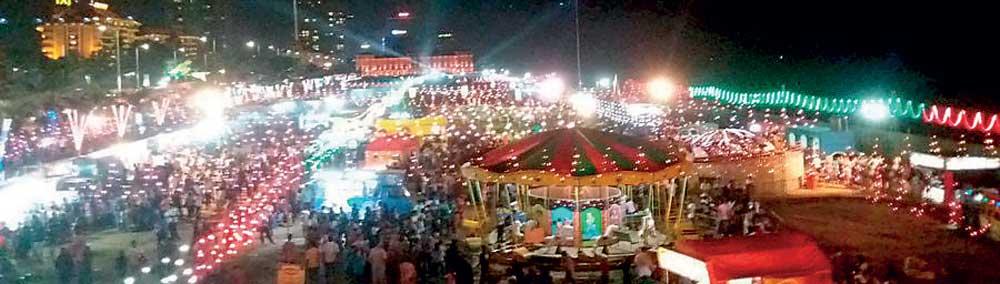
Carnivals and musical shows are a major attraction during the upcoming festive period, often accompanied with deafening music. But noise pollution caused by these events which sometimes run late into the night would be a burden to residents living in close proximity. Despite having a Supreme Court judgement on noise pollution with clear directions on specified time limits for nocturnal events, and duties vested on the police when it comes to investigating complaints of public nuisance caused by noise pollution and taking necessary action, the Daily Mirror learns that the public continues to be inconvenienced by these noisy events not just in the capital, but across the country, too.
The best option is to follow the SC judgment. A sound heard outside the perimeter of a premises is an
offense
Dr. Jayampathy Wickramaratne
Concern from victims of noise pollution
Residents living at Galle Face apartments have raised concerns regarding carnivals at Galle Face Green with loud music. “We have no objection to people enjoying, but they should have some respect for residents,” said one resident who spoke on conditions of anonymity with the Daily Mirror. “One event organiser argued that they can attract more crowds when the music is louder. Another issue is with regards to vehicles revving up their engines, especially during the night,” the resident said. They further requested authorities including the Colombo Municipal Council to investigate into this matter. They question how the construction of residential apartments were allowed opposite an area that frequently hosts musical shows and carnivals, causing a public nuisance.
Another victim of noise pollution is Milinda Weerasinghe, a resident of Kalapaluwawa, Rajagiriya who along with 15 other individuals filed a case against a prominent hotel in the area which severely inconvenienced them with outdoor functions that happened in the evenings. Police complaints against loud noises from outdoor functions hosted by this hotel were filed between July 2017 and September 2018. The functions that ran late into the night often prevented school children from concentrating on their studies while depriving residents of their sleep, the complaints revealed. In response, the Colombo Magistrate Court issued a conditional order against the hotel over noise pollution from outdoor functions.
“Permits have been issued for events in spite of people’s complaints and the case has been pending at the Colombo Magistrate Court for the past six and a half years,” Weerasinghe said, speaking to the Daily Mirror. “Recently the hotel in question hosted a party with music so loud that it literally shattered windows at my home because I live in extremely close proximity to the hotel, around 150 metres away. My daughter is a pilot and she needs to take pre-flight rest prior to a flight. So it could be afternoon or morning but with these disturbances, sleep has become a luxury for us,” he added.
Weerasinghe is hopeful that the courts would issue a fair judgement as noise pollution itself is a public nuisance.
The number of social media users who write to a Facebook group titled ‘National Coalition against Noise Pollution’ reveals the gravity of the situation. Many are affected by the use of loudspeakers at religious place of worship. They complain of high stress levels that elderly persons and infants have to endure as a result of loud noises in their neighbourhoods. Garages revving vehicle engines, use of welding machines and lawn movers during weekends are common incidents of noise pollution.
A landmark judgement
In 2008, then Chief Justice Sarath N Silva delivered a landmark Supreme Court decision stipulating conditions related to sound pollution. It established that noise pollution was a public nuisance and that police were obliged to entertain complaints from citizens in relation to public nuisances under Section 261 of the Penal Code.
The case commenced as a fundamental rights application by the trustees of a mosque in Weligama against the Police for refusing a loudspeaker permit. The Police contended that residents in the area had complained of noise pollution due to the excessive use of the loudspeakers by three mosques. The Supreme Court noted that the application raised fundamental issues with regard to sound pollution and standards that the Central Environmental Authority (CEA) should enforce.
Some of the notable directions issued by the Court after hearing the aforementioned case are as follows;
i. That the emission of noise by the use of amplifiers, loudspeakers or other equipment or appliances which causes annoyance to the public or to the people in general who dwell or occupy property in the vicinity be considered a public nuisance in terms of section 261 of the Penal Code and that the Police should entertain complaints and take appropriate action for the abatement of such public nuisance;
That all permits issued by the Police under section 80(1) of the Police Ordinance shall cease to be effective forthwith;
That no permits shall be issued in terms of section 80(1) of the Police Ordinance for the use of loudspeakers and other instruments for the amplification of noise as specified in that section covering the period 10 p.m. (night) to 6 a.m. (morning). Such permits may be issued for special religious functions and other special events only after ascertaining the views of persons who occupy land premises in the vicinity, a record of such matters to be maintained and the grant of any such permit shall be forthwith reported to the nearest Magistrate Court;
That in respect of the hours from 6.00 a.m. to 10.00 p.m., permits may be issued for limited periods of time for specific purposes subject to the strict condition that the noise emitted from such amplifier or loudspeaker or equipment does not extend beyond the precincts of the particular premises.
Where a permit is issued in terms of section 80(1) as provided in direction (iii) and (iv) sufficient number of Police Officers should be designated and posted to the particular place of use to ensure that the conditions imposed are strictly complied with;
That the Police will make special arrangements to entertain any complaint of a member of the public against any person guilty of an offence of public nuisance as provided in section 261 of the Penal Code or of using any loudspeaker, amplifier or other instrument as provided in section 80 of the Police Ordinance contrary to any of these directions and take immediate steps to investigate the matter and warn such person against a continuance of such conduct. If the conduct is continued after that warning to seize and detain the equipment as provided in section 80(4) of the Police Ordinance and to report the matter to the Registrar of this Court.
Speaking to the Daily Mirror, Dr. Jayampathy Wickramaratne, President’s Counsel said that in the absence of a law, this judgment is the law. “Following the decision the Supreme Court ordered the Inspector General of Police to send out circulars in conformity with the judgement. Subsequently, IGP’s Circular No. 2031/2007 and Crime Circular 17/2007 were issued. Speculation is rife regarding a further amendment to be made to the law in terms of measuring noise levels, but this would spell disaster. Who’s going to measure the noise levels? Therefore, the best option is to follow the SC judgment. A sound heard outside the perimeter of a premises is an offense,” he added.
Dr. Wickramaratne further said that no government is willing to address the issue of noise emanating from religious places. Motorists are another issue. Loud noises affect the health of the people and residents in Battaramulla have also observed a reduction of bats and bird life, especially near Parliament and it’s possible that this could be due to loud noises and fireworks,” he underscored.
A carnival at Galle Face Green Source - social media
In April 2024, a 11-member committee appointed by the then Minister of Justice, Prison Affairs and Constitution Reforms Wijeyadasa Rajapakshe reviewed regulations on noise pollution and proposed amendments to existing laws. The Committee chaired by Supreme Court Judge, Justice Mahinda Samayawardhena suggested publishing new regulations under the National Environmental Act to address community noise pollution in Sri Lanka. In addition, amendments were proposed to the existing police circulars with the aim of empowering the police to deal with complaints of noise pollution.
Duties vested on the Police
Appearing on behalf of the aggrieved parties in Rajagiriya, Attorney-at-Law Nalinda Indratissa pointed out that the police have to issue permits for events when people are using loudspeakers and that, a circular issued by the Inspector General of Police notes that police can’t issue permits for musical or other events where loudspeakers are used after 10pm. The authority issuing the permit must also inform the area magistrate. The circular also makes it clear that the party to which the permit is issued has a responsibility to ensure that, if a function is being held, any noise resulting from the function cannot be heard outside the hall.
When contacted, the Police Media Division said that event organisers should obtain a permit from the Police. If an event continues beyond 10.00pm the Police would initially issue a warning, failing which the organisers would be subject to arrest.
Mixed reactions from the entertainment industry
When the incumbent government assumed power, representatives of local bands met with Minister of Buddhasasana, Religious and Cultural Affairs, Dr. Hiniduma Sunil Senevi requesting him to extend the time limit for musical events in Sri Lanka. In response, the Minister assured that steps would be taken to raise the matter with the Cabinet to extend the time limit without inconveniencing the public. Recently, MP Dayasiri Jayasekara revealed a 700% hike in the loudspeaker license fee for musical shows implemented by the government.
Several attempts to contact Deputy Environment Minister Anton Jayakody and Dr. Hiniduma Sunil Senevi to inquire about enacting new regulations on noise pollution control proved futile.
Challenges in controlling noise pollution
The National Environmental (Noise Control) Regulations sanctioned in 1996 under the gazette No: 924/12 and amended in 1997 controls noise pollution cause due to operation of prescribed industries and construction sites. The Central Environmental Authority (CEA) is one of the authorities vested with the responsibility of monitoring noise pollution with a unit dedicated to Air Resource Management and Monitoring. Speaking to the Daily Mirror, Vernika Ranawakarachchi, Director at CEA’s Air Quality, Noise and Vibration Monitoring Unit said that amendments to existing regulations have been submitted to the legal draftsmen and plans are underway to enact these regulations into the law at least by the end of the year.
However, she said community noise pollution, especially from buffers and amplifiers that generate sound has become a common problem that affects people. “The National Environmental Act comprehensively assesses industrial noise pollution but people are affected by musical shows, Sunday fairs, lottery vendors and many other sources of noise pollution. A Supreme Court judgement is in effect but community noise pollution needs to be regulated. In fact there were certain regulations on the use of buffers and sound amplifiers but successive regimes have discouraged these regulations as they fear that it would stir unwanted issues within the religious communities.”
One of the biggest barriers faced by the CEA with regards to implementation of regulations is the lack of resources and manpower. “In order to measure the sound limits in various places we need more staff. The Department didn’t have provisions to obtain calibrators and other sound measuring devices. The Police Ordinance also indicates a clause on public nuisance caused by noise pollution. We have submitted new regulations to the incumbent subject Minister as well. We hope that the authorities would be empowered with the necessary technology and manpower to address this issue,” she added.
The Police too, has a duty to take necessary actions when a complaint is being made by an aggrieved party. Ranawakarachchi further said that noise pollution also affects tourists who arrive in the country in search of a peaceful retreat. “Sometimes they write bad reviews as a result of these unpleasant experiences. Therefore, moving forward we should opt for a zoning mechanism where industries would be established in one zone, commercial activities in another and residential areas in a separate zone to better manage noise pollution. At present, controlling noise pollution is a challenge. On the other hand, a shift in attitudes of people who resort to producing loud noises too, is required,” she underscored.
Concerned citizen Thursday, 10 April 2025 12:25 AM
Dehiwala marine drive and all the restaurants were built recently. People live here for long time. These restaurants use rock music around the clock. Children can’t study, elders and sick people can’t sleep. We can’t work or listen to anything we want. I informed the police they came and stop and next day they do the same thing till morning 3 AM or 4 AM. Never ending irritation and insult to humanness. I don’t know these restaurants are being run by drug dealers and immoral beings... Its police duty to ensure law and order.
028
Sammy Thursday, 10 April 2025 11:32 AM
What about religious places? They play loud music, chantings, recitals
283
wickrama Wijayasiri Friday, 18 April 2025 06:27 PM
They all should be banned, including 'Chuun Paan' and metal collection trucks with megaphones. Make law requiring permits for the use of megaphones. Enforce the laws in place on vehicles roaring with altered silencers.
01
None-Sense Sunday, 13 April 2025 09:04 PM
This is not a difficult debate. Areas around the city/entertainment district can have relatively louder events. Areas designated residential should have strict rules to be kept as peaceful as possible. Any business who wants to open up in a residential areas (a boutique shop, a cafe, a grocer etc) should strictly adhere to the area. If you want loud music, pay rent at a commercial environment.
03
wickrama Wijayasiri Tuesday, 15 April 2025 05:37 AM
SL does not have Land Use Zoning by-laws. Old society. Difficult to do it retroactively. Because of the climate, difficult to count on technology to isolate noise without making extensive alterations to existing building on top of climate control. It should be a responsibility of the municipality to grant building permits and occupancy permits to minimize impact. They have to be stipulated on the new commercial occupancies; noise control. Strict and hefty fines on violators.
030
Shane Thursday, 17 April 2025 01:09 AM
In major cities like London, nightclubs are in the basement of buildings and sound proofed so that there is no disturbance to residents and other adjacent premises.
00
wickrama Wijayasiri Tuesday, 15 April 2025 06:01 AM
The use of megaphones/loudspeakers should be banned irrespective of their use. In the western hemisphere where there is a sizeable Islamic population, we do not hear any megaphone calls from mosques. In SL the Buddhist temples and Mosques should be banned from this practice. Vehicles running without acceptable noise attenuation should also be prosecuted. There should also be a limit to the loudness of vehicle horns. All above falls under the responsibilities of the Ministry of Environment.
27
Shane Thursday, 17 April 2025 01:05 AM
We have been disturbed for many years by loud music being blasted from the (illegal) open air rooftop of a restaurant in Colombo 2. Most neighbours are reluctant or frightened to complain to the police, which is the main problem. However, based on complaints from me and one other neighbour, the police have taken action in the last one year and thankfully the music is no longer intrusive.
03
222
Add comment
Comments will be edited (grammar, spelling and slang) and authorized at the discretion of Daily Mirror online. The website also has the right not to publish selected comments.



 Kamanthi Wickramasinghe