 Kamanthi Wickramasinghe
Reply To:
Name - Reply Comment
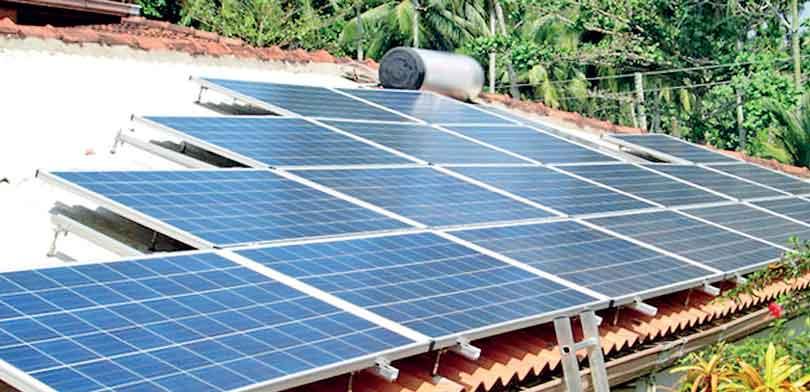
Renewable energy advocates claim that the rooftop solar sector saves over US$ 500 million annually by preventing fossil fuel usage
 Sri Lanka’s energy sector is at a critical juncture due to the growing friction between conventional and non-conventional energy sectors. While the world is moving away from fossil fuels, coal and is looking at depending on renewable energy, Sri Lanka is challenged by various obstacles. Despite submitting an elaborate energy policy with ambitious targets, the incumbent government is yet to take some proactive and practical decisions to strengthen the renewable energy sector. In this backdrop, renewable energy experts have expressed their frustration regarding policy inconsistencies, bureaucratic hurdles and infrastructure-related inconsistencies that would threaten the future of the renewable energy sector in Sri Lanka.
Contradictions in govt.’s energy policy Vs. NPP Policy
By 2030, the government aims to fulfill 70% of the energy requirement through renewable energy in addition to bringing all energy requirements to net zero level by 2050. The NPP’s energy policy mentions the launch of a rapid national programme to add 2000 MW of solar photovoltaic (PV) capacity as a strategic measure to avert the impending energy crisis in the near future. The policy pledges to strengthen efforts to achieve net zero emissions while promoting rooftop solar PV behind-the-metre battery storage systems by introducing new business models and tariff structures aiming at reducing the overall cost of energy generation.
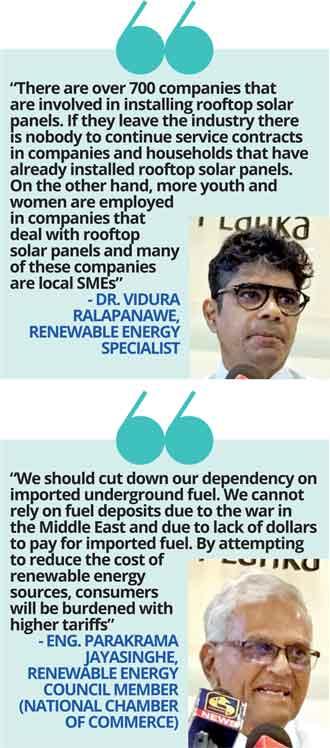
In this backdrop, renewable energy advocates have raised concerns as to whether the government is actually walking the talk. Speaking at a recent media briefing, renewable energy specialist Dr. Vidura Ralapanawe said that those who promised to add 2000MW from rooftop solar PV have made it impractical due to two reasons. “One reason is that there are over 700 companies that are involved in installing rooftop solar panels. If they leave the industry there is nobody to continue service contracts in companies and households that have already installed rooftop solar panels. On the other hand, more youth and women are employed in companies that deal with rooftop solar panels and many of these companies are local SMEs. In the event that they cease operations, this void would be filled by mega scale companies or fossil fuel companies,” said Ralapanawe.
He further said that there are several power plants around this country, but they are million dollar investments. “When we start paying debts the rupee will appreciate against the dollar and electricity tariffs would increase. I don’t understand what they are trying to do by getting rid of the cheaper option and whether they could actually lower electricity tariffs. During the Soorya Bala Sangramaya the original tariff for rooftop solar was a two-tiered system: Rs. 22 for the first seven years and Rs. 15.50 for the subsequent 13 years. The cost of ground-mounted solar panels was Rs. 23. But back then everybody claimed that the cost was too much,” he added.
Restoring energy security
While reiterating the fact that energy security is a vital component of national security, Eng. Parakrama Jayasinghe, a Renewable Energy Council member at the National Chamber of Commerce, said that it is rather unfortunate to note that Sri Lanka hasn’t taken maximum use of its already available renewable energy sources. “We should cut down our dependency on imported underground fuel. We cannot rely on fuel deposits due to the war in the Middle East and due to lack of dollars to pay for imported fuel. By attempting to reduce the cost of renewable energy sources, consumers will be burdened with higher tariffs. The Middle Eastern countries are exporting fuel and becoming richer. So we have to look at producing our own electricity and easing the burden on consumers. This would strengthen energy security in the long run,” he said while asserting that Sri Lanka’s existing 2,000 MW of non-traditional energy sources save up to about USD 620 million foreign exchange.
Reasons behind Feb 9 blackout
Renewable energy advocates claim that the banking sector had already invested over Rs. 100 billion in the energy sector, providing loans to consumers as well. Numbers wise, there are over 100,000 rooftop solar panels installed spanning from 2.5KW in domestic households all the way up to 2.5-3 MW capacity rooftop solar panels. This is how the 1500 MW was generated over the past 10 years. However speculation is rife about attempts to halt rooftop solar panels based on the power breakdown that happened in early February. The government claimed various reasons for this breakdown. Initially it was a monkey and then on the Victoria reservoir. But what actually transpired remains a mystery.
Explaining the technical aspects of the February blackout, Dr. Ralapanawe further said that following the blackout, the CEB made an announcement to disconnect power generated from solar, hydro and mini hydro projects on Sundays and holidays. “As soon as the blackout took place, top officials at CEB blamed it on solar energy even before a detailed report regarding the breakdown was submitted. But we should first look at what happened and how renewable energy contributed to this breakdown,” he said.
Dr. Ralapanawe explained that the main issue is that the CEB hasn’t configured transmission protection accurately. “What happened is similar to a breakdown in a substation due to a malfunctioning fuse in a domestic household. The first report doesn’t indicate that the fault occurred due to solar power. But subsequently the blame was directed at solar power perhaps to safeguard the transmission protection unit and other components. There are 11 recommendations in the preliminary report and all these need to be carried out by the CEB. But they haven’t acted upon these recommendations over the past few years. What needs to be done is to review these failures and fix the issues at hand without putting a halt to rooftop solar. Otherwise experiencing three to four blackouts per year would be a regular occurrence,” Ralapanawe warned.
However, on Wednesday (April 23) the CEB confirmed that the primary reason for the February 9 blackout, was low system inertia resulting from an ‘exceptionally high contribution of solar power at the time’.
Impacts from tariff cuts
In Sri Lanka there are over 1000 companies that actively engage in rooftop solar installations that employ over 40,000 people. There are over 100,000 small and medium scale companies, mega scale companies and consumers and they also earn a considerable income and it is a 100% local industry. But due to policy shifts, over 60,000 jobs are threatened in solar installation and manufacturing sectors. “We have generated around 600MW of energy from rooftop solar alone during the last year, but we can reach a full capacity of 1600MW,” said Eng. Prabath Wickramasinghe, Renewable Energy Council member at the National Chamber of Commerce. He said that Sri Lanka has generated 250MW from ground-mounted solar panels as well. Therefore the total would sum up to 1800MW. “But it hadn’t cost a cent for the government to generate this 1800MW. If you talk about this 1800MW, we have provided 14% of energy to the national grid. Since 1940s, the contribution from Victoria, Randenigala, Kotmale, Lakshapana and other mega hydropower plants to the national grid is 33%,” he added.
Wickramasinghe further said that there’s a catalyst for each and every consumer and company to remain in this industry. “This catalyst is the mechanism to purchase electricity presented by the CEB and the subject ministry. For example if they feel that it’s too costly they can reduce the purchasing price. Then people will be discouraged to invest in it. If they feel that it is a favourable industry they can increase the purchasing price and develop this industry. The price evaluation committee is the catalyst of this industry. The Committee that met this year have proposed to artificially reduce the purchasing price. These proposals have been done in several ways; there is a formula for determining the price and it indicates what sort of profits the investor should receive. The formula also mentions about the debt/interest rates but they have indicated a lower value. A large scale company could afford to obtain a loan at a lower interest rate but this isn’t the case for a small or medium scale company or an individual consumer,” he explained.
He further said that Sri Lanka hasn’t purchased emergency power over the past three years and the main reason is due to the rooftop solar industry. “Another issue is that all users have been asked to disconnect solar power plants from the national grid on Sundays. The reason is that factories, offices and other institutions are closed on Sunday, therefore the demand is low and the supply could also be reduced. Our members have installed these facilities with bank loans and they are at risk of incurring even a small profit,” he said.
But as speculated the government announced users to disconnect their rooftop solar units during the New Year holidays until April 21 in order to ‘maintain grid stability’. Members of the national chamber of commerce question whether the government would continue to issue this announcement during Vesak and all other holidays. Wickramasinghe further said that the long-term power generation plan drafted by the CEB recommends installing battery systems since 2022. “But this hasn’t been done. There is no progress on Battery Energy Storage Systems (BESS) despite urgent need. According to the Long Term Generation Expansion Plan 2023-2042 Sri Lanka should have 300 MW/ 1700+MWh of battery storage by end of 2025. But instead of working on recommendations they are looking at disconnecting rooftop solar panels and halt rooftop solar panels that would be installed in future. The CEB also hasn’t paid for renewable energy producers in three months. Then how could we continue it as a business? We anyway have to pay the bank loan on time irrespective of whether CEB paid us or not,” he added.
Proposed solutions
The feed-in tariffs for solar were slashed from Rs. 42/kWh to Rs. 27/kWh which is a 35% reduction without stakeholder consultation between 2023-2024. In October 2024, the government recalculated Q1-Q3 2024 tariffs demanding refunds from developers for ‘overpayments’. Renewable energy advocates claim that the rooftop solar sector is saving over US$ 500 million annually by preventing fossil fuel usage. In terms of solutions, stakeholders demand over policy stability for renewable energy. They request the government to mandate public consultations for energy policy changes while empowering the PUCSL to make tariff decisions. In terms of sector reforms, stakeholders have proposed to appoint an independent regulator to set all tariffs and to reestablish the National Electricity Advisory Council with public consultation and accountability.