Reply To:
Name - Reply Comment
By C. V. Vivekananthan Attorney-at-law
The societies that sprang along the river valleys of the East and those of the Mediterranean considered women weaker than men. Aristotle thought that women were weaker and impulsive than men. Plato had a better reflection of women’s abilities. He thought women could equal men as philosophers and admitted them to his Academy.
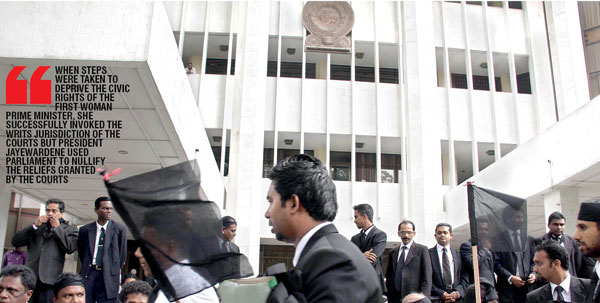
Men were allowed to study law and medicine and not women. The churches and the public were hostile to women practising these professions. Law offered many difficulties. Training was in private offices and the societies did not encourage it at all and they were not allowed to practise the profession. After a strenuous fight, Myra Bradwell was able to practise in 1872 when Illinois brought legislation to remove sex disqualification. Though Bella Lockwood was admitted to the Supreme Court of the District of Columbia (1873) she was denied the right to practise in the Supreme Court of United States till legislation was passed in 1879.
The modern freedom for women in Great Britain commenced with the introduction of the legislation of Married Women Property Act, 1882. The Sex Disqualification (Removal) Act 1919 opened to them many professions hitherto before closed to them.
" The judgment on the interpretation of the cross-over of UNP Members had greatly divided and weakened the UNP, making one strong arm of UNP to support the Government while the others formed the Opposition, crawling hard to stand up to show its strength as a strong Opposition Party. The judgment in regard to 18TH Amendment had exalted the office of the President with the paraphernalia of state power "
Sri Lanka
In Sri Lanka, prior to the introduction of the Sex Disqualification Removal (Legal Profession) Ordinance No. 25 of 1933, the fair sex was not permitted to be admitted or enrolled as an Advocate or as a Proctor or as a Notary or as a Commissioner for Oaths.
Section 2 of this Ordinance states: “A woman shall not be disqualified by reason only of her sex – (a) from being admitted and enrolled, or from practising, as an Advocate or as a Proctor; or (b) from being authorized to practise as a Notary by a warrant issued under the provisions of the Notaries Ordinance, or from practising or functioning as a Notary under the provisions of that Ordinance or of any other written law; or (c) from being appointed, or from functioning, or as a Commissioner for Oaths under the provisions of the Oaths Ordinance.
Constitution and Lawyers
In Sri Lanka, the Constitution ordains that the Supreme Court shall admit and enroll Attorneys-at-law. An Attorney-at-law has to subscribe oath or affirmation in the same and identical terms as the oath or affirmation required to be taken by the President, Ministers, Judges and other officials of the State. Thus, the legal profession is accorded with an exalted position and privilege in the Constitution.
The legal profession is divided into two branches, the Unofficial Bar and the Official Bar. The Official Bar is headed by the Attorney General who is the head of the Attorney General’s Department which is manned by lawyers. The Attorney General and his deputies shall examine every Bill and give his opinion to the President, Speaker, Ministers. All indictments and other incidental and connected steps would be taken under his name and he advises the police in their investigations into crimes. Thus, the powers and functions of the Attorney General are manifold.
Thus, the Legal profession becomes an essential part of the administration of justice and for the preservation and protection of the independence of judiciary. No other profession is given such an important role in the Constitution. The guideline principles of the legal profession are blended to further the welfare of the nation, democratic practices and to uphold the cause of justice without fear or favour, affection or ill-will.
Today, the lawyers stand divided on the issue of the impeachment of the Chief Justice, Dr. Shirani A. Bandaranayake but all, without exception, believe in democratic process, the independence of judiciary, principles of natural justice, rule of law and fairness in holding any inquiry though degree of conviction and firmness may be at variance among them. Lawyers prosecute and defend conspirators and no lawyer was ever indicted for conspiring, aiding and abetting to overthrow a government. A well trained lawyer shall never be a party to such a dastardly and anti-national act. They will always uphold the cherished and noble principles of the legal profession.
" In Sri Lanka, the Constitution ordains that the Supreme Court shall admit and enroll Attorneys-at-law. An Attorney-at-law has to subscribe oath or affirmation in the same and identical terms as the oath or affirmation required to be taken by the President, Ministers, Judges and other officials of the State. Thus, the legal profession is accorded with an exalted position and privilege in the Constitution "
78 Constitution
President Jayewardene had long, long political ambitions. Upon the promulgation of the ‘78 Constitution, he dreamt to banish SLFP and its leftist partners to political obscurity and the UNP to rule the country for many, many years without interruption. He wanted himself to become similar to a British King of the 16TH century and enjoy absolute power. Accordingly, he made the President above and beyond the reach and control of the Parliament and the Courts.
The President’s unconstitutional or illegal commissions or omissions could only be remedied by Impeachment Resolution but its procedure for such removal was made untenable with entrenched safeguards against removal. An astute President could easily mangle the entire process by necessary manoeuvring.
Whilst President Jayewardene opted to show the world that he was a protagonist of the immutable principles representative democracy by assuring to the country freedom, equality, justice and the independence of judiciary, he made sambar out of his perception of his own theories of government with those of Great Britain, American and French systems of government and made the President omnipotent with maximum, untrammelled state power. In the process, he made a topsy turvy constitution, inherent in itself a process to subvert the democratic form of government to despotism.
A ruler would prefer to have his own lawyer with docile character as the Chief Justice to execute all his political wishes without a word of demur. President Jayewardene made Neville Samarakoon, Q.C. the Chief Justice while the present Government made Dr. Shirani A. Bandaranayake the Chief Justice, unmindful of the reality that Lawyers could be retained to advocate one’s cause but not judges. Judges are a different class of persons. They have not failed to demonstrate independence and courage whenever a demand arose.
When and where situation demanded some of the judges had risen up to uphold the independence of judiciary while some of them had by their judgments conferred enhanced power on the legislature and the executive and reduced the power of the courts.
President Jayewardene with his massive majority and the resignations of Members of Parliament in his pocket could not impeach Neville Samarakoon CJ as the then PSC was presided by Lalith Athulathmudali, a President of the Oxford Union and a dedicated teacher of jurisdiction. He possessed a profound and deep knowledge of law and practice and was a strong believer of rule of law and independence of judiciary. He conducted the PSC proceedings under the impugned Standing Order 78A with dignity and honour and applied fair and objective procedure to ensure fairness at all stages of the inquiry.
When steps were taken to deprive the civic rights of the first woman Prime Minister, she successfully invoked the writs jurisdiction of the Courts but President Jayewardene used Parliament to nullify the reliefs granted by the Courts. The fate of the reliefs granted by the Courts to the first woman Chief Justice was frustrated by the might of Parliament and it rendered the impeached Chief Justice to proclaim that “I am totally innocent of all charges and had there been a semblance of truth in any allegation, I would not have remained even for a moment in the august office of the Chief Justice”.
" In this scenario, apprehension is lurking in the political horizon that even a most pious and honest democrat could transform himself into a despot. Therein lies the greatest danger "
The judgment on the interpretation of the cross-over of UNP Members had greatly divided and weakened the UNP, making one strong arm of UNP to support the Government while the others formed the Opposition, crawling hard to stand up to show its strength as a strong Opposition Party. The judgment in regard to 18TH Amendment had exalted the office of the President with the paraphernalia of state power.
Everyone, whether a Member of Parliament or a Judge or a lawyer may be in one way right, and in another way wrong but the debate on the procedure of removing the Chief Justice had shaken the confidence of the people in the administration of justice. Above all, the fully and completely controlled legislature and the subservient and docile judiciary are made to sail in the direction to accord with the wish of the President. There is no Opposition Party capable of taking the reign of power for many, many years. In this scenario, apprehension is lurking in the political horizon that even a most pious and honest democrat could transform himself into a despot. Therein lies the greatest danger.