Reply To:
Name - Reply Comment
.jpg) As we know, there are two established methods of reading – on the lines and between the lines. The latter method is often useful when it comes to reading official reports and statements, as well as the bulk of contemporary Sri Lankan journalism.
As we know, there are two established methods of reading – on the lines and between the lines. The latter method is often useful when it comes to reading official reports and statements, as well as the bulk of contemporary Sri Lankan journalism.
Generally speaking, reports by archaeologists do not need to be read between the lines. Archaeology has been described as a guessing game. It’s better described as an educated guessing game, because an educated person’s guess should be closer to facts than that of someone uneducated (though there could always be exceptions to this rule, such as the uncanny ability of the villager, or the fisherman, to predict the weather while a PhD on vacation remains clueless, but that is an exception).
In this educated guessing game, archaeologists have the aid of science and advanced technology, along with time-tested psychological processes such as deduction. In this, they have something in common with detectives, pathologists, surgeons, historians (and spouses. In the latter case, it’s known as smelling a rat). Whether you are opening up muscle tissue, digging a grave or somebody’s past, you will need sound working methods, reliable technology as well as an alert mind capable of rational thinking and deduction (along with some luck) to work out who put what into that grave, as well as when and why.
The technology available to a contemporary archaeologist is much greater to what, for example, Sir Mortimer Wheeler had at his disposal in Mohenjodaro and Harappa, or what Howard Carter had to do with in Egypt. It’s hard work, sometimes risky, but the results can even be glamorous. One does not envy, just the same, the lot of our archaeologists entrusted with the task of digging up burial sites.
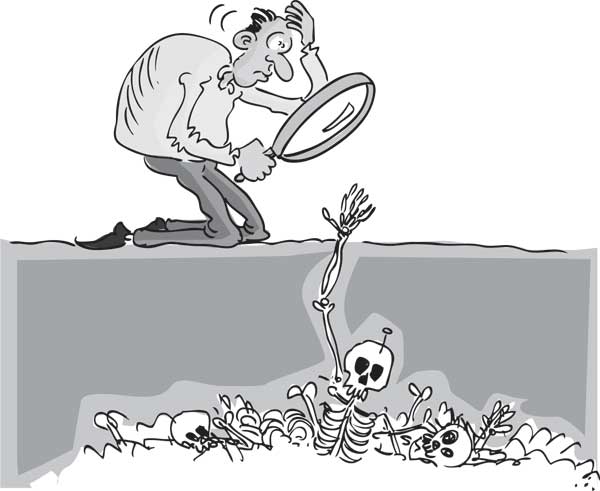
Archaeology in Sri Lanka is hardly glamorous. One can see this from the column written by Dr. Raja Somadeva, of the post-graduate Institute of Archaeology at the University of Kelaniya, to the Ravaya newspaper last week. It contains much scientific information as to how a dig should be conducted, hence is very interesting. But the real interest lies in what is said between the lines. As such, his column is a classic piece of writing which establishes salient truths about how Lankan professionals must live, work and protect themselves from official wrath while trying to find a convenient word which will describe a spade without actually calling it a spade.
Opening up Tutenkhamen’s tomb is one thing. Digging into a mass grave is another. The writer begins by saying that he and his team began work at the Matale hospital mass grave only because of a request by the court. The work was hampered by the fact that the burial remains (a better term, in this context, than skeletons) had already been disturbed by unskilled diggers.
Nevertheless, the archaeologists were able to determine that the grave could not be older than 1987, or more recent than 1990, on the basis of two ‘artefacts,’ – a piece from a plastic bottle manufactured in 1986, and a medicine container manufactured in 1988 (the British manufacturer stopped this manufacture in 1989). They were in two different layers separate from the skeletal remains, above and below them, giving the archaeologists a clue as to the grave’s probable age.
So much for the archaeological aspects of the Matale mass grave, which are totally eclipsed by its political aspects. I mentioned earlier the very useful psychological tool of deduction – used in science, in Sherlock Holmes and Hercule Poirot stories, real life detective work, and by people wronged in love etc. to get to the ‘heart of the matter.’ Deduction works at two levels – logic based on theory and knowledge, and the all-important quality of intuition. Sometimes, it’s as simple as putting two and two together. The trouble is that, in a real life or fictional mystery, two and two may be all but invisible though laid out there plainly to see. You see it but you don’t know what it means.
" The university professor points out that iron nails were discovered alongside bone fragments (if anyone’s ready to believe that this is a bronze age burial ritual, let’s bear in mind that iron didn’t exist in the bronze age). We don’t really need to waste tax payers’ money on doing Carbon-14 tests. It’s well known that captives were tortured with nails hammered into their bodies "
When I first heard about the Matale mass grave in the news, I immediately began to put two and two together. I admit that this was totally unscientific. But it was logical. I even arrived at its probable time span without painstaking analysis. These remains undoubtedly belong to some of the thousands of young people, many of them (though not all) JVP activists dedicated to overthrowing the government and destroying democracy (such as it existed in 1987-90), who died during horrible torture by clandestine military and paramilitary groups.
The university professor points out that iron nails were discovered alongside bone fragments (if anyone’s ready to believe that this is a bronze age burial ritual, let’s bear in mind that iron didn’t exist in the bronze age). We don’t really need to waste tax payers’ money on doing Carbon-14 tests. It’s well known that captives were tortured with nails hammered into their bodies.
Now that a presidential commission has been proposed on the above, that’s the best indication where all this is heading. Successive governments have succeeded in seriously damaging our democracy, which was what the JVP-DJV terrorism tried to do. There is no doubt that some of those piled into this grave did horrible things themselves. But that’s where we need law and order, which is achieved via the courts, and not in torture chambers.
The worst aspect is that when mentally unbalanced, sadistic individuals are given a carte blanche to wipe out terrorism, no one is safe. People who have nothing to do with terrorism too, become victims. Richard de Zoysa comes immediately to mind, because he was not a nameless victim unlike those in the Matale grave. He was killed because he was a human rights activist. But the story that he was a high-ranking JVP member was popularised to justify the murder. He had friends and acquaintances in the JVP, like almost everyone else in the country. But that doesn’t make him a terrorist and in no way justifies being brutally beaten to death at a Colombo seaside location which is now a popular venue for expensive dinners.
I don’t want to end up in someone’s mass grave several years hence, just because I have spoken out for other people’s rights (which are my rights, too, even though we may not share the same world views and goals). You don’t need to be the Oracle of Delphi to see them coming. This is why some kind of trial and deterrent is needed as a warning to those who commit horrible crimes to ‘safeguard democracy.’ Sadly, I see no sign of that now or in future. We have no right to call ourselves a civilised country if we have now mentally accepted this pattern – once every generation, thousands will rebel against unjust governments. The rebellions will be crushed brutally with summary executions, and law and order handed over to clandestine death squads. It doesn’t matter if these mass graves are found in Matale or Kokkadicholai – this pattern must stop if we are to call ourselves civilised. Our immediate neighbours India and Pakistan have better records in this regard, despite the fact that India is fighting three separatist movements as well as Islamic terrorism, and Pakistan has been under military rule for nearly half the time since its creation.