Reply To:
Name - Reply Comment

There have been rumblings against Sri Lanka in the South Indian state of Tamil Nadu in recent weeks resulting in several Lankan establishments being damaged and several persons including Buddhist monks being assaulted.
This is believed to be part of the build-up to the sessions of the United Nations Human Rights Council (UNHRC) where Eelam lobbyists are working overtime to tarnish Sri Lanka’s image. Their sentiments have found ready resonance in Tamil Nadu, home to some 60 million Tamils.
Wading into this controversy head first is Tamil Nadu’s eighty -eight year old former Chief Minister Muthuvel Karunanidhi. The octogenarian’s Dravida Munnetra Kazhagam (DMK) may be out of power in Tamil Nadu but is an ally of the ruling Congress -led coalition.
On Tuesday, Karunanidhi announced that he was withdrawing the support that his eighteen parliamentarians gave to Prime Minister Manmohan Singh. It was, he said, as a result of Singh not doing enough to “protect Sri Lanka’s Tamil population”.
“The DMK has always worked for the Tamils and has been demanding a tough stance against the Sri Lankan government over war crimes against Tamils”, Karunanidhi said, announcing his decision. He said he felt let down by the lukewarm response of the central government.
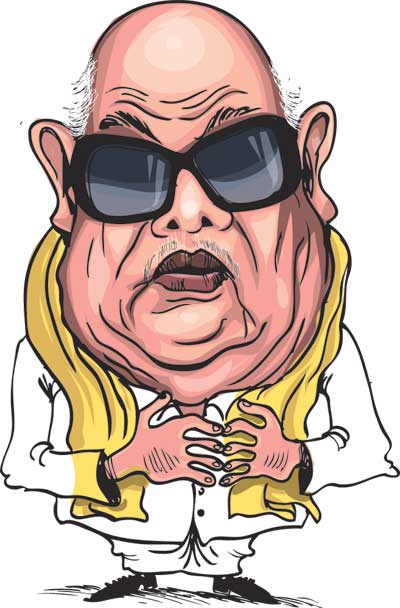 Karunanidhi’s stance does not sound the death knell for Singh’s government which can survive with the support of other minority parties. However, such political high jinks are nothing new to Karunanidhi.
Karunanidhi began life as a screen writer for the vibrant film industry in Tamil Nadu. Ironically, among those actresses who shot to fame reading his lines was Jayalalithaa Jayaram, later to become his political nemesis.
Karunanidhi is somewhat of an institution in Tamil Nadu. It is said that he entered politics at the age of fourteen. A strong Tamil nationalist, he has been the leader of the DMK for the past forty three years and has been elected Chief Minister five times.
Karunanidhi also holds the record of winning his seat in every election in which he has participated, in a political career spanning more than 60 years. As he advances in years, his daughter Kanimozhi is set to follow in her father’s footsteps in the political arena.
Lately however, Karunanidhi has been forced to play second fiddle to Jayalalithaa, who wrested control of the Tamil Nadu state. However, he remains in the limelight because of his often vocal support to Prime Minister Singh.
It will be recalled that during the long years of the armed conflict with the Liberation Tigers of Tamil Eelam (LTTE) Karunanidhi was a key figure, playing godfather to the then budding Tiger cubs. He was not shy to admit this either.
The interim report of the Jain Commission, which oversaw the investigation into Rajiv Gandhi’s assassination, indicted Karunanidhi for abetting the LTTE. The interim report recommended that Karunanidhi and the DMK be held responsible for helping Gandhi’s assassins.
The final report however contained no such allegations and Karunanidhi was free to carry on with his political career. Later however he publicly declared that India would not forgive the LTTE for assassinating Gandhi.
Playing sponsor and benefactor to the Tigers was a strategy that enabled him to appear as the saviour of Tamils and garner votes in state elections in Tamil Nadu. On more than one occasion, Karunanidhi cleverly played the Tiger card to become Chief Minister.
This was a tactic that Karunanidhi’s arch rival in Tamil Nadu for decades, Jayalalithaa, did not take kindly to. The result was a contest between the two to woo the Tigers, so they could reap the political dividends in their state.
That left Sri Lanka in a perilous state with successive state governments in Tamil Nadu aiding and abetting the LTTE in their campaign of terror. To date, the animosity between Chennai and Colombo has remained-and Karunanidhi has played a major role in this conflict.
It didn’t help Colombo to find Karunanidhi in the Chief Minister’s seat in Tamil Nadu in 2009 when the final battle of the Eelam war was being staged in the murky waters of Nanthikadaal. Karunanidhi did his utmost to support the Tigers and win international sympathy for them.
That he failed is history. Also, the annihilation of the LTTE played a significant role in his ouster from state power in elections held two years later. As expected, Jayalalithaa played the “he didn’t do enough for the Tamils” card with good effect.
Since the conclusion of the war, there has been little room for Karunanidhi to intervene directly in Sri Lanka’s affairs. That hasn’t however stopped him from trying to influence New Delhi’s policies towards Colombo and trying to exploit its differences of opinion to his advantage.
Karunanidhi has persistently-if unconvincingly-claimed that Tamil civilians had been subjected to discrimination in post-war Sri Lanka, a claim also made by Jayalalithaa. Again, the duo are trying to outdo each other in whipping up anti-Sri Lanka rhetoric.
Karunanidhi’s stance of withdrawing from the Congress led the coalition to suggest a political stunt rather than a serious statement of intent. There is every chance that he will return to the fold after a couple of reassurances and placating statements from New Delhi.
It also came as a surprise because there was every indication that India would vote against Sri Lanka when the resolution at the UNHRC was put to a vote. Cynics would argue that Karunanidhi was merely trying to steal Jayalalithaa’s thunder and hog the headlines in the national media.
New Delhi, already set on a collision course with Colombo, is extremely unlikely to adopt a more hard-line strategy at the UNHRC, just to appease Karunanidhi. Rather, .jpg) it would be wary of rising communal tensions in Tamil Nadu, given the volatile nature of politics in that state.
it would be wary of rising communal tensions in Tamil Nadu, given the volatile nature of politics in that state.
Muthuvelu Karunandhi is on the wrong side of eighty but his words and deeds still pack a punch in the streets of Tamil Nadu. Like him or loathe him, that is why Sri Lanka needs to be wary of him. Certainly, Sri Lankans will hear more from this wily old politician in the days to come.