AI SUMMARY GENERATED ONLY FROM THIS ARTICLE'S TEXT.
Obstinacy pays the price?
By Gamini Akmeemana
The 19th century printing press which belongs to the Ranwella Purana Viharaya in Kataluwa, has been badly damaged in a fire. The loss to the country’s cultural heritage thereby is immeasurable.
For anyone doubting that statement, this German-made Gutenberg-type printing press was used to produce Lankalokaya, one of the pioneer Sinhala journals. The money to buy it came chiefly from a donation by the Crown Prince (or King) of Thailand, who also donated a valuable collection of books and marble Buddha statues. Many of these priceless statues too, have been destroyed in last Tuesday’s fire.
When I first heard about this printing press, I immediately began to worry about this prospect, and now this fear has come true. The country’s five presidents and four governments since then (I haven’t counted the number of ministers of culture, museum directors and archaeological commissioners) but no one has had the sense to acquire the Lankalokaya press and put it on display at the National Museum.
According to the Department of Archaeology, it had once requested the handover of the historic press, but was denied the request. When asked about this, chief incumbent Ven. Galagama Sugathawansa had said very firmly that the press belonged to the temple and would not be handed over to anyone for safekeeping
. If the authorities were keen on restoring it, the monk added, they were welcome to do that at the temple premises.
But the temple itself is largely destroyed, with most of its roof gone, and what remains of the press and other damaged objects will be at the mercy of sun and rain in the foreseeable future. Even if this problem is solved without delay, it’s hard to see how this small temple with its two monks (the other is even older than the chief incumbent) can shoulder the responsibility of protecting and maintaining the press any further (most of the other items of historical interest, including the movable typefaces of lead used for printing, having been destroyed in the fire).
The temple is situated near Koggala, away from the main Matara-Colombo highway. The neighbourhood looks and feels like backwater. Though the temple has a committee (dayaka sabha) it doesn’t seem to have much say in anything. A neighbour who declined to be named said the chief incumbent was difficult to deal with, and that the temple committee even had to lodge a complaint with the police to get a safe opened when it was found out that termites were damaging the books inside it.
Given this state of affairs, it’s up to the government to intervene, remove the damaged press to a museum, and oversee its restoration. Cynics will point out that nothing is safe even inside the National Museum. But the press is simply too big and heavy to be stolen, and it’d be of no interest to a thief except as scrap iron (how good the museum’s fire-fighting system, if it has one, is another matter, but the city fire brigade is available in case of fire).
The best account of this press’ history comes from the first volume of the monumental nine-volume ‘Sinhala Puwathpath Sangara Ithihasaya’ (History of Sinhala journalism) by the late Rev. Kalukondayawe Pannasekara. According to it 's history, though popularly known as the Lankalokaya Press, the printing of Lankalokaya newspaper wasn’t started at this temple (Lankalokaya is the first Sinhala newspaper published in this country, though the first publication to be registered as a Sinhala newspaper was Lakminipahana (on Sept. 11 1862). Lankalokaya, on the other hand, was started in June 1860 by someone called W. Easton. A bimonthly, it ceased publication within a year.
Subsequently, considering the fact that Buddhists did not own a printing press at the time, Rev. Bulathgama Siri Dammalankara Sumanathissa took the lead in starting a Buddhist press in 1861. This led to the establishment of Lankopakara press in July 1862 at the Paramananda Viharaya in Galle. The money for this came chiefly from the royal family of Thailand, which donated 212 British pounds and 10 shillings for the task. The press was moved to its present location after Rev. Sumanatissa passed away.
The Lankalokaya was revived as a newspaper on Aug. 4 1886, and it may have been this revival which led to the press being known locally as the Lankalokaya press.
This beautiful cast-iron machine looks more like a work of art than an industrial product, art-nouveau in style with floral metalwork on its frame and with the characteristic griffin, heraldic animal of the printers’ guild, on its upper bar. It has stood the vicissitudes of time for over 150 years but its fate now looks very uncertain unless the government acts firmly to protect it.
Comments - 0
Comments - Lankalokaya press damage a loss to cultural heritage
222
Add comment
Comments will be edited (grammar, spelling and slang) and authorized at the discretion of Daily Mirror online. The website also has the right not to publish selected comments.



_DM-8re.jpg) By Gamini Akmeemana
By Gamini Akmeemana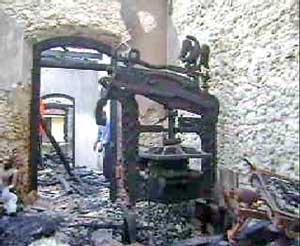 When I first heard about this printing press, I immediately began to worry about this prospect, and now this fear has come true. The country’s five presidents and four governments since then (I haven’t counted the number of ministers of culture, museum directors and archaeological commissioners) but no one has had the sense to acquire the Lankalokaya press and put it on display at the National Museum.