Reply To:
Name - Reply Comment
(1).jpg) By Jonathan Power
By Jonathan Power
Is South Africa going to tumble from the sky like some out-of-control aeroplane? It is beginning to look like it. Ex-president, Nelson Mandela, who sacrificed a good part of his life in jail to liberate it, must be wondering, and doubtless is full of grief. What is worse for South Africa is that it happens concurrently with the rest of Black Africa’s economic take-off. Present's forecasts suggest that Nigeria in a few years’ time will overtake South Africa to be sub-Sahara’s largest economy.
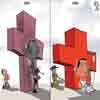
Archbishop Desmond Tutu, a great non-violent freedom fighter, summed it up well: “The gravy train stopped at the station just long enough for the whites to get off and the black elite to clamber on.”
The black elite, or much of it, has been favoured- not only by being given fast-track promotion (which in many cases was the right thing to do), but also by being offered shares and stock in companies at knock down prices, by being taken onto company boards, by favourable bank loans to buy companies and by priority in government projects and, most undermining of all, by sweetheart deals.
This elite show too little concern for the masses who often live in urban squalor or in impoverished villages. The promised advance in education, health clinics and so on has not been realised, although on housing the government has made some noticeable progress. Pay levels have barely kept up with the rising cost of living. Economic growth creeps along. Unemployment among youth is extraordinarily high. It is no surprise the mine workers continue their strikes.
Little spoken about is the crisis in land ownership. Without land reform as a priority the 40 per cent who live in the countryside have little chance of improvement unless they move to the overloaded towns where perhaps there is at least a job if they scramble hard enough.
" As in Zimbabwe the South African leadership made big promises but they are unfulfilled. Not surprisingly there are agitators demanding the South African government to seize white land and ignore the carefully worded compromises made in the negotiations that preceded the end of white rule- whereby white farmers could voluntarily be bought out by the government at market prices "
.jpg)
It was lack of the much promised land reform in Zimbabwe that started the economic decline there. Only after 20 years of peasant failure did the government get round to it- and then in the most counterproductive way-confiscating prosperous white-owned farms which made the country self-sufficient in food and then settling blacks on their land but without any back up with teachers of modern farming methods, easy-to-get cheap credit, improved seeds and fertiliser. The haemorrhage of the exodus was not stemmed and the towns are overloaded. The villagers were deprived of their best and brightest. Zimbabwe is now an economic basket case.
Land reform is the best way of reducing the tide of migrants and of bringing adequate incomes to half the population as well as cutting down the expensive imports of food.
As in Zimbabwe the South African leadership made big promises but they are unfulfilled. Not surprisingly there are agitators demanding the South African government to seize white land and ignore the carefully worded compromises made in the negotiations that preceded the end of white rule- whereby white farmers could voluntarily be bought out by the government at market prices.
In South Africa only 8 per cent of the land has been redistributed, compared with the 30% promised by the end of five years of black rule.
The government has under-funded land reform. The Land Redistribution Commission has had to place a moratorium on buying land because it has run out of money. The government has failed to aid the beneficiaries of land reform by offering cheap credit and skill training in modern farming techniques. Farmers are not being given basic irrigation and sufficient electricity supplies. Besides, the idea of giving a whole white farm to a black “community” à la Soviet Union has not worked. What are needed are more independent small-holders. The World Bank has shown from its world-wide research that such farms produce more per acre than big farms.
Meanwhile the great inequality of land owning persists-whites own 75 per cent of the land while constituting less than 10 per cent of the population. The black bourgeoisie, especially well-to-do government hierarchy members, as in Zimbabwe, are buying out white farmers.
( This elite show too little concern for the masses who often live in urban squalor or in impoverished villages. The promised advance in education, health clinics and so on has not been realised, although on housing the government has made some noticeable progress )
Where will it end? Where will the gathering urban unrest and rural discontent lead to?
President Jacob Zuma does not appear to recognise the dangers ahead. During the miners’ strike he has made only anodyne remarks. His idea of rural development appears to be limited to building a large scale compound for himself in his home village. There is little sign that resources are being re-directed either to the urban slums or to agricultural development. An unnecessary defence budget has been grossly enlarged, creaming off funds needed for rural and urban slum development, despite the country having no external enemies and no likelihood of any. But arms purchases did provide backhanders for powerful ANC government members including, it has been alleged, the president himself.
Is South Africa digging its own grave? That is the question.