AI SUMMARY GENERATED ONLY FROM THIS ARTICLE'S TEXT.
The Indian judiciary is an important organ of our state and commands considerable respect from the people of India for dispensing justice impartially. The independence and integrity of the members of the judiciary has always been a crucial element in the functioning and maturing of our democracy. However, sporadic allegations of corruption, sleaze, nepotism and misbehaviour involving the Judges of the higher judiciary have threatened to lower the prestige of the judiciary. In the recent past, the subject of impeachment of a Judge captured national attention in India and stirred a debate in the wake of the recommendation of the Chief Justice of India for the removal of Justice Soumitra Sen, a sitting Judge of Calcutta High Court. Against this backdrop, it would be worthwhile to look into the constitutional provisions and the procedural developments that have taken place in the legislature with regard to the impeachment of Judges.
CONSTITUTIONAL PROVISIONS
The Constitution of India contains certain provisions for the removal of a Judge from his office and regulation of the procedures thereof. The Constitution provides that a Judge of the Supreme Court or of a High Court may, by writing under his hand addressed to the President, resign his office, but he cannot be removed from his office except by an order of the President passed after an address by each House of Parliament in the prescribed manner.
The Constitution further provides for a “method” and “grounds” on which a Judge of the higher judiciary is to be removed which is as under:
“A Judge of the Supreme Court shall not be removed from his office except by an order of the President passed after an address by each House of Parliament supported by the majority of the total membership of that House and by a majority of not less than two-thirds of the members of that House present and voting has been presented to the President in the same session for such removal on the ground of proved misbehaviour or incapacity.”
It can thus be inferred from this provision that the Constitution enjoins the following pre-conditions for the removal of a Judge of the Supreme Court:
a Judge of the Supreme Court shall be removed only by an order of the President;
it should be after presentation of an Address by each House of Parliament;
the Address should be supported by a special majority;
the Address should be presented to the President in the same session; and
removal has to be on the grounds of “proved” misbehaviour or incapacity.
Further, the Constitution stipulates that “the Parliament may by law regulate the procedure for the presentation of an address and for the investigation and proof of the misbehaviour or incapacity of a Judge[3].
THE JUDGES (INQUIRY) ACT, 1968
The Judges (Inquiry) Bill, 1964 was formulated, laying down the procedure as contemplated by the above provision of the Constitution and the Bill was referred to a Joint Committee of the two Houses. After elaborate discussion before the Committee, in which eminent Members of Parliament and the then Attorney General and former Attorney General gave their evidence, the Joint Committee gave its report on 13 May 1966. The recommendations of the Committee were taken into account and The Judges (Inquiry) Act, 1968 was passed prescribing the procedure for the investigation and proof of misbehaviour and incapacity of Judges of the Supreme Court, including the Chief Justice of India, the Chief Justices and Judges of the High Courts.
Procedure laid down in the Act:
Under the procedure laid down in the Act, a notice of a motion for presenting an Address to the President for the removal of a Judge, if given in the Rajya Sabha (Upper House of the Indian Parliament), is to be signed by not less than fifty members of the House and, if given in Lok Sabha (Lower House), by not less than one hundred members of that House. The Chairman or the Speaker, as the case may be, after due consideration and consultation, may admit or refuse to admit the motion.
Consequent on the admittance of the motion, the Chairman or the Speaker, as the case may be, will constitute a Committee of three members, one each from (i) the Chief Justice and other Judges of the Supreme Court; (ii) Chief Justices of the High Courts; and (iii) distinguished jurists. In case the notices of motion are given on the same day in both the Houses, the Committee will be constituted only if the motion has been admitted in both the Houses and thereupon jointly by the Chairman and the Speaker. In case notices of motion are given in both the Houses on different dates, the notice which is given later shall stand rejected.
The Committee will frame definite charges against the Judge on the basis of which investigation is proposed to be held and will have the powers of a Civil Court in respect of summoning persons for examination on oath, production of documents, etc. In a case of alleged physical or mental incapacity and where such an allegation is denied, a Medical Board will be appointed for the medical examination of the Judge by the Chairman or the Speaker, as the case may be, or, where the Committee has been constituted jointly, by both of them.
At the conclusion of the investigation, the Committee will submit its report to the Chairman or, as the case may be, to the Speaker, stating therein its findings on each of the charges separately with such observations on the whole case as it thinks fit. The report will, thereafter, be laid before the respective House or the Houses, if the Committee has been appointed jointly by the Chairman or the Speaker.
If the Committee absolves the Judge of any misbehaviour or incapacity, the motion pending in the respective House or Houses, as the case may be, will not be proceeded with. If the report of the Committee contains a finding that the Judge is guilty of any misbehaviour or suffers from any incapacity, the motion will, together with the report of the Committee, be taken up for consideration by the House or the Houses in which it is pending.
In the event of the adoption of the motion in accordance with the constitutional provisions, the misbehaviour or incapacity of the Judge will be deemed to have been proved and an Address praying for the removal of the Judge will be presented in the prescribed manner by each House of Parliament in the same Session in which the motion has been adopted.
INSTANCES OF IMPEACHMENT
After the passing of The Judges (Inquiry) Act, 1968 a notice of a motion for presenting an address to the President for the removal of a Judge of the Supreme Court was given in Lok Sabha by 199 members on 15 May 1970. However, the Speaker did not consider it to be a fit case for action under The Judges (Inquiry) Act, 1968 and did not admit the notice[5].
So far judicial enquiry or impeachment motion has been initiated only against three Judges in India. The first such case involved the impeachment motion in Lok Sabha of Justice V. Ramaswami of the Supreme Court in May 1993 on charges relating to gross abuse of his financial and administrative powers as the Chief Justice of the Punjab and Haryana High Court and criminal misappropriation of property. However, the impeachment motion was defeated as it could not garner a special majority in the House as required.
The second case involved Justice Soumitra Sen of the Calcutta High Court whose removal from office was sought on two grounds by the following motions: (i) misappropriation of large sums of money in his capacity as the receiver appointed by the High Court of Calcutta; and (ii) misrepresentation of facts with regard to this misappropriation of money before the High Court of Calcutta. The Upper House voted in favour of his impeachment by 189 votes in favour and 16 votes against, first by a voice vote and then through division. The motion for his impeachment was to come up in the Lower House[6].
However, Justice Soumitra Sen sent in his resignation as a Judge of the Calcutta High Court to the President of India, with a copy to the Speaker, Lok Sabha, before his impeachment proceedings could begin in the Lok Sabha. The message relating to the decision of the Lok Sabha not to proceed with the matter was reported in the Rajya Sabha on 6 September 2011[7]. Thereafter, the impeachment motion lapsed.
The third case involved Justice P. D. Dinakaran, Chief Justice of the Karnataka High Court, against whom charges of corruption were made. The Chairman, Rajya Sabha, set up another Inquiry Committee on 15 January 2010, to investigate into the grounds on which his removal was sought for. However, before the Committee could complete its investigation and submit its Report, the concerned Judge submitted his resignation on 29 July 2011 by addressing a letter to the President of India. In view of this, the notice of motion praying for presenting an Address to the President became infructuous and the Chairman, Rajya Sabha, brought the work of the Inquiry Committee to a close. A Notification and a Parliament Bulletin Part-II were issued in this regard. To be contd.,
Comments - 0
Comments - Impeachment of a Judge in the Indian Parliament
222
Add comment
Comments will be edited (grammar, spelling and slang) and authorized at the discretion of Daily Mirror online. The website also has the right not to publish selected comments.



.jpg) The Indian judiciary is an important organ of our state and commands considerable respect from the people of India for dispensing justice impartially. The independence and integrity of the members of the judiciary has always been a crucial element in the functioning and maturing of our democracy. However, sporadic allegations of corruption, sleaze, nepotism and misbehaviour involving the Judges of the higher judiciary have threatened to lower the prestige of the judiciary. In the recent past, the subject of impeachment of a Judge captured national attention in India and stirred a debate in the wake of the recommendation of the Chief Justice of India for the removal of Justice Soumitra Sen, a sitting Judge of Calcutta High Court. Against this backdrop, it would be worthwhile to look into the constitutional provisions and the procedural developments that have taken place in the legislature with regard to the impeachment of Judges.
The Indian judiciary is an important organ of our state and commands considerable respect from the people of India for dispensing justice impartially. The independence and integrity of the members of the judiciary has always been a crucial element in the functioning and maturing of our democracy. However, sporadic allegations of corruption, sleaze, nepotism and misbehaviour involving the Judges of the higher judiciary have threatened to lower the prestige of the judiciary. In the recent past, the subject of impeachment of a Judge captured national attention in India and stirred a debate in the wake of the recommendation of the Chief Justice of India for the removal of Justice Soumitra Sen, a sitting Judge of Calcutta High Court. Against this backdrop, it would be worthwhile to look into the constitutional provisions and the procedural developments that have taken place in the legislature with regard to the impeachment of Judges.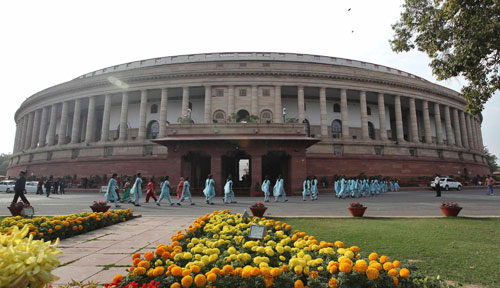 The Judges (Inquiry) Bill, 1964 was formulated, laying down the procedure as contemplated by the above provision of the Constitution and the Bill was referred to a Joint Committee of the two Houses. After elaborate discussion before the Committee, in which eminent Members of Parliament and the then Attorney General and former Attorney General gave their evidence, the Joint Committee gave its report on 13 May 1966. The recommendations of the Committee were taken into account and The Judges (Inquiry) Act, 1968 was passed prescribing the procedure for the investigation and proof of misbehaviour and incapacity of Judges of the Supreme Court, including the Chief Justice of India, the Chief Justices and Judges of the High Courts.