Reply To:
Name - Reply Comment
CONTD FROM LAST WEEK THE CASE OF JUSTICE SOUMITRA SEN
.jpg) Under article 124(4) of the Constitution, notice or notices of Motion with supporting documents, and signed by not less than 50 Members of Rajya Sabha is/are submitted to the Chairman, Rajya Sabha, praying for removal of a Judge of High Court/Supreme Court. The file is put up for orders of the Chairman under section 3(1) of the Act, who after consultation and consideration either may admit the Motion or refuse to admit the same.
Under article 124(4) of the Constitution, notice or notices of Motion with supporting documents, and signed by not less than 50 Members of Rajya Sabha is/are submitted to the Chairman, Rajya Sabha, praying for removal of a Judge of High Court/Supreme Court. The file is put up for orders of the Chairman under section 3(1) of the Act, who after consultation and consideration either may admit the Motion or refuse to admit the same.
If the Chairman admits the motion, a para in Rajya Sabha Bulletin Part-II is published to this effect for information of Members. The process of constitution of a Committee under section 3(2) of The Judges (Inquiry) Act, 1968 is also initiated immediately. The Chairman may seek from the Chief Justice of India, a panel of the names of Judges of the Supreme Court and Chief Justices of High Court, from amongst whom he may choose one name each for the constitution of the Committee. The name of an eminent jurist, as the third Member of the Committee, is chosen by the Chairman, Rajya Sabha himself.
As and when the Committee is constituted, a notification in the Gazette of India, Extraordinary, Part-II and a Parliamentary Bulletin Part-II are issued to that effect (Annexures I & II). A note is sent to the Department of Justice for information about the constitution of the Committee and requesting that Department to issue Presidential Requests in respect of the serving Judges who are members of the Committee so as to enable them to work in the Committee (Annexure III). Another note is sent to the Department of Legal Affairs requesting them to make the necessary budgetary provisions to meet the expenses of the Committee as laid down in Rules 14 and 15 of the Judges (Inquiry) Rules, 1969 (Annexure IV).
Once the Department of Justice obtains the Presidential Request and intimates the same (Annexure V), letters are issued to the Judge members of the Committee as also to the eminent Jurist, signed by the Secretary-General, informing them about the constitution of the Committee and their appointment to work as Members of the Committee (Annexure VI).
The Chairman, Rajya Sabha, on receipt of a Motion submitted by Members of Rajya Sabha, on 20 March 2009 and having found the Motion in order, had accordingly appointed a Committee to inquire into the allegations of misbehaviour/misconduct in respect of Mr. Justice Soumitra Sen of Calcutta High Court and the fact was communicated to its members.
Submission of Report to the Chairman, Rajya Sabha and laying the same on the Table of both Houses of Parliament: In pursuance of proviso to Rule 9(2) (c) of the Judges (Inquiry) Rules, 1969, the Judges Inquiry Committee constituted in respect of Justice Soumitra Sen sought extension of time of two months for submission of Report on two occasions and the extension was granted by the Chairman, Rajya Sabha, on merits, in each case. The Report of the Committee, duly authenticated by the Presiding Officer, was presented to the Chairman, Rajya Sabha on 10 September 2010, in the presence of two other members of the Committee.
The Report of the Judges Inquiry Committee was laid on the Table of both Rajya Sabha and Lok Sabha on 10 November 2010 along with a copy of the evidence tendered before the Committee and documents marked as Exhibits by the Committee. Printed copies of the Report were also made available to Members of Lok Sabha and Rajya Sabha respectively.
Consideration of the motion for presenting an Address to the President praying for the removal of a Judge of High Court by the Council of States in Justice Soumitra Sen’s case:
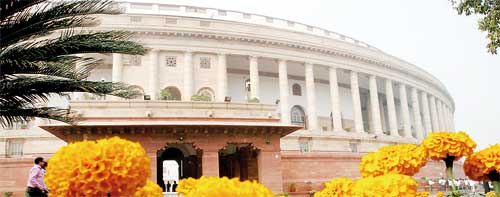 After the laying of the Report, a copy of the Report was forwarded to Justice Soumitra Sen to file his reply. At his request, Justice Soumitra Sen was given approximately one month’s time to file a written reply on the findings of the Report. He gave his reply on 9 December 2011, copies of which were circulated to all the Members of Rajya Sabha. A para in the Parliamentary Bulletin Part-II was also issued.
After the laying of the Report, Members gave Notices of Motion for consideration of the Report. Notices of only those Members were entertained who were signatories to the original pending motion. It was also decided to broadly follow the Rules of Procedure and Conduct of Business in the Council of States, governing the ‘Motion on matters of public interest’ in respect of the subsequent notices of motion. These notices of motion for consideration of the Report of the Inquiry Committee were admitted by the Chairman and published in the Parliamentary Bulletin Part-II as ‘No-day-yet-named’ motion.
The Chairman, Rajya Sabha, in consultation with the Minister of Parliamentary Affairs and the Leader of Opposition, informally decided the date for consideration the motion in the Rajya Sabha. The Business Advisory Committee, in its meeting held on 11 August 2011, allotted four hours for discussion on the motion, excluding the time given to the Judge or his representative to present his arguments before the House. A Parliamentary Bulletin Part-II was issued in this regard and a copy forwarded to the Lok Sabha Secretariat for their information.
It was further decided that the motion would be discussed in the House on two days and an opportunity would be given to the concerned Judge to make his submission from the Bar of the House. In view of this, the Lobby Office was requested sufficiently in advance to erect a bar with raised lectern at the appropriate place. The Parliamentary Security Service, Rajya Sabha, was requested to allow the entry of the concerned Judge and his two counsels in the Parliament House, to escort them into the inner lobby and out of the precincts of the House immediately after the submission before the House.
Immediately after fixing of the date for taking up the motion in the Rajya Sabha, Secretary-General, informed Justice Sen about the same. Initially, he was given 90 minutes time and was advised to make only oral submission during his presentation in the House. On the day on which the Motions were to be taken up in the House, the original pending motion, along with subsequent motion for consideration of the Report of Inquiry Committee, were listed in the names of the movers of the subsequent motion (Annexure VII). On the motion being taken up in the House on 17 August 2011, at the outset, the Chairman made an announcement setting out the procedure to be followed for considering the motion.
Thereafter, one of the signatories of the original and subsequent motion, moved both the motions and spoke thereon. The Judge then presented his defence from the bar of the House and withdrew. After that the House proceeded to consider the motion and several Members spoke on it. The discussion on the motion continued for two days i.e. 17 and 18 August and, in the end, the mover of the motion replied to the debate.
After the end of the debate, the motion for presenting an Address under article 124, read with clause (4) of article 217 of the Constitution, along with the Address to the President was put to vote. Both were adopted by a majority of total membership of the House and a majority of two-thirds of Members present and voting.
On the day the motion was adopted, a message, enclosing a copy of the Address to the President, was communicated to the Lok Sabha. The message was reported in that House which listed its own motion for discussion on 5 September 2011 and included an item in the List of Business for that day accordingly. The concerned Judge, however, resigned from office before the motion could be taken up in the Lok Sabha.
The resignation letter being in order, was accepted by the President of India and the Ministry of Law and Justice issued a notification in this regard. Before the Motion could be taken up in Lok Sabha, the fact of resignation of the Judge was reported by the Union Law Minister in the Lok Sabha. Thereafter, the Speaker, Lok Sabha, took the sense of House and decided not to proceed with the Motion and address for removal of Justice Sen. Secretary-General, Lok Sabha communicated the fact through a message, which was reported in the Rajya Sabha. The concerned file was, thereafter, placed before Hon’ble Chairman, Rajya Sabha to treat the matter as closed.
The primary role of Parliament is to legislate. However, it has a judicial function too. To deal with the issue of a Judge’s misconduct or proven misbehaviour, within the meaning of Article 124 and 217 of the Constitution, is the prerogative of the Parliament. The removal proceedings against a judge of a High Court or the Supreme Court are no doubt a serious matter. For the first time in the history of the Indian Parliament, the Upper House adopted a Motion for removal of a judge.
The constitutional and statutory safeguards ensure that judges discharge their duties without fear or favour in the pursuit of delivery of justice. It is, therefore, essential that the principles of transparency and accountability in the functioning of the judiciary are put in place to address such issues. With this objective, the Judicial Standards and Accountability Bill, 2010 has been introduced in the Parliament to lay down judicial standards and provide for accountability of judges.
It seeks to repeal the Judges (Inquiry) Act, 1968 while retaining its basic features. It aims to create a statutory mechanism for enquiring into individual complaints against judges of the High Court and the Supreme Court and recommending appropriate action, enabling declaration of assets and liabilities of judges etc.