Reply To:
Name - Reply Comment
.jpg) - By Athulasiri Kumara Samarakoon
- By Athulasiri Kumara Samarakoon
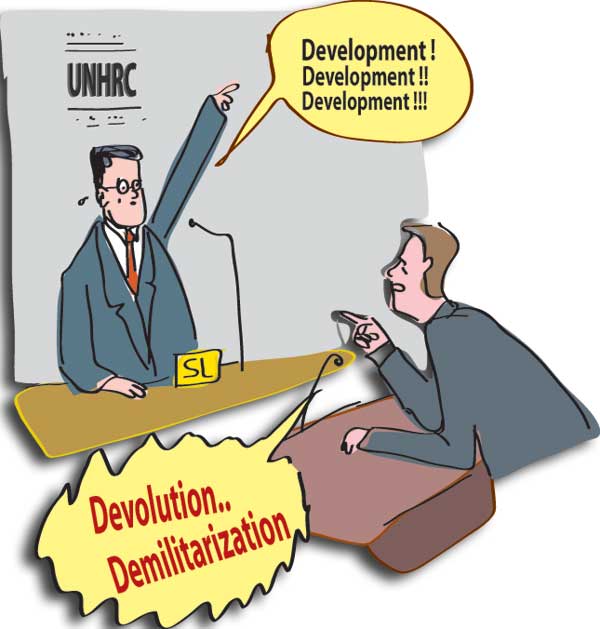
That Sri Lanka has lost the battle to the USA at the 22nd Geneva UNHRC Conference is no news now, but the message sent from there to Colombo seems to be decoded differently. Only thirteen nations stood together with Sri Lanka, and the majority opinion of the international community, twenty five nations, requested Sri Lanka to shift its policy priority from ‘Development’ to ‘Devolution’ and ‘Demilitarization’. Surely, the majority opinion at UNHRC wishes to see that Sri Lanka remains bound to democratic ethos, and hence democracy’s future of this country could be an imperceptible aim behind the resolution. All these four ‘D’s – development, demilitarisation, devolution and democracy – have to be given an equal importance in the post-war context, but the absence or delay in devolution and demilitarisation has been more emphasised at Geneva.
Nevertheless, it is clear that Sri Lanka’s tarnished image at the international level and its incessant search for narrow escapes from the commitment to the international normative obligations or display of non-conformity to international norms would help it very little in the long run. Perhaps, the government may take Geneva’s message positively for possible strategic realignment of Sri Lanka’s foreign policy in a way that recognises the hegemonic presence of India in the region; and also for the refurbishing of its democratic values at the domestic front. These could be the structural compulsions that have driven the Geneva resolution against the small nation sponsored by USA with the support of India.
The International community, all those who voted for and against the Geneva resolution, are aware that international normative compulsions, regulations on state behaviour in the spheres of human rights law, are also a part of the Realpolitik of great powers. But, such a realist realisation of international politics or politics of human rights, particularly, won’t save us from the dangers and the possible punitive action in future. Because, the political reality at the national as well as the international level could be felt similarly by the weak elements; that the ‘the strong do what they can and the weak suffer what they must’. So, ironically, the fate of the Lankan Tamils at the domestic front and the small nation called Sri Lanka at the international front, both actors being weak at different levels, could be identical in nature, though the degree of suffering could differ.
Among those powers who voted against the US resolution was Venezuela, a vehement anti-imperialist power, but, one which has set an impeccable record of holding the most transparent elections in the world, according to Jimmy Carter, former US President who was an independent observer of elections in Venezuela. Though Venezuela opted to vote against, from the post-Chavez Latin America, the US could garner some more votes including Argentina, Brazil and Chile. Those twelve countries that came to save the image of Sri Lanka were mostly constituted by the countries of the Islamic world. Pakistan’s active role in gathering the support of Islamic nations on Sri Lanka’s behalf may be realistically seen as a move to counter India’s defect and also its wish to be an important actor in a region mostly influenced by the latter.
At any count, Sri Lanka cannot misconstrue the goodwill of those nations who supported it at the hour of need that they have ignored the promotion of reconciliation in the post-war context, with much accountability and respect for ethnic and cultural equality. Especially, Islamic nations would like to see that Muslims in this country are not subjected to any harassment and ill-treatment in their right to exercise religious freedom and cultural rights. An interpretation on the anti-vote for US’s resolution by these nations could be drawn as a kind of third world solidarity, in an era of waning nonalignment; but rather, they were realistic enough to counter a country-specific resolution that similarly could be brought against them as well.
" The International community, all those who voted for and against the Geneva resolution, are aware that international normative compulsions, regulations on state behaviour in the spheres of human rights law, are also a part of the Realpolitik of great powers. "
Regional great power India’s concern regarding the Tamil community’s prolonged battle on the sharing of political power of their traditional homeland, the Northern Province, is understandable. The role played by some political parties of Tamil Nadu and the interest groups therein could be one important factor having a decisive impact on India’s decision to vote in favour of the US sponsored resolution. Yet, Tamil Nadu cannot be the most deterministic factor for India’s move. India as a democratic nation is more compelled to be in the strategic alignment of the USA, since the international and regional political structure, at this moment of power politics, remains more complex with the redistribution of power more in favour of China in the East-Asian region. India may attempt to counter Chinese encroachment into the South Asian region since its hegemony could be challenged if the small nations are easily charmed by Chinese ‘soft-power’, non-military but unconditional economic offers.
China’s approach to South Asia certainly could be working as a countervailing force for the small nations in the region who would like to see that India’s hegemonic role would not obstruct their internal and external behaviour. China has offered Sri Lanka unwavering economic assistance, and the quality of democracy, good governance or respect for international ‘norms’, has not been a concern for such commitment on its part.
The aim of the US sponsored resolution on Sri Lanka is clear that India in the regional and USA in the international system would like to see that Sri Lanka trod the path of democracy and good governance with respect for international norms. So, the politics of international human rights and humanitarian law have been used by the great powers against Sri Lanka in the context of its post-war development spree, mostly funded by China.