Reply To:
Name - Reply Comment
 s the Dailymirror said in an editorial last Monday, veteran educationist Prof. Nihal Amerasinghe has pointed out that Sri Lanka spends too little on education. The country’s public expenditure on education has remained low at around two per cent of GDP during the past decade and a half, compared to an average of 4-6 per cent in the rest of Asia.
The upshot of low investment in education means that school leavers are poorly prepared as they join the workforce or are unemployed. Albeit Sri Lanka has achieved high levels of literacy, it has not provided students with quality educational services such as – IT access, effective teaching and better math and science education – to participate successfully in the knowledge economy of the 21st Century.
As we enter the last two weeks of the campaign for the August 17 general election the two major alliances and the Janatha Vimukthi Peramuna have all pledged they would double and gradually increase to about six percent the budgetary allocation for education besides making other changes whereby for students hidden meanings would dawn on their readings. The ruling United National Front for Good Governance on July 23 presented a five point programme to build a new Sri Lanka in 60 months, which means its next five-year term in parliament. In terms of the programme, high priority will be given to education. The UNFGG says its vision and goals are to create a more educated and knowledge-rich generation.
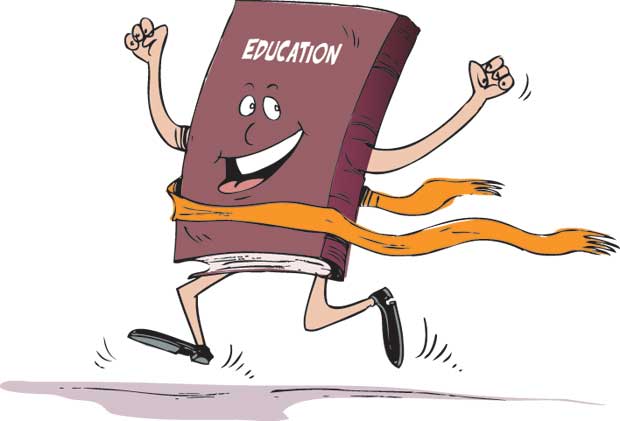
All children will be given the opportunity to receive a higher education despite what their GCE Ordinary Level examination results are with a new education Act with six per cent of the GDP allocated for this vital sector. The plan also says UNFGG will set up 18 technical colleges with high standards, institutes to teach English because up to 40 percent of the students who sit the GCE O/L examination are known to have failed in the English language test. Going far and wide in high technology, the UNFGG has pledged to set up e-libraries whereby students will have access to the world’s best research books at their fingertips. A smart card IT package will be given to university students to buy laptops at low cost and have access to the internet free Wi-Fi zones in universities. In view of reports that 14 per cent of Sri Lanka’s children drop out of school before they reach the GCE O/L, education for all children will made compulsory for 13 years.
United People’s Freedom Alliance in a 12-point manifesto launched last Tuesday reiterates its commitment to free education and says education will be made compulsory for all children till they finish the GCE O/L examination. Interest-free loans will be provided from state banks to university students and all students who sit the GCE (A/L) examination to buy a computer. Students who fail Mathematics at the GCE (O/L) examination will be allowed to progress to Advanced Level education on condition that they complete O/L Mathematics within two years. A monthly allowance of Rs.5,000 will be given to all pre-school teachers, while an interest-free loan up to Rs.50,000 will be granted to all government-approved pre-schools to purchase teaching equipment.
"All children will be given the opportunity to receive a higher education despite what their GCE Ordinary Level examination results are with a new education Act with six per cent of the GDP allocated for this vital sector."