Reply To:
Name - Reply Comment
The Parliament ‘debated’ the PSC Report, an illegal document according to court decisions, on January 10 and 11. The MPs (with an artificial majority) of the government voted by a 2/3 rd majority to impeach the Chief Justice on the evening of January 11. Accordingly, the President was able to ‘sack’ the CJ and appoint a ‘new CJ’ or an ‘Acting CJ’.
 The whole thing amounts to a conspiracy to undermine the Constitution; provided one accepts the interpretations given by the Supreme Court. As the Supreme Court is the sole authority for interpreting the Constitution the CJ cannot accede to her dismissal without violating the Supreme Court and Appeal Court rulings. She continued with her duties on Monday. Parliamentary government is based on the principle that the law is king; the Constitution is supreme and it cannot be violated even by the Parliament. Any change to the Constitution has to follow the procedure given in the Constitution. However, we have seen in the history of Lanka instances where Parliament converted itself to a constituent assembly to construct an entirely new Constitution dismissing the existing fundamental law of the country. In both occasions the Parliament leaders claimed that a people’s mandate was given, as they campaigned in the preceding election requesting a mandate for changing the Constitution. That is entirely a different question. Merely because an illegitimate report was passed with over two-thirds majority does it become a part of the law?
There were more extreme cases in the history of Europe where Parliament powers were taken over by ruling elites backed by military power. Cromwell was responsible for the death of King Charles 1 in 1649. As a member of the Rump Parliament he dominated the short-lived republic of England. On 20 April 1653 he dismissed the Rump Parliament too, by force, and ruled as Lord Protector of England and its territories. More drastic steps were taken by Hitler in Germany. After his appointment as chancellor in 1933, he transformed the Weimar Republic into a single-party dictatorship based on the ideology of Nazism. The “legal measures” taken by the Nazi government in February and March 1933 commonly known as “coordination” meant that the government could legislate contrary to the constitution. The republic nominally continued to exist until 1945, as the constitution was never formally repealed. However, the measures taken by the Nazi government in the early part of their rule rendered the constitution irrelevant. Thus, 1933 is usually seen as the end of the Weimar Republic and the beginning of Hitler’s dictatorship.
.jpg) In the first case, Cromwell as a leader of war against reactionary pro-royal forces, in addition to the loyalty of a strong section of the army, had the backing of the English middle classes both urban and rural. Hence, in spite of his dictatorial politics he is considered a leader of the English democratic revolution. In the case of Hitler, he was backed by desperate German middle elements that were in a frenzy of hatred against Jews and communists. Three important features of Hitler’s propaganda were, firstly, the theory that the Jews and communists were anti-German and were trying to dominate Germany, which was a conspiracy. This conspiracy theory was considered a joke but the leading Nazis took it seriously. Secondly, endless claims were made that the Jews were “born communists” and that by “eliminating” the Jews from German life he would get rid of the “biological root” of Communism. Thirdly, public pronouncements that Jews and Communists are pests, rogues and traitors were made regularly. Hence Hitler led a reactionary counter-revolution against freedom and democracy of the people.
In the first case, Cromwell as a leader of war against reactionary pro-royal forces, in addition to the loyalty of a strong section of the army, had the backing of the English middle classes both urban and rural. Hence, in spite of his dictatorial politics he is considered a leader of the English democratic revolution. In the case of Hitler, he was backed by desperate German middle elements that were in a frenzy of hatred against Jews and communists. Three important features of Hitler’s propaganda were, firstly, the theory that the Jews and communists were anti-German and were trying to dominate Germany, which was a conspiracy. This conspiracy theory was considered a joke but the leading Nazis took it seriously. Secondly, endless claims were made that the Jews were “born communists” and that by “eliminating” the Jews from German life he would get rid of the “biological root” of Communism. Thirdly, public pronouncements that Jews and Communists are pests, rogues and traitors were made regularly. Hence Hitler led a reactionary counter-revolution against freedom and democracy of the people.
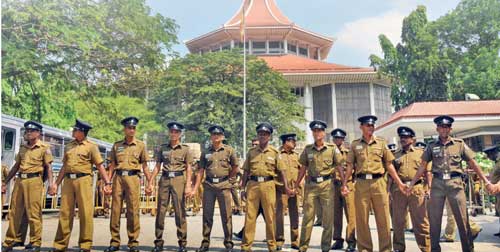 |
| Policemen seen forming a human barricade at the entrance to the Supreme Court yesterday to prevent Shiriani Bandaranayake from coming to Court |