AI SUMMARY GENERATED ONLY FROM THIS ARTICLE'S TEXT.
Hot on the heels of a pending Supreme Court decision regarding the display of images on cigarette packets sold in Sri Lanka, a campaign to ensure that such is included in all packets of cigarettes currently being sold in the country has intensified.
The call by many quarters including the country’s Venerable Mahanayake Theras to ensure that health warnings in the form of images are depicted, covering at least 80 % of each packet has been resisted by the tobacco industry, and understandably so. Understandable -because business interests and profits drive the capitalist economy.
Understandable because research conducted by many an organisation has reached the conclusion that health warnings deter, especially the younger generation and new smokers from taking up a habit that has proved to be fatal.
The fact remains that those addicted to the nicotine thrill find it hard to give up, tobacco is one of the most researched industries in the world and the conclusion some researchers have reached is the fact that nicotine is more addictive than heroin; as much as this conclusion is open for interpretation, it is enough to give one a certain notion regarding the intensity of such addiction.
The ‘Caveat emptor’- let the buyer be aware principle has been continuously used as both an excuse and a justification for the continued operation of the tobacco industry within the Island. The choice is the consumers’, and that remains a fact.
The world over, giant Tobacco manufacturers thrive in the gullibility of its consumers. The marketing campaigns both subliminal and otherwise are catered to ensure that the consumer is first ‘hooked on’ and then ‘locked in’ the maze if not a myriad of psychological, physical and biological reactions that come with the addiction to nicotine
However, the fact also remains that many of the global tobacco giants’ insistence on challenging the health warning leads to many a question.
The figures of tax revenue to the government through the sale of cigarettes have been time and again publicised and recognised. However what has not yet been recognised is the cost the government incurs in financing the patients who fall prey to the vicissitudes of the ‘cancer stick’.
It is a free choice that a man makes to hold the cancer stick, and so is it to consume cyanide, heroin, or inject morphine to themselves. That remains a free choice, but civilized societies have ensured that limits prevail. Consumers should and must be protected, especially the gullible ones , the youth ,who are mainly exposed in the context of tobacco. It is common knowledge that many ‘chain’ smokers inculcate the habit within themselves during their teen years. Late smokers although they do exist are a rarity.
One would most certainly argue that since the tobacco industry is regulated by the government and heavily so, is enough of a deterrent to the local consumer. One would also point out that the ban on advertising, promotion of any sort and any other form of canvassing in the country is a limit that is good enough to pre-empt the “Caveat emptor” principle.
The call by many quarters including the country’s Venerable Mahanayake Theras to ensure that health warnings in the form of images are depicted, covering at least 80 % of each packet has been resisted by the tobacco industry, and understandably so. Understandable -because business interests and profits drive the capitalist economy.
But the fact also remains that Sri Lankans are gullible. A good look at the Sri Lankan Parliament would emphasise and re- affirm this.
The world over, giant Tobacco manufacturers thrive in the gullibility of its consumers. The marketing campaigns both subliminal and otherwise are catered to ensure that the consumer is first ‘hooked on’ and then ‘locked in’ the maze if not a myriad of psychological, physical and biological reactions that come with the addiction to nicotine.
The subtle marketing tactics used by the Tobacco manufacturers to ensure such results are both astounding and alarming, most of which have again been documented and research upon.
These very marketing tactics might be used in Sri Lanka too in order to ensure that ‘new customers’ are continuously touted in.
It only makes business sense that this happens, if not how would a business thrive within such a closed environment?
The release of six million once secret documents from seven cigarette manufacturers doing business in the United States in the year 1998 sheds light to the length and extremes that the manufacturers would go in order to ensure a continuous demand and supply.
Unsurprisingly, the parent company of CTC-British American Tobacco is also one of the seven companies of which 35 million pages of documents were released.
The documents detailed information about many of the plans and processes of the tobacco companies in their attempt to delay or obstruct tobacco-control measures or policies.
They reveal both overt and covert moves that were taken to resist regulations by the Congress, in order to ensure that the nicotine machine continues to work - oiled and ready for sale.
It is evident that close to 20,000 people die each month in Sri Lanka as a direct result of smoking and in order to continue to attain the sales volumes - either 55 new smokers have to take up smoking each day, failing which the current smokers have to be induced into smoking higher volumes of cigarettes.
The fact also remains that the tobacco company is a business entity, and a business entity that manufactures and supplies a product must ensure that demand is created, and target volumes are achieved. A business entity has to achieve profit and in order to achieve profit, consumers must smoke and new consumers must take up the habit. This is the method in which any corporate entity works, the difference however is the fact that cigarettes kill.
The revelations are astounding however the fact remains that the use of cigarettes should not be encouraged, and if the discouragement is to come from health warnings then why have we to oppose such a move is indeed a point to ponder!
Comments - 2
Comments - Cigarettes Kill Over 200,000 Sri Lankan annually as a direct result of smoking
KRISHNA Tuesday, 17 September 2013 06:45 AM
when the world knows the problem of deaths and causes which is more than any war or natural disasters , that is Cigarette smoking still they cant Ban its use. Shows how powerful politics and Money plays over religion , health, life style , freedom, knowledge etc...
00
Paul Sunday, 08 July 2018 03:59 AM
Very interesting article One health warning that should be is Smoking is highly addictive another is Smoking cause stomach cancer Smoking causes bad breath ,tooth decay, gum Disease and tooth loss.
00
222
Add comment
Comments will be edited (grammar, spelling and slang) and authorized at the discretion of Daily Mirror online. The website also has the right not to publish selected comments.



 Hot on the heels of a pending Supreme Court decision regarding the display of images on cigarette packets sold in Sri Lanka, a campaign to ensure that such is included in all packets of cigarettes currently being sold in the country has intensified.
.jpg) The world over, giant Tobacco manufacturers thrive in the gullibility of its consumers. The marketing campaigns both subliminal and otherwise are catered to ensure that the consumer is first ‘hooked on’ and then ‘locked in’ the maze if not a myriad of psychological, physical and biological reactions that come with the addiction to nicotine
The world over, giant Tobacco manufacturers thrive in the gullibility of its consumers. The marketing campaigns both subliminal and otherwise are catered to ensure that the consumer is first ‘hooked on’ and then ‘locked in’ the maze if not a myriad of psychological, physical and biological reactions that come with the addiction to nicotine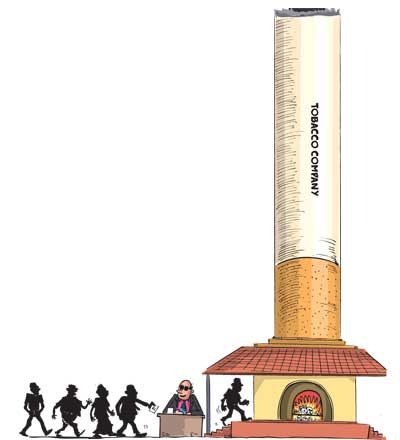 and extremes that the manufacturers would go in order to ensure a continuous demand and supply.
.jpg)
.jpg)
.jpg)