AI SUMMARY GENERATED ONLY FROM THIS ARTICLE'S TEXT.
In light of the current ARPC process, the Daily Mirror decided to speak to Amita Arudpragasam who released a documentary titled ‘The APRC: Spiriting Away the Constitution’ on the constitution making process from 2006-2010.
Since January 2015 Ms. Arudpragasam has been working as the Private Secretary to Sri Lanka’s Foreign Minister. She first decided to produce a documentary on the APRC process in 2013, while she was doing research on constitutional reform at Verité Research and her reading on the APRC and the national question motivated her to teach herself how to direct, edit and shoot videos so she could tell this story through images. This is her first documentary film.
“I was inspired by the efforts of both Nizam Kariappar and Yogarajan who, at great political costs to themselves, went ahead and released and tabled the unofficial records.”
Q What kicked-off your interest in the APRC and what were some of the challenges faced in filming and releasing this documentary?
It actually started as part of a research project on constitutional reform which I was working on at a think tank since the APRC was our most recent attempt at constitutional reform if you exclude the unsuccessful nature of it. The research project started in 2013 and when I was writing the report I was very interested in observing the legal as well as political aspects of constitutional reform and why it had failed to achieve a successful outcome in satisfying people. Many attempts from J. R Jayewardene to the CBK talks had all failed so I was keen on analysing past constitutional failures and the grandeur political framework at the time.
For the research project, the only video I shot was on an old mobile phone. I was inspired by the efforts of both Nizam Kariappar and Yogarajan who, at great political costs to themselves,went ahead and released and tabled the unofficial records. I then started working more on the intended film with more sophisticated editing software and a camera.
Because of the time in which I was shooting the film, I had to take the political risk of putting it out into society. It was a time when journalists were at great risk. Finding people to work on it also had to be done carefully. I didn’t want to get funding from any particular source so as to be as independent as possible and to make sure that there would be no attack on that front. I made sure that a local crew was involved in it. I tried hard to be as representative as possible even with the interviewees, but unfortunately the representative from the SLFP didn’t want to talk to me. However the fact that I look young and inexperienced allowed many people to open up and talk to me. I hope I could have interviewed ex-President Mahinda Rajapaksa and members of the SLFP. In hindsight I would have liked also to have viewed the role women played in the whole process.
“We are still trapped in the notion that there is a war.”
Q As a person, who would by now be well versed in the entire process, what do you feel are the key points that need consideration this time around?
In any constitutional process the fundamental laws and values need to be enshrined and these include the protection of liberties and the assurance of justice among many others. Identifying Sri Lanka as being in a bit of a shift in terms of a political culture after the January election means that the Constitution needs to result in the needs for multi-culturalism and pluralism.
It also needs to reflect that this formulation is happening post-war. Even though the APRC was intended to be released after the war, it was created during the existence of the LTTE and the mindset of the people was the belief that we were under threat. Now this situation has changed after the defeat of the LTTE, but to some extent we are still trapped in the notion that there is a war; even though the enemies have changed.
The international community has become the new enemy. With the war mentality subsiding together with the political shift there is a need us to have a new opportunity for peace to be reflected in our Constitution. A fundamental legal system needs to be created that protects us from new forms of international terrorism as opposed to the traditional geographic ally based terrorism. We also need to look at our historic problems in promoting peace.
There will be arguments against it but look at Singapore which illustrates the use of radical policies. Steps such as the prevention of segregation of ethnic communities and ethnic housing quotas which may look radical need to be implemented now in the context which exists with the change of the political climate. The focus has been to end the ethnic problem but we need to move beyond that now, while not forgetting it by incorporating the lessons learnt. Aspects such as women and the youth need to be looked at. The Constitution needs to be forward-looking and be able to predict any clashes that we may see in the future.
“This was not something actually intended to provide results.”
Q In your view, looking at it from an outside perspective, did you feel that the focus of the APRC was unwavering throughout?
The focus didn’t really shift but starting from MR’s very forward-looking statement of pluralism, religious freedom and tolerance made at the founding of the APRC, when you look at the timeline you can see that, while there was a lot of excitement at the beginning, towards the latter half it became quite clear to most of the people involved,as well as to external observers,that this was not something actually intended to provide results. This was even though the participants had really invested their time in it for three years. As an external observer, it really captures the fact that the process was emblematic of the overarching political system which was losing the confidence of people at that time.
“The fact that a community that is part of our country wanted to create a single state and isolate themselves is a matter for grave concern.”
Q Should the focus of the Committee still be on the National Question or is there room and the need for the entire process to evolve into something more?
We can’t get away from the fact that we just came out of a 30-year-long war which caused significant ethnic conflict. There still continues to be ethnic disharmony in the country. The fact that a community that is part of our country wanted to create a single state and isolate themselves is a matter for grave concern. I don’t think constitutional reform is the end all. There needs to be a package of solutions in terms of transitional justice and devolution of power.
The Constitution has a large impact on how people function. This brings up another problem of our Constitution not being as supreme as we like to think it is.
There is constant change with the many amendments. We need to re- establish the supremacy of it and prevent consecutive Governments from coming in and changing the entire structure of it. Therefore it doesn’t have to be focused on one single point.
We also don’t pay enough attention to the fact that 52% of our population consists of females who are crucial to economic development. Mothers give birth to sons. As the Canadian Prime Minister Justin Trudeau said in 2015 it’s not why should there be equality but why there shouldn’t be. All these interest groups should be part of the constitution -making process. There should be an introduction of anti-hate laws that don’t limit freedom of expression, individual and group rights, laws that protect the economic climate and anti – corruption laws to make sure corruption doesn’t propagate itself. Even very basic things like how politicians are elected from their electorate and how much money he needs to contest need to be looked into. We also need to see whether we can make our policies more accessible to people who don’t have tons of money to make decisions. It’s all interlinked.
Making sure public servants are efficient plays a part in reconciliation. I have spoken to many Tamil people and they always say that the Government doesn’t care about them. We need to increase efficiency and productivity to get services to people so that they don’t think negatively of the State.
“If you don’t pay attention to the needs of 52% of your population then you will have to deal with political, social and economic problems in the future.”
Q Following up on your earlier point, do you feel that gender inequality is a problem in Sri Lanka?
Absolutely. The invisible inequality that no one talks about is prevalent in both the private and public sectors. In the private sector there are glass ceilings on employment. There is a low number of women entering the workforce since there are no laws protecting their right to take care of children. There is discrimination in both sectors which is proved by statistics as well. This problem is not only in the workplace. It is also about the larger problems that take place. There is so much gender-based violence; very few people are convicted of rape and there is less protection for women. This has to be part of the Constitution as well. Lots of feminists speak about subtle things like how women in the public sector have to wear the national dress but men get away with wearing suit. These are subtle issues but there are also many larger ones as well. In many villages women have to trek several km to fetch drinking water and only a few have access to water.
Some people glorify the LTTE by saying that under their rule women were never raped. The LTTE was ruthless,authoritarian and exploited people but if the Government stepped in and made sure women were safe then there would be no need to look at other examples. It’s a self-perpetuating problem. If you don’t pay attention to the needs of 52% of your population then you will have to deal with political, social and economic problems in the future. If you look at women in politics this is a huge problem. How many women are there in Parliament? We can’t just have quotas. We need to create a culture where they get interested in a wide range of issues which will then make them viable candidates.
Migrant workers work in difficult climates. In light of the recent Saudi Arabian issue, which is just one example,it’s sad that a woman of Sri Lanka felt that she couldn’t live in our country and needed to go abroad to earn a similar wage to what she would have earned here. We can’t blame the Saudis since that is the law of the land. We ourselves need to take on the responsibility of providing incentives to our women to stay here by carefully scrutinizing our policies.
“In hindsight, one of the major mistakes was that they were spending so much time building the confidence of the international community that they missed out on building the confidence within our own community.”
Q Looking back, what would you classify as the most eye-opening revelation in terms of governance and the political process in Sri Lanka?
To mention a few, R. Yogarajan who claims to represent the Tamil population is misled when he says that the majority of people don’t want devolution but that they need it nevertheless to create ethnic harmony. That is because if you look at the polls that were done during the APRC and afterwards it shows that a majority of the people do in fact want devolution including the Sinhala population. So even among the Tamil representatives and the Tamil population there is a misrepresentation that devolution is undesirable and a paranoia that Sinhalese are against devolution. It is to be assumed that the Sinhalese majority who also suffered from the war would they themselves endorse an unequal Constitution. That is unfair by the Sinhalese people. This notion of being weary of not upsetting the Sinhalese masses is prevalent in politics as well.
Also the previous Government did take confidence-building amongst the international community very seriously. We were using the APRC to buy time to wage the war by promoting the image of a harmonious Government and the rule of law. In hindsight, one of the major mistakes was that they were spending so much time building the confidence of the international community that they missed out on building the confidence within our own community. This was seen in January when MR who came as Human Rights defender left as pseudo-dictator. If he had lived up to the promises he made to the people this wouldn’t have happened.Therefore we must build the confidence in all stakeholders within the country.
“People in our country are certainly capable of engaging in debate”
Q Is there a bigger picture you hope to achieve through this documentary or is it only focused on the APRC?
Yes. I’ve always thought of the APRC as a good platform for discussion. The Constitution does matter and people need to be engaged in this debate and not have it restricted to just the elite. Masses may not think devolution is bad but they must have a say in it so that the political forces cannot misrepresent the people. The idea was to create something that could be accessed by anybody which is why it was translated into the three languages. It is intended to be discussed in any group or circle be it sociology anthropology or women’s rights. It was made to inspire debate. There is a lack of debate in our country which may cost the lives of friends and loved ones. There also has to be a certain level of awareness carried out that the Constitution is not just a document. The clauses and amendments impact certain tangible aspects of our lives. Awareness of this link needs to be made explicitly. It should be made at an early stage in schools as is done in America or India. We do have a high literacy rate; therefore our people are indeed educated enough to be learning about it in this country. And they must. As someone once said ,at moments of change it is the ideas that are picked up and made into solutions.
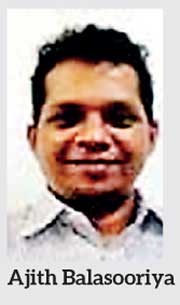
The Daily Mirror was also in conversation with Dr. B.A.C. Ajith Balasooriya, a Senior Lecturer at the Department of International Relations of the University of Colombo, on the hurdles that the proposed devolution needs to cross. The Doctor has received his PhD from the University of Hiroshima in Japan on ‘Internal Dual Structure of Causes of the Armed Conflict between the Government of Sri Lanka and the Liberation Tigers of Tamil Eelam (2013)’ and is both SEDA Qualified (UK) and CTHE Qualified (Sri Lanka).
He has also published several publications such as “Issues at Own Backyard: Caste Based Socio-Economic Inequalities as “Unseen Hurdles” in Post-conflict Northern Sri Lanka” in the Journal of International Development and Cooperation, Vol.19, Graduate School for International Development and Cooperation, Hiroshima University and “Search for Common Grounds: Tamil Caste System as “A Spoiler” in Post-conflict Peace-building in Northern Sri Lanka”, IPSHU English Research Report Series, No.26, Peace-building and the Ownership of Local Society in Sri Lanka, Institute for Peace Science, Hiroshima University, among many others.
Dr. Balasooriya who has been working in the North for over 10 years since 2002 states that even though devolution of power is indeed important there is a dire need to address the heavily-neglected socio-economic differences within the Tamil community itself. It is important to address these rights of the “entire community of Tamils”. This includes the 21 identified caste groups of the North as identified by scholars such as Pfaffenberger (1990). He feels that through devolution only the upper castes will derive benefits and these historical divisions will prevent the benefits being accrued by castes that are not politically prominent and whose interests are not discussed in the political environment. These divisions are more visible in the prevailing post conflict scenario. Another obstacle to these castes is that the level of education is also very low. The graduates that emerge out of these castes are arts graduates, therefore unlike the science and medical graduates that emerge from the upper castes, the former graduates have no link to the political process.
“If their needs are not addressed they might become a tool for another ethnic conflict” says Dr. Balasooriya.
Comments - 0
Comments - APRC Process: Spiriting Away the Constitution
222
Add comment
Comments will be edited (grammar, spelling and slang) and authorized at the discretion of Daily Mirror online. The website also has the right not to publish selected comments.



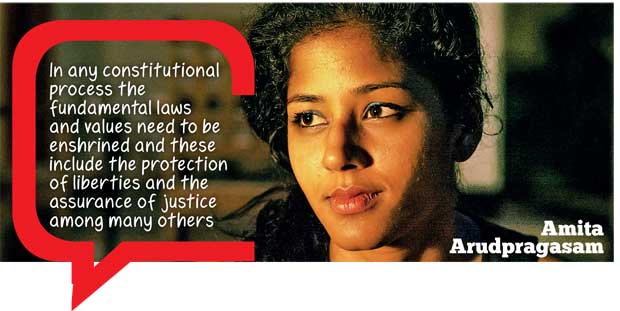
 Since January 2015 Ms. Arudpragasam has been working as the Private Secretary to Sri Lanka’s Foreign Minister. She first decided to produce a documentary on the APRC process in 2013, while she was doing research on constitutional reform at Verité Research and her reading on the APRC and the national question motivated her to teach herself how to direct, edit and shoot videos so she could tell this story through images. This is her first documentary film.
 majority of the people do in fact want devolution including the Sinhala population. So even among the Tamil representatives and the Tamil population there is a misrepresentation that devolution is undesirable and a paranoia that Sinhalese are against devolution. It is to be assumed that the Sinhalese majority who also suffered from the war would they themselves endorse an unequal Constitution. That is unfair by the Sinhalese people. This notion of being weary of not upsetting the Sinhalese masses is prevalent in politics as well.