AI SUMMARY GENERATED ONLY FROM THIS ARTICLE'S TEXT.
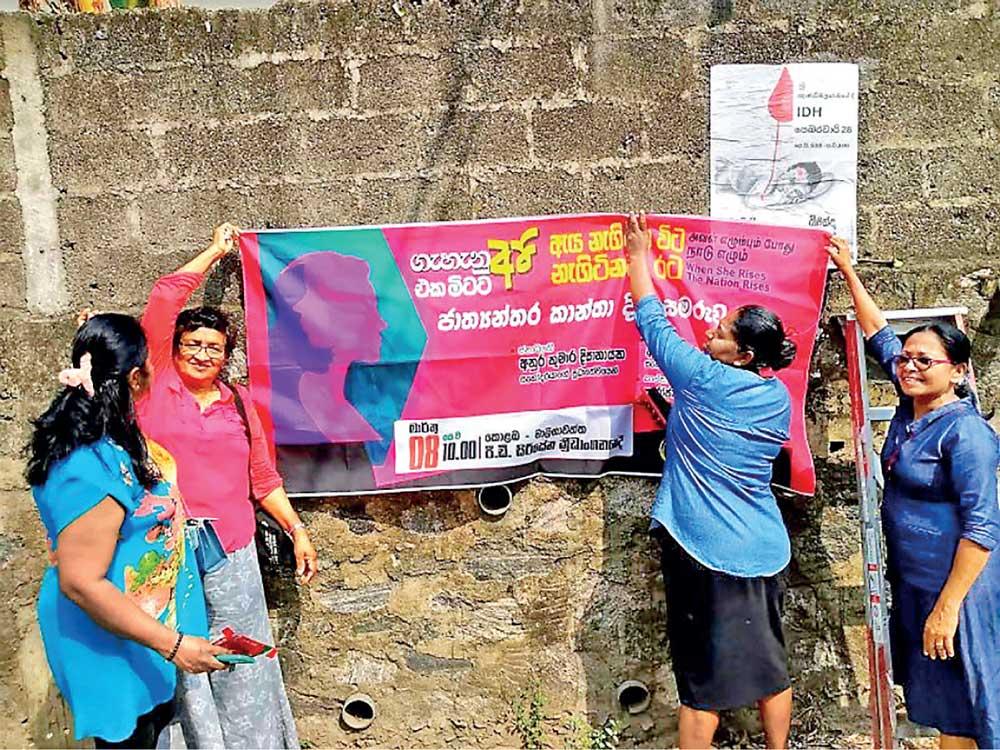
Women seen putting up posters ahead of NPP’s Women’s Day event. Images courtesy of NPP
We need to protect the dignity of female politicians. We need to introduce new laws and also develop a discourse around it. It’s not suitable for anybody to disrespect female politicians. There are many unethical characters in parliament but nobody can stop our journey and it’s important to change attitudes of people”
NPP MP Samanmalee Gunasinghe
The discourse around increasing women’s participation in political processes has evolved since 2018. At present, there are many women who aspire to engage in politics due to various interventions such as the introduction of the 25% quota. But their aspirations continue to be challenged by darker patriarchal shadows that still continue to hover around grassroots level political systems. In an attempt to empower women to play an active role in political, economic and social decision-making processes, a project titled ‘Promoting women’s development and meaningful participation in political processes’ was launched. This project, supported by the United Nations Development Programme’s (UNDP) ‘Promoting Participation Pathways for Human Development (3P4D Project) and implemented by Search for Common Ground (SFCG) aimed to empower women in the Eastern and Uva Provinces by strengthening their leadership skills. The project included dialogues and discussions between women leaders, government officials and community actors, capacity building and mentoring and creating platforms for women to voice challenges and influence decisions.
Barriers to meaningful participation
Through these dialogues, some key barriers faced by women participants were listed as follows;
Marginalisation and symbolic pressure
Party politics, control and restricted autonomy
Threats, intimidation and safety concerns
Economic inequality and financial exclusion
Legal awareness and institutional challenges
Exclusion from collective platforms
According to an analysis of key barriers faced by participants from Eastern and Uva provinces women have limited power to make decisions within local government bodies and are also excluded from key committees. They are also impacted by male dominated systems and internal party hierarchies. Economic dependency was identified as a barrier in addition to financial constraints, campaign costs and lack of funding support for women. Some women had limited knowledge about governance, budgeting and policy understanding which stood in the way of their political careers. Some participants highlighted social stigma, gender norms and family restrictions. The lack of institutional protection mechanisms also discourage women from participating in political processes as they are vulnerable to being intimidated and harassed.
Rejections and double standards
Chandra Wedagedara, Programme Coordinator of the Women’s Development Centre, Badulla has been engaged in grassroots level work for the past 30 years. She said that despite campaigns to increase women’s participation at local government elections to 25%, they still haven’t been able to reach this quota within the Badulla District. “Initially there were around 100 female candidates elected to local government bodies through nomination lists and so on. But this time there were only 75 candidates,” Wedagedara told the Daily Mirror.
She noted that even though female candidates are being promoted during campaigns, they face many challenges when working with fellow candidates within their respective parties. “There’s a lack of democracy among these political parties. At grassroots level, women are at the forefront when it comes to organising meetings, serving food, compering and even drawing crowds to meetings. But they are rejected when nominations are being called. These trends haven’t changed over the years,” she added.
Wedagedara further said that despite the ‘Gehenu Api Eka Mitata’ campaign launched by the NPP, there are numerous instances when women are being sidelined when it comes to politics. “They are excluded from planning meetings, their ideas are not being consulted when electing candidates to nomination councils. The entire election process is grounded in patriarchy. Even though some women were elected as presidents and prime ministers due to their strong political backing and capacity, it is a distant dream for most female candidates working at the grassroots level,” she said.
Overcoming patriarchal barriers
But despite these patriarchal barriers, female candidates elected to local government bodies have improved their knowledge and capacity by working with various organisations such as SFCG. These trainings include improving knowledge about various laws and acts including the municipals ordinance, local government regulations and so on. Capacity building activities such as working with communities and minority groups are also included.
Wedagedara said that they have been able to develop a close relationship with the community and have advocated for women’s rights. “Female candidates have submitted various proposals to uplift the wellbeing and livelihoods of women in their communities and they work with determination to obtain approval for these proposals. They have also been instrumental in establishing children and women’s committees in local government bodies. So if they get a chance they are able to show their progress. In fact, female candidates at local government level work together irrespective of party politics as a result of these trainings,” she added.
Progress made by female parliamentarians
But according to NPP MP Samanmalee Gunasinghe, much progress has been achieved in terms of women’s meaningful participation in Parliament. “As a result of the ‘Gehenu Api Eka Mitata’ campaign, we were able to elect 20 female candidates to Parliament for the first time in history,” she noted. “Many of these women were involved in political activities at the grassroots level. But now they have been instrumental in passing new acts such as the Act to End Corporal Punishment in Schools to the new Microfinance Act. We have also introduced a women’s commission and we have a Women’s Parliamentary Caucus to discuss issues relating to women and children. Female parliamentarians have been actively involved in many key discussions and they provide immense support to the government,” she added.
Gunasinghe further said that they don’t work to please the Opposition and that their priority is citizens and their well-being. When asked about certain types of harassment and cyber bullying faced by female politicians and women leaders at grassroots level, Gunasinghe said that discussions are underway to address these challenges. “We need to protect the dignity of female politicians. We need to introduce new laws and also develop a discourse around it. It’s not suitable for anybody to disrespect female politicians. There are many unethical characters in parliament but nobody can stop our journey and it’s important to change attitudes of people,” she underscored.
Recommendations
Following these dialogues, several recommendations were listed into three categories namely structural, behavioural and resource and capacity. Some key recommendations are as follows;
Introduction of women-friendly meeting arrangements by taking note of timing, safety, childcare and language
Promotion of gender-responsive planning and budgeting
Conduct community awareness engaging men, elders and religious leaders
Establishing village level women leadership groups
Training women on governance systems and processes
Strengthen financial literacy and livelihood skills
Provide digital safety training on misinformation and cyber risks
Comments - 0
Comments - Women should be more active in governance and decision making
222
Add comment
Comments will be edited (grammar, spelling and slang) and authorized at the discretion of Daily Mirror online. The website also has the right not to publish selected comments.



 We need to protect the dignity of female politicians. We need to introduce new laws and also develop a discourse around it. It’s not suitable for anybody to disrespect female politicians. There are many unethical characters in parliament but nobody can stop our journey and it’s important to change attitudes of people”
 The discourse around increasing women’s participation in political processes has evolved since 2018. At present, there are many women who aspire to engage in politics due to various interventions such as the introduction of the 25% quota. But their aspirations continue to be challenged by darker patriarchal shadows that still continue to hover around grassroots level political systems. In an attempt to empower women to play an active role in political, economic and social decision-making processes, a project titled ‘Promoting women’s development and meaningful participation in political processes’ was launched. This project, supported by the United Nations Development Programme’s (UNDP) ‘Promoting Participation Pathways for Human Development (3P4D Project) and implemented by Search for Common Ground (SFCG) aimed to empower women in the Eastern and Uva Provinces by strengthening their leadership skills. The project included dialogues and discussions between women leaders, government officials and community actors, capacity building and mentoring and creating platforms for women to voice challenges and influence decisions.