 MOHAMED AYUB
 Reply To:
Name - Reply Comment
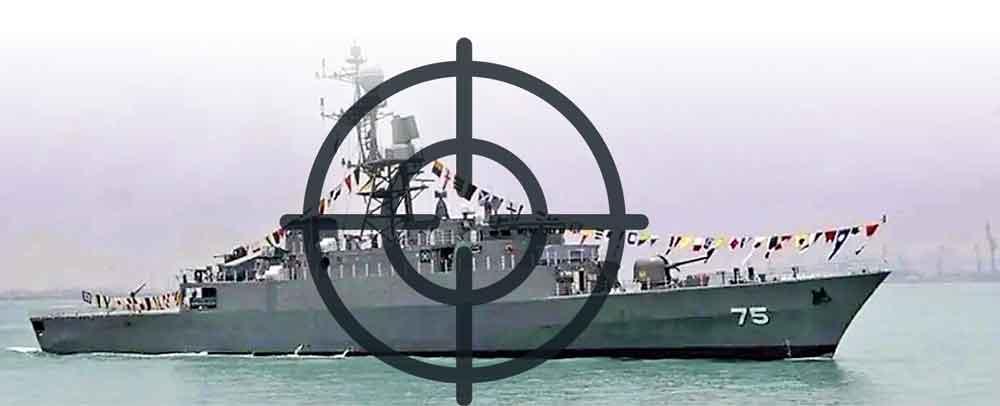
Iranian frigate IRIS Dena sank outside Sri Lankan territorial waters. (image: X)
 There are some blurry points and unanswered questions in connection with the incidents involving the sinking of the Iranian ship within Sri Lanka’s Exclusive Economic Zone near the southern city of Galle and its two auxiliary ships IRIS Bushehr and IRIS Lavan
Whatever the various versions of political parties may be, there are still unanswered questions involving these three ships, when news reports of various other sources are taken into account
 It must be the ongoing war in West Asia that has been the toughest issue that the National People’s Power (NPP) Government has encountered since its assumption of power in late 2024.
Even among the issues related to the war launched by the US and Israel against Iran on February 28, the handling of the Iranian Navy frigate IRIS Dena which was torpedoed by the US Navy on March 4 must be the even more delicate issue that the current Government had to face during their short tenure.
Yet, the Government managed the situation successfully, earning accolade from locally and internationally, but to the utter disappointment of some of the Opposition parties here.
Yet, there are some blurry points and unanswered questions in connection with the incidents involving the sinking of the Iranian ship within Sri Lanka’s Exclusive Economic Zone near the southern city of Galle and its two auxiliary ships IRIS Bushehr and IRIS Lavan.
Many people had expressed concern over the incidents after Iran’s Ambassador to Sri Lanka, Dr. Alireza Delkhosh, told journalists that the frigate IRIS Dena was in Sri Lankan waters at Colombo’s own invitation when it was torpedoed by a United States submarine. Prior to that, New Democratic Front (NDF) MP Chamara Sampath Dasanayake had told Parliament the Iranian ship had been orally invited by the Sri Lanka Navy Commander. However, Ambassador’s statement was serious since it seemed to clash with the Government’s narrative.
The first news about IRIS Dena reached the people of Sri Lanka on March 4 shortly after it was attacked by the US Navy. Stories carried in the electronic media said the Sri Lanka Navy and the Sri Lanka Air Force launched a joint rescue operation after an Iranian vessel IRIS Dena, a Moudge-class frigate in the Southern Fleet of the Islamic Republic of Iran Navy, sent out a distress call off the coast of Galle.
It had been hit after it had participated in India’s International Fleet Review and the multinational MILAN 2026 naval exercises at Visakhapatnam between February 15 and 25, which involved vessels from over 70 countries, including the United States and Sri Lanka. It is reported that 104 people in the ship had been killed in the incident injuring another 32. Bodies of the deceased and the injured were brought ashore by the Navy.
On the next day, March 5 media reported another Iranian ship, IRIS Bushehr which had accompanying IRIS Dena had developed technical issue while one of its members had fallen ill had requested permission to dock in Colombo Port. However, the Government took the ship and the entire crew 206 individuals under Sri Lanka’s jurisdiction, according to the international law.
It was reported on March 6 that a third Iranian ship IRIS Lavan had docked in India at Port of Kochi in Kerala.
The Opposition was of the view that these Iranian ships should have been permitted to dock in Sri Lankan ports and suggested that the Government deliberately allow one ship to be attacked. MPs Kabir Hashim and Mujibur Rahman accused that the authorities made IRIS Dena to wait in the Sri Lanka’s Exclusive Economic Zone for 11 hours until it was hit by the US submarine.
Whatever the various versions of political parties may be, there are still unanswered questions involving these three ships, when news reports of various other sources are taken into account.
For clarity, let us look at the various related incidents in a sequence.
The Navy Commander had orally invited these ships for a friendly visit during the Indian naval exercise. The three ships had left Indian waters on February 25 with the conclusion of the naval exercise. President Anura Kumara Dissanayake stated in Parliament that Iranian authorities had sought permission on February 26 for three ships to dock at Sri Lankan ports. He said the request was turned down in the light of a US request for permission on the same day for two of its fighter jets to land at Mattala airport while a tense situation having been developing in the West Asian region, involving the US and Iran.
Then, Iran had sought permission from India for three of its ships to dock at Indian ports on February 28 the day the US and Israel began a war on Iran and permission was granted by India on March 1, according to a speech in Indian Parliament on March 9 by Indian Foreign Minister S. Jaishankar. This means Sri Lanka had communicated to Iran its decision on permission for the ships before February 28, posing a question about the presence of two Iranian ships close to Sri Lanka while another apparently in the Indian waters by March 4, the day IRIS Dena was attacked. Was there any miscommunication(s)?
Sri Lanka had refused permission for Iranian ships before the war started, while a tense atmosphere was building in the Gulf region. But India had granted permission for the same a day after the war started, indicating its moral obligation to do so and its ability to withstand any eventuality or its confidence on the situation. However, at a time when international law is dead, as Iranian Foreign Minister Dr. Abbas Araghchi put it, India and Sri Lanka have taken risk of protecting two Iranian navy ships.
This is so, given the Sri Lanka’s level of capacity to challenge any decision by the US with regard to the ship which is under the care of Sri Lanka. Sri Lanka does not possess the capacity to forewarn, leave alone the military prowess to prevent such an eventuality. Opposition leader Sajith Premadasa, ridiculing the national security under the NPP Government, questioned, “If a submarine had entered our waters 40 nautical miles from Sri Lanka, did we not have the technology to detect it? Do we not have surface radars? Sonobuoys or underwater sonar networks? Do we not have towed sonars or satellite surveillance?”
Alas, we do not seem to possess such things.
Rear Admiral Y.N. Jayarathna (Retd.) former Director General Naval Operations of the Sri Lanka Navy has this to say in an article published in the ‘Factum’ website: “The Sri Lanka Navy does not have underwater detection or sub-surface surveillance system in the southern part of the island as the consecutive Government’s (and the incumbent) never have thought of investing for such, or to develop a seabed sensor network due to the fact that the seas are deeper in that region. However, even with such a system in place, the nature of the oceanographic parameters in the area makes it difficult to detect underwater movement of submarines due to the mixing of low-salinity waters of the Bay of Bengal and the high salinity waters of the Arabian Sea.”