Reply To:
Name - Reply Comment
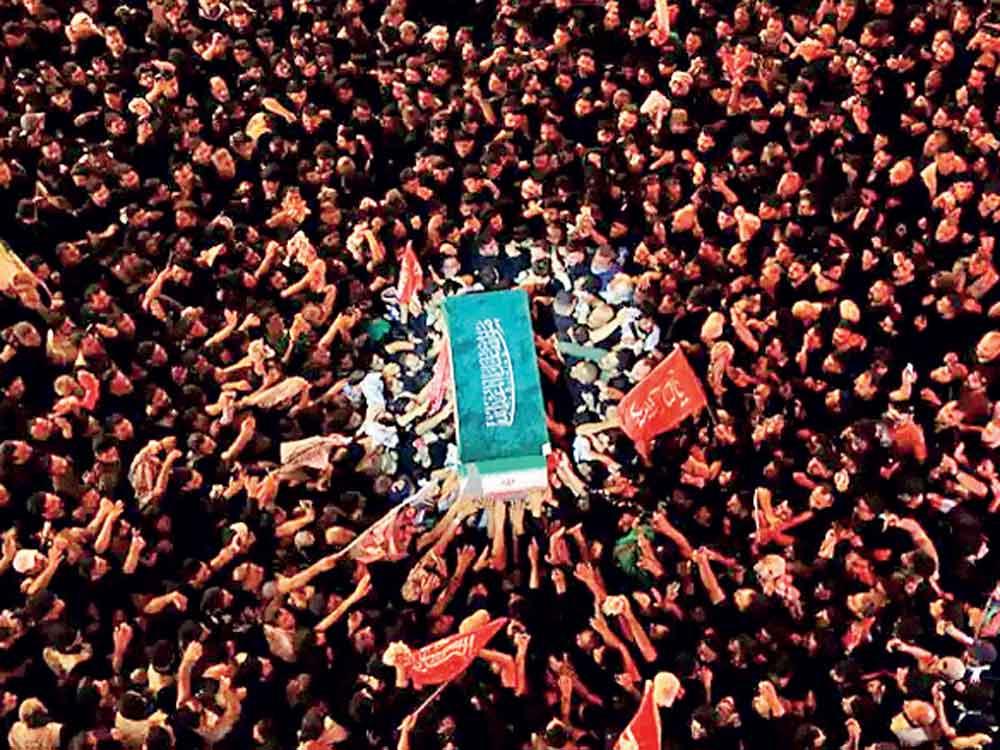
Mourners attend Ayatollah Khamenei’s funeral procession in Iraq, with his body due to be buried in Iran’s Mashhad yesterday.
 A nation in mourning. A ceasefire deal in tatters. Energy prices rising yet again. Developing nations bearing the blows. Peace saboteurs eager to resume the war. A president desperate to etch his name into history—not with deeds but with ego-driven misdeeds.
That nation in mourning is Iran. The ego-driven president is Donald Trump, the like of whom the United States has never seen before.
Maverick and unpredictable, Trump refuses to play by diplomacy’s rules. Instead, he makes his own rules and demands that the world obey. Whatever little respect the US commanded before Trump assumed office has now evaporated.
Among many examples, striking is this week’s red card reversal ahead of the US-Belgium World Cup encounter, enabling a star US striker to play. Trump, the conceited bully, made the request to FIFA, and its boss Gianni Infantino, like a stooge, complied—a black mark in soccer history. Infantino suspended Russia for its invasion of Ukraine but rejected calls to apply the same rule to Israel when the Zionist state launched a genocidal campaign in Gaza. It comes as no surprise that he is hosting one of history’s most discredited tournaments. Rightly so, he is being berated as a disgrace to the world’s most popular sport. But that is a matter for another day. Our focus today is the likely resumption of the war no rational nation—except Israel—desires.
Obsessed with legacy, Trump seeks to bully Iran into submission. Yet Iran—a middle power with limited military might but formidable willpower—continues to prove its ability to resist US military pressure.
Since a memorandum of understanding was signed on June 18 by the US and Iran to extend the April 8 ceasefire by another 60 days, few were optimistic about its longevity. Fragile from day one, the MoU—mediated by Pakistan and Qatar—survived for three weeks despite attempts by Israel and Zionist infiltrators in the Trump administration to sabotage it. This in itself was a surprise.
On Wednesday, after attending the NATO summit in Ankara and amidst renewed US strikes and Iranian reprisals, Trump declared the deal almost over and warned of further attacks “tonight”. That same day, the US carried out what was seen as the largest strike since the June 18 deal, raising questions about whether the agreement is truly dead or whether diplomacy still has room to operate.
Alongside missiles and drones, the two parties traded accusations of violating the MoU. Citing the agreement, Iran insists on a complete ceasefire in all theatres, including Lebanon. Yet with diplomatic efforts to force Israel’s withdrawal making little progress against the regime’s intransigence, Iran began targeting ships in the Strait of Hormuz—especially those defying its safe passage rules, which it claims align with the MoU. Decrying the attacks as a violation of the MoU, the US demands total freedom of passage in the Strait of Hormuz—a vital chokepoint that holds the world economy hostage, as one-fifth of global oil supplies flow through it.
On Wednesday, the US announced it was revoking the sanctions waiver granted to Iran—meaning Iran would no longer be able to freely export oil and petroleum products—as a further measure against military attacks on Iranian cities. Without limiting its strikes to Iranian military installations along the Strait of Hormuz, the US on Wednesday night targeted facilities deep inside Iran. One notable attack was on the railway line connecting Tehran and Mashhad, where Iran’s slain Supreme Leader Ayatollah Ali Khamenei was to be buried yesterday at the Imam Reza mosque. Mourners travelling by train were diverted to road transport so they could be present when the casket carrying the body of the late leader returned from the Iraqi holy cities of Najaf and Karbala, the burial sites of Shiite Islam’s first and third imams, the Prophet Muhammad’s son-in-law Ali and grandson Hussein.
Despite fears of a possible US or Israeli attack on the funeral, the crowd surged. Tens of millions attended, many uncontrollably sobbing in scenes that shocked the Trump administration and belied Israel’s propaganda that Iranians did not support their leaders.
Despite the nationwide mourning, Iran retaliated. On Tuesday night, Iran launched 85 strikes on US military facilities in Kuwait and Bahrain and also attacked a Qatari ship and a Saudi ship. Early yesterday, Iran launched further attacks on US bases in Kuwait, Qatar and Bahrain. If the war resumes, more Gulf countries—particularly the UAE, which Iran accuses of facilitating US attacks—could come under fire. Oil prices, which soared over US$ 80 yesterday from US$ 70 last Friday, may once again cross the US$ 100 mark, impeding the global economic recovery after the oil shock.
Not known for diplomatically restraining his words, reckless Trump blasted Iran’s leadership as “scum” and “cuckoo”. Only days earlier, he had praised them as rational leaders when defending the MoU with Iran. In response, Iran’s foreign minister Abbas Araghchi said, “Using derogatory language to address the civilised and courageous nation of Iran does not diminish its greatness. We do not answer vulgarity with vulgarity, but with action—fearlessly and with great valour.”
The attacks, counterattacks, conflicting claims over control of the Hormuz Strait, and the worsening crisis that signals the imminent resumption of war raise a basic question: why is there no provision in the MoU to facilitate arbitration when disputes arise over conflicting interpretations of its clauses? Surely the mediators were aware of the importance of such a safeguard, given the widening trust deficit between the two warring parties.
The absence of a dispute resolution mechanism suggests either that the MoU was hastily negotiated or that the stakeholders believed a flawed deal and fragile peace were preferable to no deal and the continuation of war. Compliance with this flawed deal is based on a “commitment in return for commitment” approach—if you do this, I will do that. Though an understanding between the parties allows complaints about non-compliance to be made to the mediators, there is little evidence that the mediators have ruled on a dispute or named the violator. It is likely they do not want to rock the boat and kill the deal.
As a result of this lacuna and the parties’ unwillingness to compromise for fear of losing the upper hand each believes it holds, the world is once again on the threshold of a major Middle Eastern war.
With war fires reignited for an all-out second round neither side wishes to enter, mediator Pakistan yesterday urged the parties to uphold their commitments under the Islamabad MoU, describing the deal as a lasting foundation for understanding, mutual respect, and shared prosperity for the region and beyond.
Words, however meaningful and well-intentioned, are not enough. Mediators Qatar and Pakistan, along with other world powers—especially China, Turkey, and Egypt—must redouble their efforts to rescue the MoU, painstakingly negotiated after much diplomatic haggling and tense moments. Amidst escalating tensions and looming conflict, a narrow path for diplomacy remains open. They must seize it.
The peace process that cautiously began after the June 18 deal and that has already survived several near-death experiences—including the worst one this week—must be preserved, with the MoU revised to include a clause for resolving disputes arising from interpretation or misinterpretation.