Reply To:
Name - Reply Comment
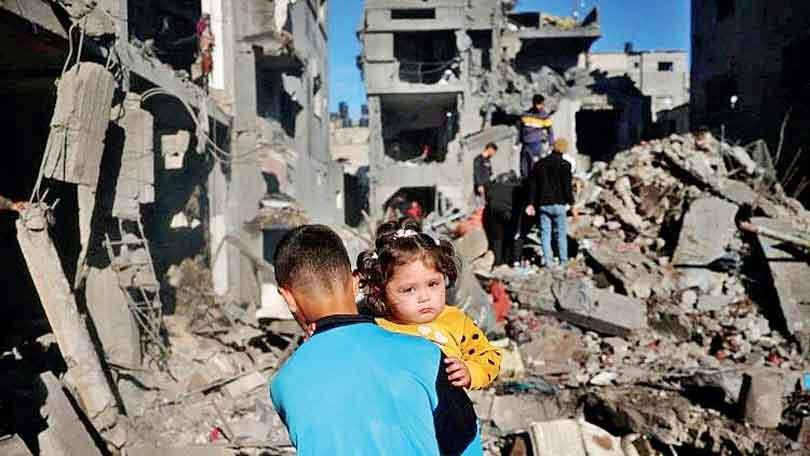
Palestinian children amidst the rubble at the Nuseirat refugee camp in central Gaza. AFP file photo
 To the children of Gaza, United Nations reports, however strongly worded, offer little hope. In recent weeks, a flurry of UN reports condemns Israeli practices and even accuses the Zionist state of committing genocide. But what use are these findings to Gaza’s children? Nearly 20,000 have been killed by Israeli bombs, about 44,000 are injured, and up to 4,000 have lost one or more limbs. And the figures continue to rise, despite a sham ceasefire.
Gaza’s children have been robbed of their childhood. The time they should be spending in classrooms, on playing fields and in the loving embrace of their parents is spent on long walks during displacement after displacement and in long waits for scarce food.
Thousands have been orphaned. In heart-rending images, traumatised children as young as ten—too young to understand family responsibility—are seen comforting their younger siblings.
The Voice of Hind Rajab, now showing in Sri Lankan theatres, vividly recounts the last two hours of a five-year-old girl pleading for help from inside a car where her cousins, uncle, and aunt lay dead after being shot by an Israeli tank in Gaza. She succumbed to her injuries even as rescue workers in Ramallah tried desperately to save her, staying on the phone with her until the end. Her death, live-streamed through audio clips on social media, was one among thousands in the ongoing genocide.
Despite the international sham of a ceasefire, at least one Palestinian child is killed by Israel every day. The ceasefire has not made Palestinian children safer. Only a few days ago, an Israeli soldier killed a seven-month-old Palestinian child. This only strengthens the allegation that Palestinian identity is being erased by preventing children from reaching adulthood and procreating.
The United Nations system has failed the Palestinian children. The so-called civilised world has failed them.
The recent UN reports that display the courage to call a genocide a genocide win applause, but they also highlight the system’s impotence. The world expected the UN system to rise like a superhero to save Gaza’s children and civilians from the evil force when bombs fell and families were buried alive under concrete rubble. After all, the UN was not created to let the innocent die in war but to prevent war and genocide.
Agree, the UN system lacks the rules and resources to act like the world’s policeman. Agree, it is only an instrument at the mercy of big powers. Agree, the UN Security Council has been hijacked by veto-wielding powers. Agree, the United States often uses its veto to shield Israel and allow the Zionist state to commit genocide and war crimes.
Besides, the UN has never invoked the Doctrine of Necessity to act outside the charter and assert its responsibility to protect the vulnerable. To act, it awaits the authorisation of the politically manipulated Security Council. Against Israel, it never happens. Given these limitations, what else can the UN do? It produces volumes of reports that do little to serve the victims, while letting perpetrators off the hook with little more than naming and shaming.
Notwithstanding these limitations, had the UN acted more decisively with the very first signs of genocide in Gaza, it could perhaps have saved many more lives. If US political interference ties the UN’s hands, it could at least have given momentum to a global movement against genocide, just as it does at climate conferences. If Francesca Albanese, the UN-appointed rapporteur for Palestine, could become the powerful voice of Palestinians, certainly the Secretary-General could have become a stronger voice against genocide. The UN Secretary-General’s role is not merely administrative; he has a responsibility to protect innocent civilians in armed conflicts.
If the outgoing Secretary-General António Guterres or his successor needs inspiration to be courageous, they could look to Dag Hammarskjöld. Often described as the most influential Secretary-General, Hammarskjöld shaped the office with a vision of turning the UN into a moral force. As a true guardian of peace, he took bold initiatives in crises such as Suez (1956) and Congo (1960). Inspiration could also be drawn from Kofi Annan, who had the courage to publicly declare that the US invasion of Iraq was illegal.
What we require from UN officials, from the Secretary-General downward, is the courage to stand up to big powers. Selectively targeting less powerful countries like Sri Lanka and initiating war crimes probes only casts a shadow on UN impartiality.
In defence of the UN, proponents say that an inefficient UN system is better than no UN system. But this familiar excuse for inefficiency must no longer be accepted.
While our criticism is aimed at reforming and empowering the UN system, the recent UN reports on Palestine, with a special emphasis on children, though too little and too late, are still welcome. The strongly worded and evidence-based reports were outstanding. They drew angry responses from Israel. One of these reports addressed conflict-related sexual violence. Another concerned violations against children in armed conflicts, including Gaza. Yet another was issued by the UN Independent International Commission of Inquiry on the Occupied Palestinian Territory and Israel.
On June 19, a heated argument erupted at the UN Security Council between Israel’s ambassador and genocide defender Danny Danon—and Vanessa Frazier, the UN Secretary-General’s Special Representative for Children and Armed Conflict. It happened during a meeting to mark the International Day for the Elimination of Sexual Violence in Conflict, after Frazier’s report, along with the one prepared by Pramila Patten—Special Representative on Sexual Violence in Conflict—blacklisted Israel and was presented to the Council.
Not to be silenced or intimidated, Frazier, a seasoned diplomat from Malta, defended the reports as based on “verified evidence,” even as Danon repeatedly told her to “be quiet” and called the proceedings and her involvement “shameful.”
The UN needs, from the Secretary-General downward, officials in the calibre of Frazier and Albanese.
This Tuesday, yet another UN report—compiled by the UN Independent International Commission of Inquiry on the Occupied Palestinian Territory, including East Jerusalem, and Israel—noted that Israel’s targeting of neonatal and maternity care centres during its war on Gaza directly endangered Palestinians’ reproductive future and the survival of newborns. It reported a rise in miscarriages, birth defects, and lasting vulnerabilities.
Its chairman, Srinivasan Muralidhar, said the commission had found “indisputable evidence” of the deliberate targeting and killing of Palestinian children, as well as torture, inhumane and degrading treatment, sexual and gender-based violence, and attacks on infrastructure essential to children, including orphanages, healthcare facilities, and schools.
Reports take time and do not stop war crimes or genocides. Reports lose their muscle against powerful nations such as Israel. What is required from the US is quicker, more immediate preventive action. If rules are not in the UN Charter, they must be found—though reforms have sadly been defied the UN system for the past eight decades.