Reply To:
Name - Reply Comment
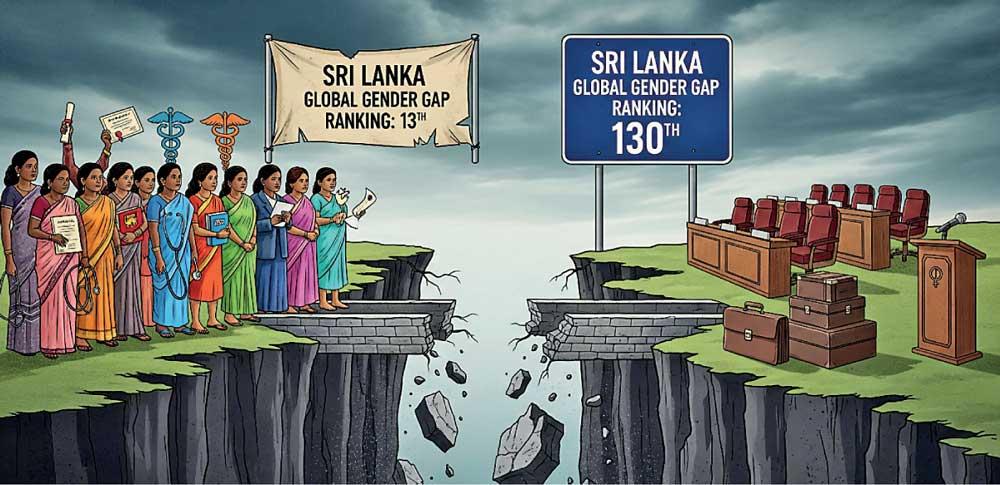
Gender at a Crossroads: As Sri Lanka slides down global gender indexes, empowering women is no longer optional, but essential. FILE PHOTO
 The 2025 edition of the World Economic Forum’s Global Gender Gap Report singles out Sri Lanka as the world’s only backslider on gender parity. Of the 100 nations monitored consistently over the past two decades, 99 have improved; Sri Lanka is the lone outlier, where the gender gap has widened. This decline is measured through the report’s Global Gender Gap Index (GGGI), which tracks disparities between men and women across four dimensions—economic participation, educational attainment, health and survival, and political empowerment—assigning each country a score from 0 (maximum gap) to 1 (no gap) since 2006.
In 2006, Sri Lanka ranked 13th out of 115 countries — ahead of Australia, Canada, Switzerland, and Singapore. Its score was 0.719, indicating that the country had closed 72% of the gender gap across four dimensions. By 2025, it had plunged to 130th out of 148 countries, placing it among the world’s worst performers, with a score of 0.645. Over two decades, it has fallen 117 places and lost 7.5 percentage points, reversing nearly one-tenth of the progress previously achieved. While a drop in rank can sometimes reflect the faster progress of other countries, in this case, the decline is both relative and absolute: Sri Lanka’s score has fallen, not just its position.
Losing the “political premium”
A significant part of this decline stems from the political empowerment sub-index, which is based on three indicators: (1) the ratio of women to men in parliament, (2) the ratio of women to men serving at the ministerial level, and (3) the ratio of years with a female head of state over the past 50 years. For decades, Sri Lanka enjoyed what could be called a “political premium” in this third measure. In 2006, we ranked first in the world here, largely because we were the first country to elect a female head of state, Sirimavo Bandaranaike.
Many Sri Lankans take pride in her 1960 election, often cited as evidence of the country’s progressive stance on gender equality. But this interpretation is overly simplistic. Bandaranaike’s rise was not the product of a society committed to broad-based female empowerment; it was the outcome of a political dynasty and class privilege—familiar features of Sri Lankan politics then and now. The subsequent presidency of her daughter, Chandrika Kumaratunga, extended this “premium” in global rankings. As this artificial boost faded, the score in this indicator dropped sharply—from 0.72 in 2006 to 0.009 in 2025.
Stalled progress in economic participation
The more enduring—and more troubling—reason for Sri Lanka’s poor performance lies in the Economic Participation and Opportunity Index. In both 2006 and 2025, the country’s score in this dimension was 0.545, showing no progress in two decades. This lack of progress reflects deep-seated structural and cultural barriers that continue to prevent women from participating equally in the economy. The index is based on five sub-measures: labour force participation rates; wage equality for similar work; estimated earned income; representation among legislators, senior officials, and managers; and representation among professional and technical workers.
Zooming in on one sub-measure—the labour force participation rate—the country has remained at 0.45 over the last two decades. In contrast, India’s score rose from 0.41 in 2006 to 0.459 in 2025, a gain of 4.9 percentage points—effectively bridging about 5% of the total gender gap in this indicator. While progress has been slow, India is at least moving in the right direction.
This stagnation stands despite Sri Lanka’s longstanding near-parity in educational attainment and health and survival, where scores have remained around 0.98 since 2006, indicating almost no gender gap. Women in Sri Lanka have achieved high levels of education and health outcomes, yet this human capital has not translated into economic empowerment.
Barriers to women’s economic opportunities
Sri Lanka’s stagnant female labour force participation stems from both cultural norms and systemic barriers. Deeply entrenched patriarchal expectations assign women the bulk of unpaid household and care work, limiting their time and energy for paid employment. Discrimination in recruitment and promotion further restricts access to economic opportunities. The lack of affordable, accessible, and high-quality childcare—and increasingly, eldercare—makes it difficult for women to remain in or re-enter the workforce. Unsafe public spaces, including widespread harassment on public transport, also deter women from seeking work and travelling to workplaces.
While cultural norms take time to change, several policy reforms are within immediate reach. One example is restructuring maternity leave so it is financed by the government rather than employers, reducing the disincentive to hire women of childbearing age. In 2019, the government took a step in this direction by proposing partial tax deductibility of maternity leave payments for private sector employers in the Budget. However, the proposal has yet to be gazetted or implemented. Similarly, ensuring safe, reliable public transportation and addressing harassment in public spaces—long-recognised problems—require not more discussion, but decisive action.
Moving beyond symbols
Sri Lanka’s reversal in the GGGI ranking should be a wake-up call. We can no longer rely on symbolic achievements from decades past to mask the lack of structural change. Having a woman at the top—even a prime minister or president—does not mean the gap is closing for women everywhere.
If we are serious about reversing this decline, we must address the root causes: stagnant economic participation, lack of enabling infrastructure for working women, and persistent social norms that limit their opportunities. Closing the gender gap is not only the right thing to do for women—it is an economic and social imperative for the entire country. Global evidence shows that narrowing gender disparities in the labour market can significantly boost GDP, increase household incomes, and improve social outcomes. The World Bank’s Gender Thematic Policy Note Series (2023) estimates that closing the labour force participation gap could raise GDP per capita by as much as 20%. The path forward requires more than rhetoric—it demands sustained investment, policy reform, and a commitment to measuring and enforcing progress.
The writer is a doctoral candidate in economics at the University of Halle-Wittenberg, Germany, and a Research Associate at Verité Research. Her work focuses on empirical questions in environmental economics, with a particular interest in climate policy and well-being.