Reply To:
Name - Reply Comment
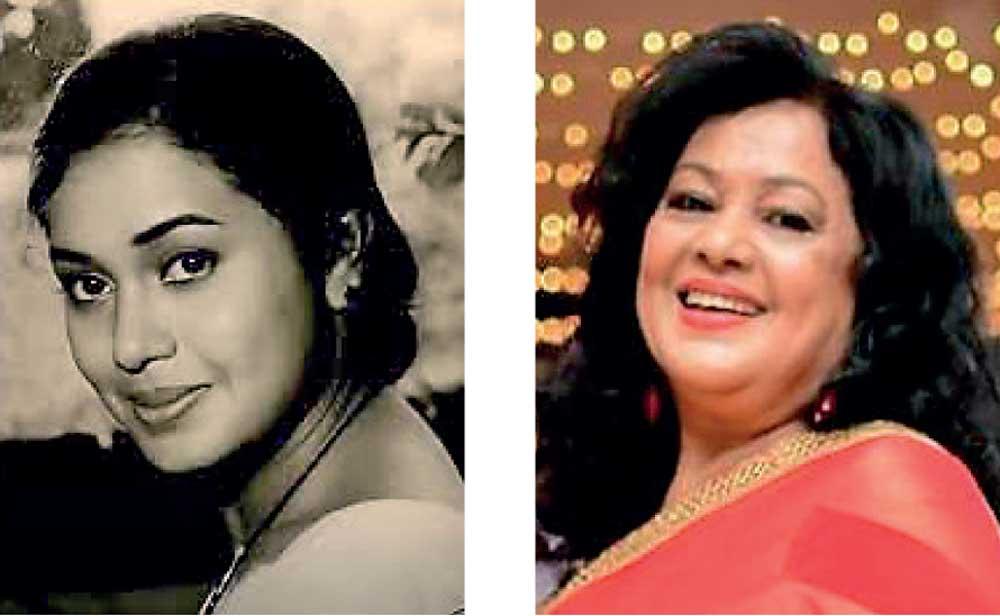
Malani Fonseka reigned as queen of Lankan cinema for several decades
By Rajitha Weerakoon
Malini Fonseka, the Queen of the Silver Screen who passed away a year ago leaving behind a legacy of over hundred and fifty films, was a symbol of perseverance. Tilak Kuruvitabandara, Editor and commentator on literature and the arts is someone who watched Malini’s progress since the inception and applauds her amazing resilience. He says Malini’s determination to succeed was unmatched.
So much so that during the nearly seven decades of her dominance in the world of cinema, Malini went on to conquer both artistic masterpieces as well as high grossing commercial films reaching the highest pinnacle of success in the Sri Lankan cinematic field.
Her entry to the stage however had taken place quite by chance when she, yet a school girl at Gurukula Maha Vidyalaya, Kelaniya, was invited by the Vidyalankara campus to play the lead role in the campus production of a drama called “Noratha Ratha.” The University at the time had no female students and the drama circle was in need of an outsider to play the lead role. Urged by her school’s dancing teacher, she accepted the role. Later, she commented that her passion for acting was born on the floor of that campus theatre.
Her first performance on a public stage was in “Akal Wassa” which won her the 1963’s “Best Stage Actress’” award. The success no doubt proved a stimulant. Commentator Kuruvitabandara says that her performance in “Akal Wassa” also led her to become an actress to take note of. The play with a controversial theme was written and directed by S. Aloka Bandara, S. Dharmadasa Jayaweera and S. Karunaratne (“S Thuna Group”) and was a phenomenal success.
The Award did launch her on a long journey as she was picked for two more stage plays of S. Karunaratne -- “Erabudu Mal Pottu Pipila” in 1964 and “Hiru Avarata Giyado.”
She was however, yet confined to the stage. It took five more years for Malini to make a breakthrough to films when she was introduced to film-maker G.D.L. Perera by Joe Abeywickreme. G.D.L. was making “Dahasak Sithuvili” – a film acclaimed as a pioneering psychological drama that won a series of Sarasaviya Awards in 1968. G.D.L. however, had already cast Nilanthi Wijesinghe and Henry Jayasena in the lead roles and Malini had to be contented playing the subordinate role of the heroine’s sister.
Film Director Tissa Liyanasooriya in the meantime, who had made a note of Malini’s stage performance in “Akal Wassa, ” offered her the leading role in his film “Punchi Baba.” This, in quick succession was followed by Kumar Weerasinghe’s “Abhudassa Kaale” and Amaranath Jayatillke’s “Aaadaravanthayo” filmed in 1969.
Journalist Kuruvitabandara, shifting gears to the cinematic landscape that existed at the time of Malini’s early years, commented that this was a transformative era in the Lankan film industry with the doyen of Lankan cinema Dr. Lester James Peries (LJP) having introduced a realistic tradition of film-making. Several more Directors in their wake were bringing to screen profound themes that touched the lives of people.
The shift made way for the entry of a new breed of actors which clamoured to be part of this nouveau cinema. Maestro Peries in the meantime was picking new faces. The leading lady of his landmark film “Rekawa” (1957) – Mallika Pilapitiya, who played the role of a simple village girl, was a novice to films. Irangani Serasinghe too, played her debut role in “Rekawa.” It laid her a solid foundation to continue a cinematic career for nearly seven decades.
Even in 1960, Dr. Peries chose a newcomer – Kanthi Gunatunge for his second film “Sandesaya.” It was the first for his leading actor – Ananda Jayaratne as well. And the master film-maker had not been able to resist including a couple of songs and dances in these early films.
Punya Heendeniya, however, was an exception. Punya with her typical Sri Lankan looks was picked to play the heroine’s role in “Gamperaliya”- the adaptation of Martin Wickremasinghe’s seminal Sinhala novel that depicted the social transformation of the village. Punya had already impressed viewers with her portrayals in 1966’s “Kurulu Badda,” “Deiyange Rate” and “Sikuru Tharuwa.” But even after
“Gamperaliya,” she remained with LJP continuing to play Nanda in LJPs’ “Kaliyugaya” and “Yuganthaya” that made up the Wickremasinghe trilogy, as well as several more of maestro Peries’ films.
For “Golu Hadawatha” (1968) the story based on Karunasena Jayalath’s popular novel, Dr. Peries’ choice once again newcomer Anula Karunatilleke to portray the playful role of Dhammi. It was only in 1969 that Malini caught the eye of Dr. Peries, resulting in her being cast in a secondary role in “Akkara Paha” – the role of the protagonist’s sister.
Malini made her major breakthrough to her first arthouse film only in 1972 when LJP cast her as Irene Abeynayake opposite the legendary Gamini Fonseka in the celebrated film “Nidhanaya.” The film in black and white was based on a dark tale authored by G.B. Senanayake. Malini’s haunting and deeply nuanced performance contributed to define the Golden Era of Sinhala cinema, establishing her as one of Asia’s greatest performing actresses. The film – her fourteenth, finally won her the “Best Actress’” Award in 1972 and was selected for the Cinematheque Francaise’s list of the top hundred films of the century. The film also won the Silver Lion of St. Mark award at the1972 Venice International Film Festival. Categorised as an outstanding film, it received a Diploma at the London Film Festival.
Having established herself as an award winning actress, Malini in 1980 enlivened the role of “Punchi Manike” in LJP’s “Baddegama,” the Sinhala film version of Leonard Woolf’s novel “Village in the Jungle.” The film with a cast that included Joe Abeywickreme, Vijaya Kumaratunge, Henry Jayasena and Arthur C. Clarke was featured as the official selection in the prestigious “Directors’ Fortnight” section at the Cannes Film Festival in 1980.
Plaudits followed with more offers to Malini for arthouse films from directors of the new generation. In 1975, her role as Susila in Dharmasena Pathiraja’s “Eya Dan Loku Lamayek,” the story of a village girl grappling with harsh realities in a patriarchal society, was yet another winner. The film was considered as one of her career’s defining moments. It earned her a prestigious Honorary Diploma at the Ninth Moscow International Film Festival in 1975.
Commentator Kuruvitabandara said that she did even better in Pathiraja’s “Bambaru Avith, ” filmed in 1978 based on a story about a clash between urban entrepreneurs and local fishermen. The film was selected for screening in the Classics section of the Cannes Film Festival in 1979. She also won international acclaim for her stellar performance as Ranmanika, the wife of the famed bandit Marusira in “Siripala and Ranmanika.” Ravindra Randeniya played the role of Siripala.
Malini was duly named as one of Asia’s twenty five greatest film actors of all time by CNN and won the Slim Nielsen People’s Award for the most popular Actor twelve times.
Having succeeded Rukmani Devi and Jeevarani Kurukulasuriya who reigned before her as celluloid queens, Malini conquered both insightful, artistic masterpieces as well as high grossing commercial films such as “Thushara,” “Sanakeliya” and “Kasthuri Suvanda”, balancing the contrasting personaes of the typical innocent village lass as well the role of the sophisticated city girl.
What amazes journalist Kuruvitabandara is how she blended into any format. While she slipped into characters which were profoundly sensitive and nuanced, she also effortlessly blended into highly energetic, larger than life glamour girl’s roles.
Her co-stars, he said, included top actors such as Gamini Fonseka, Ravindra Randeniya, Sanath Gunatilleke and Lucky Dias. The onscreen pairing therefore was popularly dubbed as Gamini-Malini, Ravindra-Malini, Sanath-Malini and Lucky-Malini. Having co-starred with Vijaya Kumaratunge in over 40 films however, they remained as the most popular duo with Malini-Vijaya ending as Sri Lanka’s star couple.