Reply To:
Name - Reply Comment
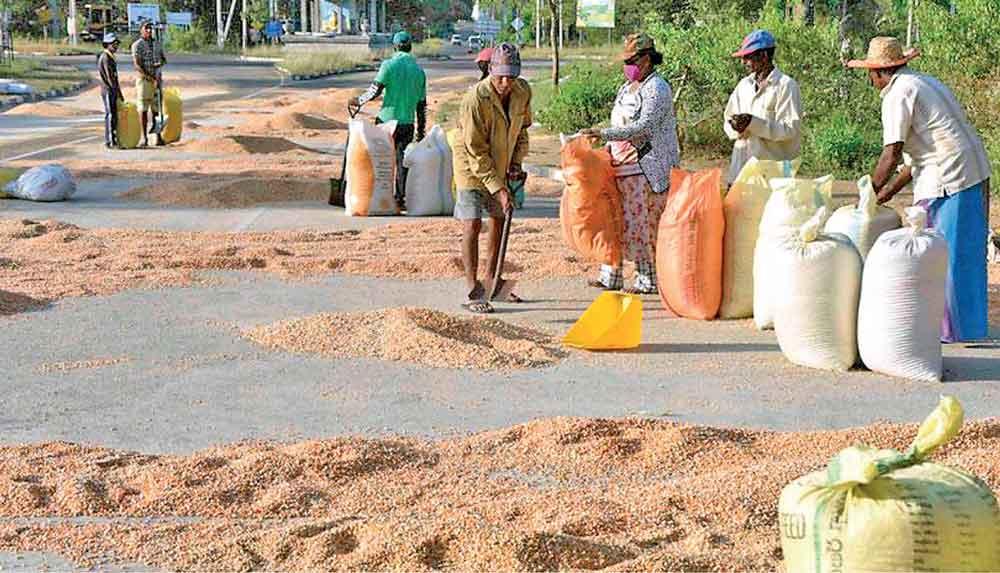
Sri Lanka’s local maize harvest simply cannot meet the country’s poultry and livestock feed requirements (pics by Nimalsiri Edirisinghe)
By A Special Correspondent
For over a decade, Sri Lanka’s poultry and livestock industry has sat across the table from successive governments, pleading for a rational, predictable maize import policy. Since 2012, industry representatives have raised the same warning at every meeting: without timely, adequate access to maize-the single largest raw material in poultry feed, accounting for roughly 50% of every feed formulation-the industry cannot function, and consumers will pay the price. Year after year, the response has been the same: half-measures, delays, and a policy environment that seems designed to squeeze the industry rather than support it. This year, that failure has reached its worst point yet.
A tax that kept climbing
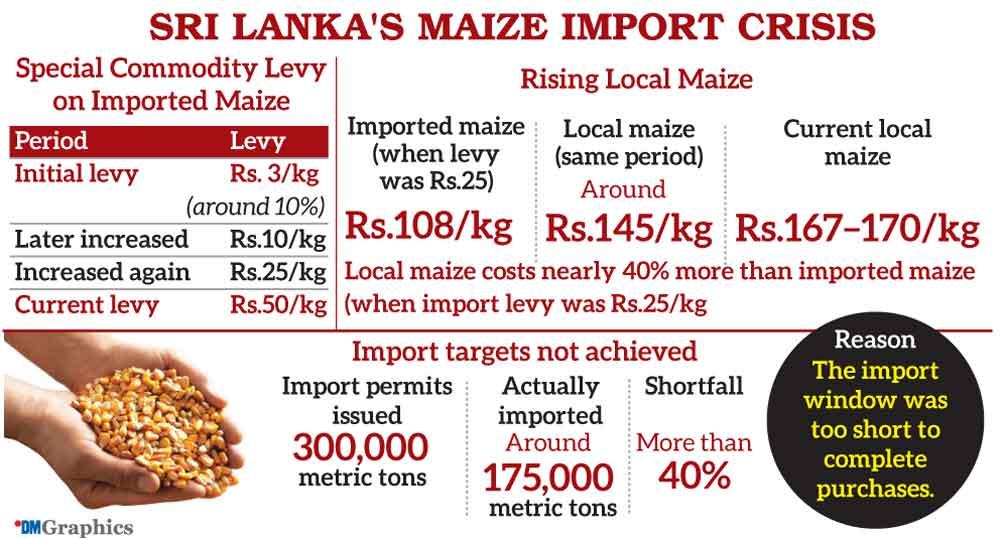
The Special Commodity Levy on imported maize tells its own story. It began at 10% -around Rs 3 per kilo. It was then raised to Rs 10, and later to Rs 25. Even at Rs 25, imported maize could be landed, duty paid, at around Rs 108 per kilo-against a local price of roughly Rs 145. That is a premium of nearly 40% for local maize over the imported, tax-paid alternative.
This year, the levy has been pushed up again-to Rs 50-while local maize now trades at Rs 167 to Rs 170 per kilo. The industry is being forced deeper into a market that is not just expensive, but dangerous.
For years, even as local prices climbed, the industry absorbed much of this cost itself. By blending in the cheaper imported maize it was able to secure, it averaged out its raw material costs and kept egg and chicken prices affordable for the local consumer-effectively subsidising the market out of its own margins. That cushion is now gone. With imports slashed, delayed, and finally cancelled altogether, there is nothing left to average against the high cost of poor-quality local maize. Every one of these bad practices is now translating directly into higher prices at the till — a cost the consumer, not the industry, will ultimately bear.
Feeding birds with poison
The quality of locally produced maize is, in a word, unacceptable. It is inadequately dried, poorly stored, and routinely tested with aflatoxin levels far beyond the permitted maximum of 20 parts per billion-a toxin to the birds that consume it. The industry is paying a premium price for maize that, by any reasonable safety standard, should not be entering the feed chain at all.
Why does this happen? Once the Maha season harvest ends, maize passes out of farmers’ hands and into the hands of stockists. The Consumer Affairs Authority, whose role should be to ensure stocks are released into the market in a timely and cost-effective manner, does nothing to compel this. The result: stockists sit on inventory, prices are driven up, and quality deteriorates in storage — while the poultry industry has nowhere else to turn.
A policy designed to fail
Sri Lanka’s local maize harvest simply cannot meet the country’s poultry and livestock feed requirements. The deficit must be imported-that much is not in dispute even by government’s own numbers. But the way import permits are managed turns a manageable supply gap into a full-blown crisis, and it does so in three specific ways.
First, timing. Import permits should logically be issued at the start of the year, allowing larger stakeholders to import their requirements while small-scale producers buy directly from local farmers. This would keep local prices stable and give everyone predictable access. Instead, government only releases import quotas equal to the local deficit-and only after the local crop is in. The result is that every stakeholder, large and small, scrambles to buy the same limited local supply, driving prices to unaffordable levels.
Second, the import window itself is disconnected from global harvest cycles. Licences are typically only granted from around June or July, with a three-to-four-month window to bring maize into the country. This does not align with international harvest calendars- and once major exporters like India and Pakistan learn that Sri Lanka has issued import licences, prices there rise too. Sri Lanka pays more, on a shorter timeline, for the same maize.
Third, the numbers don’t add up even when licences are granted. Last year, 300,000 metric tons of import permits were issued-yet only around 175,000 metric tons were actually brought into the country, a shortfall of well over 40%. This was not a failure of intent or capacity on the industry’s part. A short, misaligned import period, disconnected from global harvest cycles, makes it structurally impossible to import the full licensed quantity in the time allowed.
This year: The worst yet
This year’s handling of maize imports has been the most damaging the industry has experienced. Expecting licences in line with past practice, the industry limited its purchases of local maize to only what it anticipated needing to supplement imports. Instead, the government granted just 50% of the requested import volume and attached conditions that made even that quantity nearly impossible to bring in on schedule.
Importers were required to complete all imports within four months, by October, placing enormous strain on working capital. Worse, each Letter of Credit had to be fully executed before the next could be opened- effectively limiting any single import transaction to just 20–25% of total requirement at a time, and forcing sequential, drawn-out shipments. Then, before that process could even run its course, the government cancelled all remaining maize import permits outright and is now asking the poultry industry to buy rice instead.
Rescuing one failure with another
This last move exposes the real problem. The push toward rice has nothing to do with poultry feed requirements. It is worth noting that the very same government had, not long ago, banned the use of rice and paddy in animal feed production altogether through a gazette issued by the Consumer Affairs Authority. That ban has now been quietly revoked, with a new gazette permitting the processing, sale, and use of rice and paddy in animal feed once again, effective from late June. In other words, a regulation that once shut this option out entirely has been reversed not to serve any coherent feed policy, but simply to suit the government’s own predicament. It exists because government has over-imported rice, leaving it without the storage space or funds to buy paddy from farmers during the current harvest- leaving paddy farmers, too, up in arms. Rather than resolve a crisis of its own making, government is once again turning to the poultry industry to absorb the consequences.
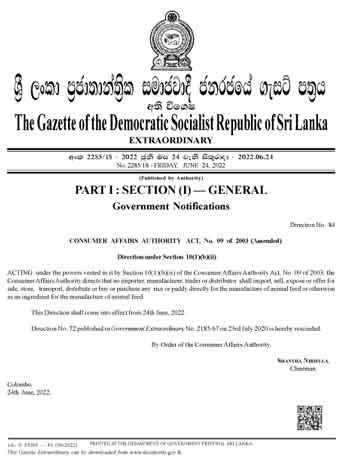 |
| Acting under the powers vested in it by Section 10(1)(b)(ii) of the Consumer Affairs Authority Act, No. 09 of 2003, the Consumer Affairs Authority, with this gazette notification, was able direct that no importer, manufacturer, trader or distributor shall import, sell, expose or offer for sale, store, transport, distribute or buy or purchase any rice or paddy directly for the manufacture of animal feed |
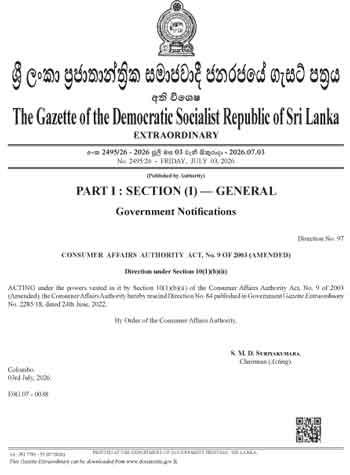 |
| Acting under the powers vested in it by Section 10(1)(b)(ii) of the Consumer Affairs Authority Act, No. 9 of 2003 (Amended), the Consumer Affairs Authority rescind Direction No. 84 published in Government Gazette Extraordinary No. 2285/18, dated 24th June, 2022 |
An industry trying to compete globally sans support
Despite every one of these obstacles, the industry has continued to invest in export markets and hold its own against international competition, including honouring supply commitments to the Maldives. This is an industry that has been built almost entirely by the private sector, through its own investment and initiative, into a globally competitive export earner. It has done so without meaningful state support-and it is now asking for exactly that: a government that enables, rather than obstructs, its ability to compete internationally. Assistance now is not a favour to the industry; it is an investment in one of the country’s genuine export success stories.
A way forward, not another stopgap
It is also worth asking why this protection is so one-sided. Paddy and maize farmers already receive government support to cultivate — fertiliser subsidies, access to loans, and other facilities designed to help them grow their crops. Poultry farmers receive no comparable assistance, despite producing the cheapest form of animal protein available to a nation that continues to battle malnutrition, and despite being a direct contributor to food security. If the state is willing to subsidise one side of this equation, it cannot justify indefinitely disadvantaging the other.
If the government’s intention is to protect local maize cultivation, that is a legitimate policy goal-but it cannot be pursued by holding an entire downstream industry to ransom indefinitely. If protection is the aim, it should come with a clear, time-bound plan: a defined period, of no more than three years, within which local maize cultivation is expected to reach international standards on both price and yield, with the fertiliser subsidies, loans, and other facilities already available to these farmers directed toward achieving that competitiveness. One to two cultivation cycles is sufficient time to bring about this change. Once that period lapses, imports must be opened up freely. If local cultivation still cannot compete on price, quality, and safety after being given that opportunity and that support, then farmers should be supported and encouraged to transition to a more productive use of that land-not left, year after year, as the justification for a policy that damages poultry, livestock, and ultimately consumers. Indefinite protection without a path to competitiveness is not a maize policy; it is a permanent tax on every other industry and household that depends on affordable, safe feed.
Efficiency gains that never reach the consumer
What makes this all the more concerning from a consumer standpoint is that the poultry industry itself has not been standing still. Year on year, producers have driven down their own costs and improved efficiencies across breeding, feed conversion, and farm management-the kind of productivity gains that, in a functioning market, should translate into more affordable eggs and chicken for the household. Instead, those gains are being absorbed and reversed by rising taxation, an unpredictable import regime, and inflated local raw material costs. The result is that consumers have seen poultry prices climb year after year, not because the industry has become less efficient, but because government policy has made it impossible for efficiency to reach the market. That is a trend consumers should be watching closely-and asking why.
The bottom line
The poultry and livestock industry is being held to ransom — forced to pay inflated prices for contaminated maize, denied a rational and timely import framework, and now asked to bail out an unrelated policy failure in the rice sector. The cost of this dysfunction will not stay with the industry alone. It will show up in higher egg and chicken prices, tighter feed supplies, and continued harm to bird health and productivity for as long as substandard, aflatoxin-laden maize remains the only local option.
The industry has been raising these issues since 2012. It is time government, opposition, and the public alike recognised that this is no longer an industry problem-it is a food security problem, and it requires a permanent, structural fix, not another season of stopgap measures.