Reply To:
Name - Reply Comment
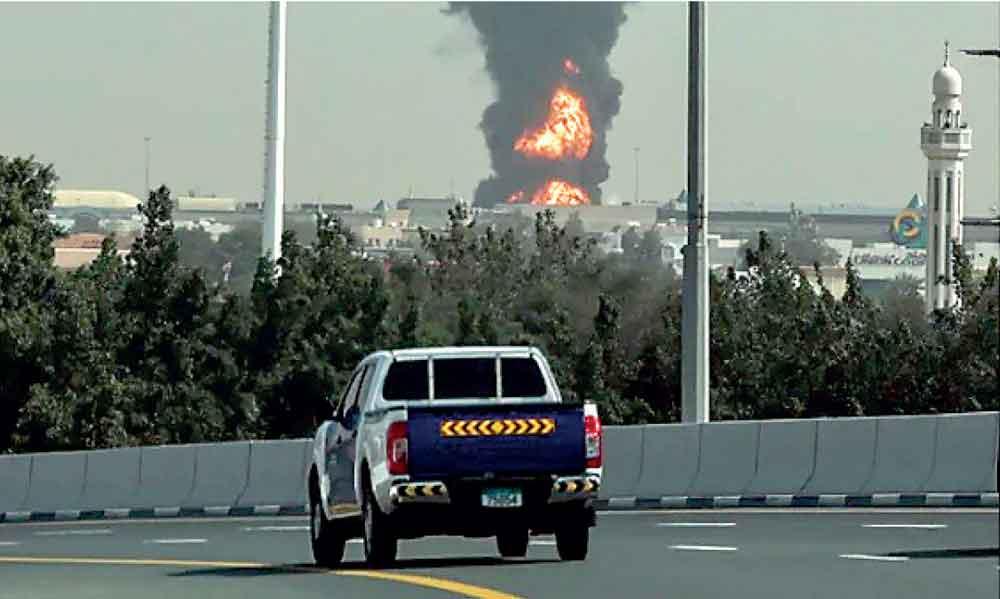
Smoke rises from a fire at Dubai International Airport in Dubai on March 16, 2026, after a drone attack
 For twenty five years, Dubai was a never-never land for the upwardly mobile from all over the world-from business tycoons to engineers, tech professionals and speculators who wanted the best that money can buy, a futuristic steel-glass-concrete haven where they were immune to the world’s troubles.
For status travellers, Dubai was the place to be seen. To be seen shopping or dining in Dubai was part of that status. But at present those glitzy shopping malls and restaurants are mostly empty, hotel managers are offering cut rates to visitors and apartments are offered unbelievably cheap to anyone who wishes to rent or buy.
But there are hardly any takes. There has been a steady exodus out of Dubai since February this year, when the US and Israel began their undeclared war against Iran, and Iran retaliated with missile attacks on the Gulf countries.
The war certainly took its toll on Dubai’s service sector. Dubai International Airport has been for years among the busiest in the world, with hundreds of long-haul routes from Europe, Africa, the Americas and Asia using it. But, as the war quickly escalated, the entire global flight network had to re-route. Cancellations became the norm just hours after the first bombs were dropped on Iran. Flights were forced to detour, and ticket prices soared.
Tourism suffered as a result. Dubai, a top holiday destination for Europeans, was now listed as a high-risk destination, and family holidays shifted to Greece. By March 2026, flights were cut by half and bookings collapsed by 80%. Hotel occupancy too, suffered greatly as a result, with exotic Dubai resorts such as Palm Jumeira began seeing occupancy figures drop from 85% to 20%. The war began to cost the broader Middle East tourism sector US$600 million a day.
But this isn’t where Dubai’s current problems started. This exodus of wealthy residents began long before the war began. Hostilities only exacerbated it. Dubai’s troubles began long before Donald Trump and Benjamin Netanyahu started this war.
Middle Eastern wealth is hinged on oil. But Dubai’s oil resources are limited. Natural resources are limited, too, and the population very small – out of five million people, almost 90% are foreigners.
Sheikh Mohammed bin Rashid Al Maktoum, ruler and Prime Minister of Dubai, is hailed as the architect of Dubai’s economic miracle, depending on other sources of income to fuel Dubai’s economy-high end service sector and tourism.
To achieve this, a make believe, futuristic megacity had to be constructed with concrete, glass, steel and synthetic materials on desert sand. Sheikh Mohammed was hailed as a visionary and genius for achieving this in such a short span of time.
Dubai has been through two major crisis during its boom years. The first was the global financial crash of 2009, when it asked for and received a US $25 billion bailout from Abu Dhabi to avoid collapse.
The second crisis was the pandemic. But Dubai turned the international health crisis into an advantage. While other countries closed their doors to visitors, Dubai welcomed them in – high end visitors, that is. Thousands of wealthy Europeans, frustratingly locked down in their homes, settled down in Dubai. In 2023, just after the pandemic, Dubai received 17,150,000 tourists.
By 2024, there were 18,720,000 visitors, 20% from Western Europe. The arrivals rate went up by 15% every year, and hotel occupancy reached 78.2%. In 2025, there was a high of 19, 590,000 visitors. Dubai’s Department of Economy and Tourism called it a golden era. But, beneath all the exuberance, cracks were appearing.
Rent had been rising dramatically over the years, forcing major retail stores which turned Dubai into such a byword for classy shopping to close their doors. Dubai rental costs surged by 7.1% in 2025. Prime locations showed a 15% increase year after year.
West Elm closed its doors in Dec. 2025. Earlier, the British department store Debenhams closed up in June 2025. Life in Dubai was expensive. This didn’t matter so much to the super rich, but not everyone who came to Dubai to work and live wasn’t in that category. For those with children, an international school cost $55,000 per annum per child. Apartments cost, too, were very high, and residents became increasingly transient.
No business model can prevail counting entirely on the rich. They have the money to live and invest in anywhere they choose to, and their moods can be capricious. The wealthy came to Dubai from Russia, India, the UK and East Africa for different reasons. As many as 4,400 individuals worth over US$10 million each re-located to Dubai.
Dubai didn’t claim income tax from them. It was a tax haven. The Russians came because their capital was locked out of European banks. Indians came to escape strict financial regulations. The wealthy British came to escape UK tax reforms.
But the rich can get easily bored, too. After a while, Dubai had nothing really new or interesting to offer them. It’s all concrete, glass and shining metal. Outside the air conditioning, the heat is unbearable. Tourists can ski indoors all day long, but now the emphasis has shifted to the authentic cultural experience, and it isn’t just backpackers, whom Dubai has never catered to, who are gluttons for that.
When they travel, people want to experience traditional cuisine, dances, art and craft instead of what is artificial. Dubai has little of that to offer. People are now shifting to Patagonia, the Maldives, Greece, Bali and Iceland’s national parks. Besides, Dubai has got a strong rival in the region – Saudi Arabia, which has embarked on an ambitious $300 billion dollar project including 8000 hotel rooms in fifty resorts, and plans to turn Red Sea islands into ultra luxury properties; and those islands have protected natural coral eco systems.
All this doesn’t mean that Dubai is doomed. It’s down, but is already reaching out to Chinese tourists, whose number have increased by 7%, and targets 40 million visitors by 2031.
But the dilemma of tourism is that short term solutions can undercut long term objectives. A Chinese visitor spends 22% less than a European traveller, and adjusting related services to that category can take years. Besides, Dubai has major ecological and environmental problems caused by global warming, not just extreme heat but extreme rainstorms, too, and solutions are going to be expensive.