Reply To:
Name - Reply Comment
By Nandakumaran Dharshika
|
Painted by different women from different districts in Batticaloa, these paintings become something larger than the sum of their parts |
Can the grief and the quiet hope of women who have lived through war ever be held within a single frame? I found my answer to that question on June 27, when I walked into an exhibition titled “A Brief Respite for Wounded Minds, Through Colours,” organised by the Centre for Human Rights and Development (CHRD) in Batticaloa. That single day became an experience I know I will carry with me for the rest of my life.
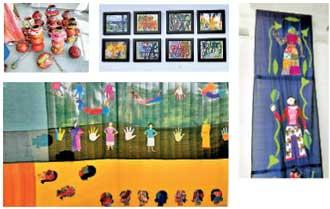
The hands reached down from the ceiling before anything else did. Dozens of them, cut from paper, painted in blues, ambers, magentas, hanging on threads that swayed gently whenever someone walked beneath. It took me a moment to realise that each one had been painted by a different woman, in a different district, on a different day — and that together, strung up under one roof in Batticaloa, they had become something larger than the sum of their parts. I stood beneath them for longer than I meant to.
I had come to see “A Brief Respite for Wounded Minds, Through Colours,” an exhibition organised by the Centre for Human Rights and Development, gathering artwork made by women from across the North and East who had lived through war, displacement, and the long, unfinished grief of not knowing what happened to the people they loved. What I found, over the hours I spent there, was not an exhibition in the usual sense at all. It was closer to a room full of testimonies that had chosen to speak in colour because words had, for too long, not been enough.
The scale of the effort behind it surprised me. Over the past months, workshops had been held in seven districts — Kilinochchi, Mullaitivu, Mannar, Vavuniya, Batticaloa, Trincomalee, and Ampara — bringing together 619 women under the guidance of the artist and feminist activist Vasuki Jeyasankar. What they produced filled the hall: appliqued cloth figures caught mid-dance, portraits built entirely out of dyed grains and pulses, clay pots painted and fringed with cloth, winnowing baskets transformed into canvases, framed abstract paintings that seemed to pulse with restrained feeling. None of it looked like therapy in the clinical sense of the word. All of it felt, unmistakably, like healing.
Colour, I learned, was doing more work in that room than I first understood. A deep red might carry loss in one painting and a fierce, defiant vitality in the next — the same hue serving two entirely different truths, depending on whose hand had mixed it and what that hand remembered. Yellow appeared again and again as a colour of hope, almost stubbornly so, as though the women painting it were insisting on a future they had every reason to doubt. Blue and green settled the eye, offering something like calm. Black, wherever it surfaced, seemed to hold silence — the specific, heavy silence of not knowing. Nobody needed to explain this to me. Standing among the paintings, I could feel it.
But it was the conversations, more than the canvases, that stayed with me.
I met a mother from Kilinochchi who had raised three sons. One died in the war, she told me, in the plain, worn-down voice of someone who has repeated a fact so many times it has stopped feeling like news and started feeling like a wound that never fully closes. Another son disappeared during the conflict and has never been found — not dead, not confirmed alive, simply gone, suspended in an uncertainty that she has now carried for years. “I have to live for my other son now,” she said, and then she wept, quietly, without any performance in it. I did not have the right words for that moment, so I offered none. I sat beside her and held her hand until the weeping passed. It seemed, in that moment, to be enough.
Not far from her stood a woman whose husband had disappeared in the same war, leaving her to raise their daughter alone. She earns her living weaving winnowing baskets — sulaku, in Tamil — and several of the painted baskets in the exhibition were hers, their surfaces covered in bright, careful hands not unlike the ones hanging from the ceiling above us. They were, she told me without much elaboration, simply how she had chosen to say what she felt.
What both women told me, almost word for word, was that CHRD and the people working within it had become something they could lean on — a kind of steady presence in years defined by the absence of answers. One of them used a phrase that has stayed with me since: that the organisation had become, in effect, a medicine for grief that has no other cure.
Tucked among the paintings were letters, too — written by mothers to sons they had lost or been separated from, full of blessings for long life, for love from family and community, for futures free of the sorrow the mothers themselves carried. Reading them, I understood that even after everything these women had endured, what they were sending forward, again and again, was not bitterness but love.
By the time I left, the light outside had shifted, and the hall behind me was still filling with visitors pausing under the paper hands, reading the letters, asking the women beside each piece what it meant. I thought, walking away, that this was perhaps the exhibition’s quiet achievement: it had not asked anyone to look away from pain, nor to dwell in it uselessly, but had shown, painting by painting, hand by hand, that pain given shape and shared with others can become something a person is able to carry, and even, eventually, to live beyond.
Nandakumaran Dharshika is from the Department of Fine Arts,
Eastern University Of Sri Lanka.