Reply To:
Name - Reply Comment
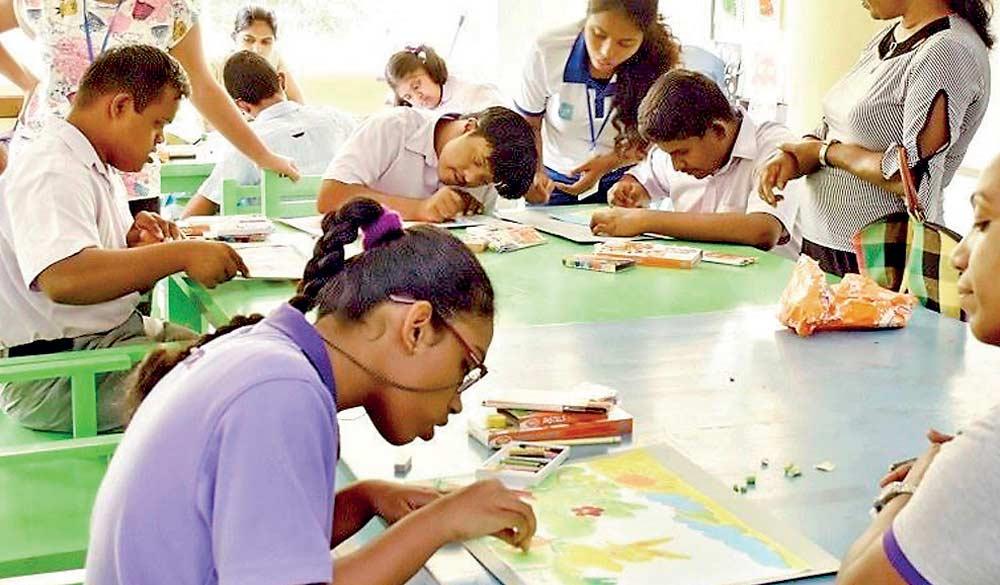
Photo courtesy: www.MENAFN.com
By Ravi Pratap Singh
On a humid morning in a small government school outside Kurunegala, a teacher waits patiently as ten-year-old Isuru tries to read a sentence aloud. The words come slowly. He struggles with letters, mixes up sounds, and looks down in embarrassment. Until recently, his teachers thought he was simply ‘lazy.’ It was only after a visiting education officer noticed signs of dyslexia that Isuru received special support. Today, he reads better, smiles more, and most importantly, still comes to school. Isuru’s story is not unusual in Sri Lanka. What is unusual is that someone noticed.
Sri Lanka is often rightly proud of its long-standing commitment to universal free education. But a national education system can be free and still leave too many children out quietly, consistently, and sometimes permanently. Inclusive education is the development agenda that asks a simple question with profound consequences: Are all children learning, participating, and progressing, especially those who face disability, poverty, language barriers, displacement, stigma, and learning differences? If the answer is “not yet,” then inclusive education isn’t a niche reform. It is the next big national priority because it sits at the intersection of human rights, economic recovery, social cohesion, and long-term productivity.
Inclusion engine for national development
When people hear inclusive education, many imagine only children with visible disabilities and classrooms with wheelchair ramps. Inclusion certainly includes them, but it goes much further. We need to definitely think beyond ramps and wheelchairs, when we talk about inclusive education. Inclusion means every child can access school, learn meaningfully, feel safe, and be supported to thrive whether the barrier is a physical disability, autism, a hearing impairment, poverty, a language gap, trauma, or simply being ‘left behind’ in a system built for an imagined average learner. Researchers and policy analyses describe inclusive education as ensuring students needing additional support spend most of their time learning alongside peers, rather than being segregated or pushed out.
For Sri Lanka it matters, because excluded children become excluded adults and exclusion has a national price tag in the form of lower lifetime earnings, higher dependency, higher health burdens, and intergenerational poverty. A development strategy that ignores inclusion is a strategy that accepts wasted potential.
In SL context, ‘now’ the right time
Three realities make inclusive education urgent today.
1) A significant population lives with disability and the system must respond: Sri Lanka’s disability prevalence is frequently cited at about 8.7% of the population (around 1.6 million people), based on national reporting and international disability-inclusion analyses. This figure, a silent national challenge, may be underreported due to stigma and measurement challenges, which makes proactive inclusion even more critical. Behind these numbers are children who may never be identified early, may be hidden at home, or may drop out when school becomes a daily experience of humiliation and failure.
2) Covid-era learning loss exposed and deepened inequities: UNICEF documented that students across Sri Lanka lost substantial instructional time during school closures, and many lacked access to online learning- creating serious risks of falling behind. In every country, learning loss hits the most vulnerable hardest: children with disabilities, children in poverty, children in remote areas, and those who need structured support. Sri Lanka now faces a choice: treat learning gaps as a temporary disruption, or rebuild the system so it becomes resilient and inclusive by design.
3) Sri Lanka already has a policy foundation, what is needed is decisive implementation: Sri Lanka’s policy environment includes national directions that recognise inclusion and equity as priorities. The National Education Policy Framework (2020–2030) provides the basis for reform across the system. More recently, the Ministry of Education and JICA produced a practical handbook on ‘reasonable accommodation for education,’ explicitly aimed at helping schools take real steps toward inclusive practice. This is important because Sri Lanka does not need to start from zero. The moment is ripe to convert policy intent into system-wide delivery.
How inclusion changes lives
It can be tempting to think inclusive education to be a ‘nice-to-have’ phenomenon. However, many of the local evidences and stories make it impossible to hold that view. It is important to note here that these are not isolated cases. They are symptoms of a system that was never designed with diversity in mind.
Case 1: The Brian story when a capable child is blocked by the system, not by disability.A Sri Lankan case narrative from a national higher-education inclusion initiative describes a blind student Brian, who excelled academically and dreamed of pursuing science, yet faced structural barriers like inaccessible learning materials and curriculum limitations (for example, certain content not being taught to blind students). The tragedy here is not that the student had a disability. The tragedy is that the system failed to adapt. Inclusive education is the difference between a talented student becoming a scientist, teacher, or innovator versus being redirected away from ambition because accessibility was too hard or too difficult.
Case 2: Plantation and rural schools where disability intersects with poverty and geography to enhance vulnerability exponentially.
Recent research on implementing inclusive education in plantation sector schools underscores real challenges and the need for frameworks that suit children with disabilities in those contexts. This matters for Sri Lanka because inclusion cannot be a Colombo-only reform. In communities where families may already face economic insecurity, the cost of exclusion is devastating: one child’s dropout can be the difference between a household climbing out of poverty or staying stuck for decades.
Case 3: Mainstream schools trying to ‘do inclusion’ without adequate support.
Sri Lankan studies highlight persistent barriers teacher training gaps, inconsistent support services, stigma, and weak system alignment making inclusion uneven across regions and school types. When teachers are willing but unsupported, inclusion becomes fragile: one motivated principal can create progress, but it does not survive leadership changes.
That’s why inclusion must be a ‘system agenda’, not a collection of isolated projects.
What inclusive education unlocks
1) A more productive workforce and a stronger economy: Inclusive education increases human capital. Children who receive early support -speech therapy referrals, assistive devices, individualised teaching approaches -are more likely to complete school, gain skills, and work. In contrast, disability is often linked with higher unemployment and poverty globally; Sri Lanka’s own disability-inclusion situation analyses highlight socioeconomic vulnerabilities among persons with disabilities. Inclusion is one of the most cost-effective long-term investments because it reduces future spending on welfare and health complications while expanding the tax base and entrepreneurship.
2) Social cohesion in a diverse country: Education is where a nation learns how to live with difference. Inclusive classrooms -when done well, create empathy and shared belonging. This is not soft rhetoric. In a country shaped by conflict-ridden history, displacement, and inequality, schools are one of the few institutions that can actively build social trust across lines of language, ability, and background. Inclusion strengthens the ‘we’ part of Sri Lanka.
3) Better outcomes for all learners: Universal Design for Learning (UDL) and reasonable accommodations are often introduced to support children with disabilities, but they improve learning for everyone through clearer instruction, varied ways to demonstrate learning, improved classroom management, less bullying, and more engagement. Sri Lanka’s recent reasonable accommodation guidance emphasises multi-layered interventions -local initiatives, whole-school efforts, and teacher skill development -because inclusion works when the entire school ecosystem shifts, not just one classroom.
Next big development agenda
If inclusive education is to become Sri Lanka’s next major development priority, it needs a clear national package, which is simple enough to scale and strong enough to transform outcomes.
1) Early identification and referral pathways (health-education linkage): Many children struggle for years before anyone names what is happening -hearing loss, vision impairment, autism, learning disabilities. Sri Lanka can build district-level screening and referral mechanisms linking schools, public health midwives, hospitals, and child protection services. This turns late-stage crisis into early support.
2) Teacher capability at scale and not one-off workshops: Research repeatedly highlights that teacher preparation and ongoing support are decisive. Sri Lanka needs sustained teacher training reform -practical classroom strategies, inclusive lesson planning, managing diverse needs, and working with parents. Mentoring models, where trained inclusion coaches support clusters of schools, are more effective than short trainings.
3) Reasonable accommodation as a non-negotiable standard: Sri Lanka now has updated guidance on reasonable accommodation, supported by JICA, intended to help schools take practical steps. The development agenda should operationalise the minimum accessibility standards, availability of assistive devices, learning materials in accessible formats, and examination accommodations, which is implemented consistently across all the provinces of the island.
Perhaps equally important is changing community mindsets. Parents and communities must see that children with disabilities are not burdens to be hidden but citizens with potential to be nurtured.
4) Data that finds the ‘invisible children’: Sri Lanka has historically used disability data sources including census-based reporting, and international best practice increasingly emphasises functional measurement approaches (e.g., Washington Group methods) for better comparability and visibility. The goal is not to label children, it is to ensure no child disappears from the system unnoticed.
5) Budgeting that matches values: Inclusion fails when it is treated as an ‘extra’. The State and donors should fund resource centres, itinerant special educators, assistive technology, transport support where needed, and school-level adaptations. Most accommodations are not expensive; what’s costly is exclusion.
The moral case
Inclusive education is ultimately about dignity. Sri Lanka’s children are not problems to be managed; they are citizens with rights and potential. A child who cannot hear the teacher clearly, a child who cannot read standard print, a child who panics in crowded classrooms, a child who learns differently -is not asking for pity. They are asking for access.
At this moment, we need to decide whether we want a recovery that rebuilds the old system and accepts its blind spots, or a recovery that ensures a nation where every child belongs.
Inclusive education should be Sri Lanka’s next big priority because it is the fastest route to a fairer society, a stronger economy, and a more resilient education system. Every year of delay is another cohort of children for whom the country did not make room to learn and thrive.
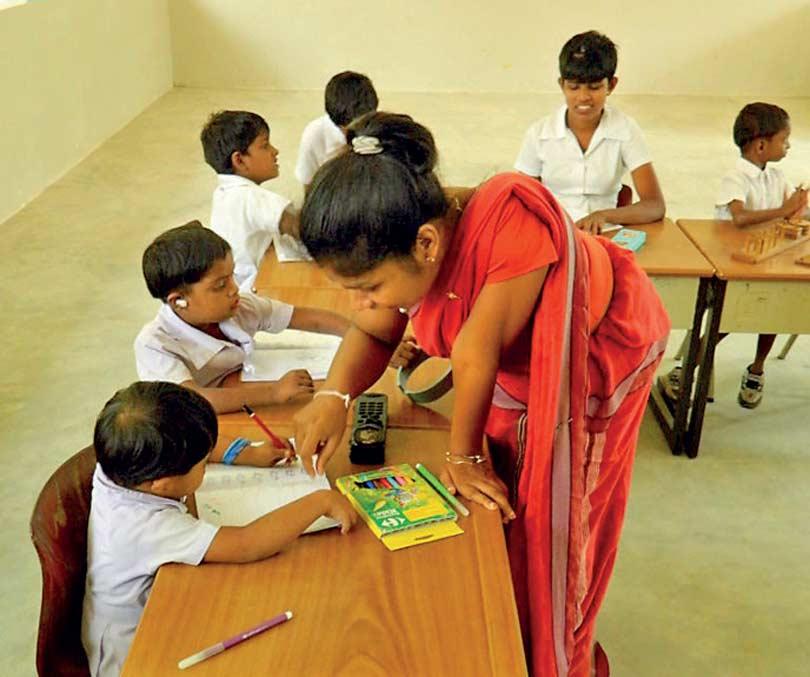
Photo courtesy: Global Giving
(The writer is a global public policy expert; and Managing Director of iLEAD International Academy, Sri Lanka, which is promoting sustained youth engagement in the area of environmental conservation and resilience building at the local level. He can be contacted at [email protected])