Reply To:
Name - Reply Comment
Today we hardly see children approaching people on the roads and asking for money
Beautiful small children running on the roads and attempting to sell food is now a thing of the past. No longer would you also see small children appearing on television advertisements promoting food items. The reason is because the Government of Sri Lanka has got cracking on banning the exploitation of children for financial gains.
Children are vulnerable. That’s why they are kept under the custody of parents or guardians. Parents as well as those close to children have a duty to shield them from falling prey to the culture of consumerism. In terms of a definition, consumerism means being preoccupied with the thought of buying goods and services, often to the point of excess. In the past, children were excessively used to promote dairy products. There was an advertisement regarding a certain brand of milk power which suggested that a child is assured of extensive growth in the brain if it consumes this formula milk. As a result, the other children in the advertisement are showcased as lesser beings.
Very recently, the Minister of Health and Mass Media Dr. Nalinda Jayatissa initiated a ban through a gazette notification banning children under 12 appearing on TV commercials that promote food items. This regulation was made under section 32 of the Food Act No: 26 of 1980.
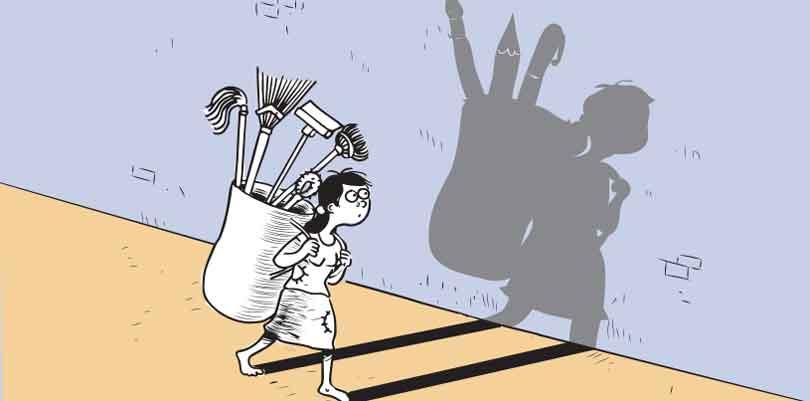
The other issue with children is them being used for labour. There have been many occasions where children have been used as beggars. Children begging on the street was a common sight many years ago. Today we hardly see children approaching people on the roads and asking for money. Past governments addressed this issue by bringing in new laws. The law now specifies that deploying or engaging children as beggars is considered an offence under the Penal Code (Amendment) Act No: 29 of 1998: punishable by a term of imprisonment up to five years along with a penalty or a fine.
These new developments are good. But then, lawmakers must also help in this initiative. We know how children are exploited during election time. There were politicians who used children to build their image and vote base. Can you remember the seasoned politician wearing the shawl, picking up children from the arms of mothers and hoisting them in an act of displaying humility? We remember a politician who went in a tuk (Three wheeled taxi) and gave lifts to children during the scholarship exam. We also ask whether acts engaged in by politicians like giving books and computers to schoolchildren must be captured and shown on media outlets.
Children are tempting objects. Creative people find ways to engage children in their projects. This can be done in real life or as fictitious characters in books and novels. Author and Attorney-at-Law Neil Wijerathne writes about a child in the book titled ‘Madurasi Koluwa’(boy from Madras). The boy is employed as a person who can scout for tourists who want to buy a bus ticket and travel to picturesque places in India.
The author skillfully writes about the boy’s marketing abilities. His job is to load buses with foreign and local tourists. We are made to imagine that he must be about age 12 or 13, the age when children fall prey to the works of commercialism. But in this story, it’s the boy who rules the roost and has a field day winning over customers. The boy’s engagement in the transport business in India suggests that child labour is also present in India.
Especially at times when we are customers, we must respond when we see children being exploited as laborers. But we must be sure about what we are doing. Once this writer was present at a wedding ceremony in a famous hotel in Kurunegala. A lad (who seemed to be about 12-13 years old at most visited our table and poured water into empty tumblers. Quickly, noticing there was ‘something not right’, we confronted the manager and inquired about the boy’s age. We were told that he was 21 years old. Later we came to know through the manager that there are certain instances in this island where males experience growth deficiencies and that he was one such case. Before we plunge into solving issues that involve children, we must do our homework.