Reply To:
Name - Reply Comment
 Iran launched ‘Operation True Promise III’ against multiple Israeli targets, marking a significant escalation in their ongoing conflict
 The arms trade is a multi-billion-dollar industry that profits regardless of whether peace or conflict prevails. It converts political disputes into profitable transactions and makes violence a permanent fixture in international politics. Arms dealers do not create wars, but their products enable disputes to become wars and undermine diplomatic solutions.
|
Arms dealing industry has the potential to turn the world into a more volatile place and conflicts between countries like Iran and Israel underscore this point in no uncertain terms |
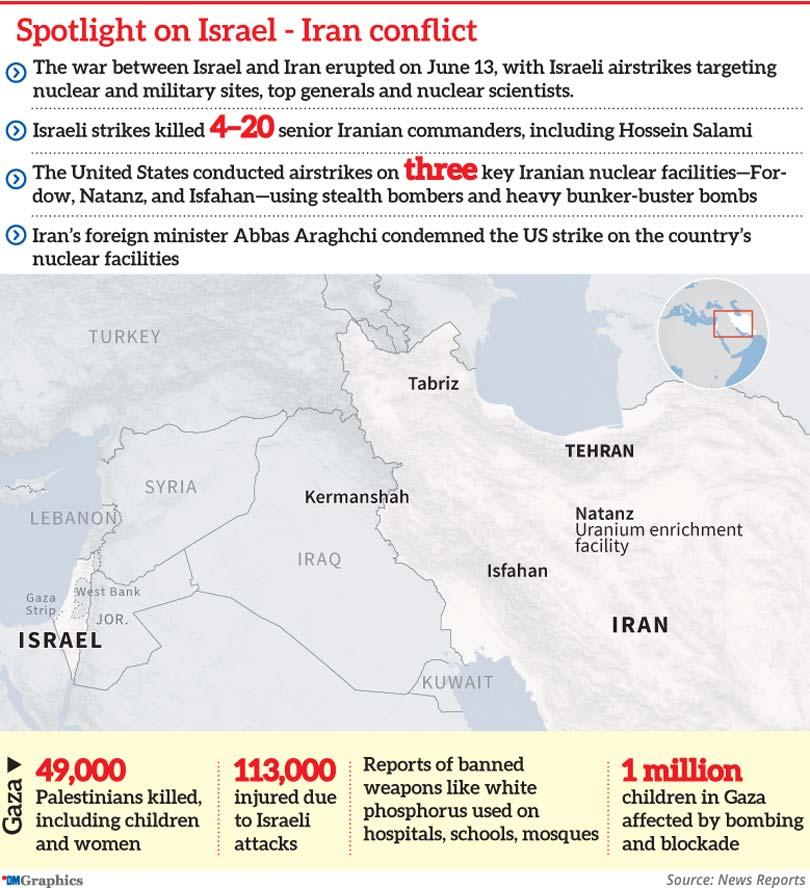
The situation has become much more dangerous following a dramatic escalation between Iran and Israel. Iran launched ‘Operation True Promise III’ against multiple Israeli targets, marking a significant escalation in their ongoing conflict. Israeli strikes reportedly killed four senior Iranian commanders, including Hossein Salami, commander-in-chief of Iran’s Islamic Revolutionary Guard Corps, although some sources suggest up to 20 senior commanders may have died.
The conflict has intensified through exchanges of missile attacks by both Iran and Israel, with Iran’s Supreme Leader Ayatollah Ali Khamenei promising “severe punishment” for Israeli strikes. Iran’s Foreign Minister dismissed calls for restraint following Israel’s large-scale attack, while Israel bombed multiple Iranian cities and nuclear facilities, possibly drawing the United States into a broader regional war.
The Middle East is at a dangerous turning point. Rising violence underscores significant problems with the international arms trade, legal obligations under world law, and political divisions within the USA. From Gaza’s destruction to Iran’s nuclear sites, these interconnected crises show how the world’s arms industry has normalized war and challenged the legal framework meant to govern conflict.
This reality highlights a key legal principle under international humanitarian and human rights law. There are strong legal duties to prohibit the transfer of weapons when there’s a clear risk that those arms will be used to commit violations of world humanitarian or criminal law. The Arms Trade Treaty underscores these duties by requiring states to prohibit arms sales when there is a substantial risk that the weapons may be used to attack civilians or commit war crimes.
Groups around the world have demanded an urgent halt to the transfer of weapons and military aid to Israel, arguing that these transactions make supplier states complicit in alleged crimes. The calls are grounded in international humanitarian, human rights, and criminal law and reflect growing alarm at the role the arms industry plays in fueling violence. The human cost of this policy is dramatic. Through attacks by Israeli forces against Hamas in Gaza, 49,000 Palestinians, including children and women, have been killed, and 113,000 injured. The scale of these civilian deaths highlights the indiscriminate nature of the attacks and the suffering they cause.
Some reports say Israeli attacks have used prohibited explosive weapons and white phosphorus against hospitals, schools, mosques, churches, bakeries, and phone networks — facilities meant to provide care and essential services to civilians. The people of Gaza, nearly a million of whom are children, find themselves stranded under constant bombing, without food, water, electricity, or proper medical care. United Nations experts have described the complete blockade, alongside “impossible evacuation orders and forced population movements,” as violations of international humanitarian and criminal law. Furthermore, statements by Israeli officials emphasizing “damage over accuracy” and calling for “erasing the Gaza Strip from the face of the earth” raise serious questions about the intentions and methods of attack.
In a single week, Israel reportedly used nearly 6,000 bombs — about the total amount the USA dropped in Afghanistan over an entire year. Human-rights advocates say these actions may amount to war crimes, crimes against humanity, and possibly even attempted genocide.
Arms flow continues
Despite growing reports of alleged violations, major suppliers — including the USA, Canada, Germany, Italy, the UK, and the Netherlands — have kept sending weapons and military aid to Israel. Some have even rushed additional deliveries, ignoring mounting calls to cut off arms in light of the alleged crimes. This policy directly disregards the 2021 urging by the UN Human Rights Council that all states halt arms transfers when there is a clear risk those arms may be used to commit serious violations of international humanitarian and human rights law. The gap between legal obligations and policy decisions emphasizes the complex mix of strategic, political, and economic factors that influence the flow of arms.
Despite initial White House denials, US officials later confirmed that America was involved in the Iran-Israel conflict, contradicting Secretary of State Marco Rubio’s claim that the USA was “not involved in strikes against Iran.” The US insisted its role was defensive — protecting hundreds of thousands of Americans and US assets in Israel — but this explanation disregards the broader implications of its policy choices. President Trump’s role in the escalation has come under particular scrutiny. He publicly encouraged tensions between Iran and Israel, believing it would pressure Iran into negotiations over its nuclear program. Instead, Iran walked away from scheduled weekend talks. Trump called the attacks “excellent”—saying Israel “got hit hard”—and threatening Iran with total destruction if a deal was not struck.
This policy reversal underscores a dramatic shift from Trump’s promises to withdraw from world wars and avoid further entangling the USA in Middle Eastern conflict. His base is divided over this, reflecting a growing controversy about whether the USA should pursue an “America First” policy or become deeply involved in disputes that many view as not directly related to US security.
MAGA Civil War
Supporters of Trump’s “America First” policy are increasingly split on the US role in Iran’s conflict with Israel. Some, like Laura Loomer, defend Trump’s aggressive policy, arguing it prevents Iran — a hostile state — from developing nuclear capabilities. However, many in the MAGA movement criticize this view, insisting that sending aid and putting US soldiers at risk to help another country is a violation of “America First.”
One critic challenged this view by noting Iran has “almost had a nuke for 30+ years”—calling it a form of “crying wolf”—and adding: “This isn’t a story of good guys vs. bad guys. It’s bad killing bad.”
When Republican Senator Lindsey Graham called for action against Iran and tweeted “Game on. Pray for Israel”—MAGA supporters dismissed him as a “war pig.”
The division highlights a fundamental contradiction within Trump’s base: the tension between isolationist promises and interventionist policy. His supporters are increasingly asking whether US soldiers should risk their lives and taxpayers’ money for wars that do not directly threaten their country’s future.
As the Middle East crisis deepens, the intersection of world legal duties, profits from the arms trade, and the USA’s own political divisions creates a fragile policy framework. The challenge for lawmakers is whether they can balance legal responsibilities under international humanitarian and human rights law with strategic priorities — all while retaining political support at home. The stakes — a regional war, nuclear proliferation, and America’s credibility — could not be higher.
Whatever policy path is chosen; it will profoundly affect not only the future of the USA’s role in world politics but also the future stability of the Middle East.
(The writer can be reached at [email protected])