Reply To:
Name - Reply Comment
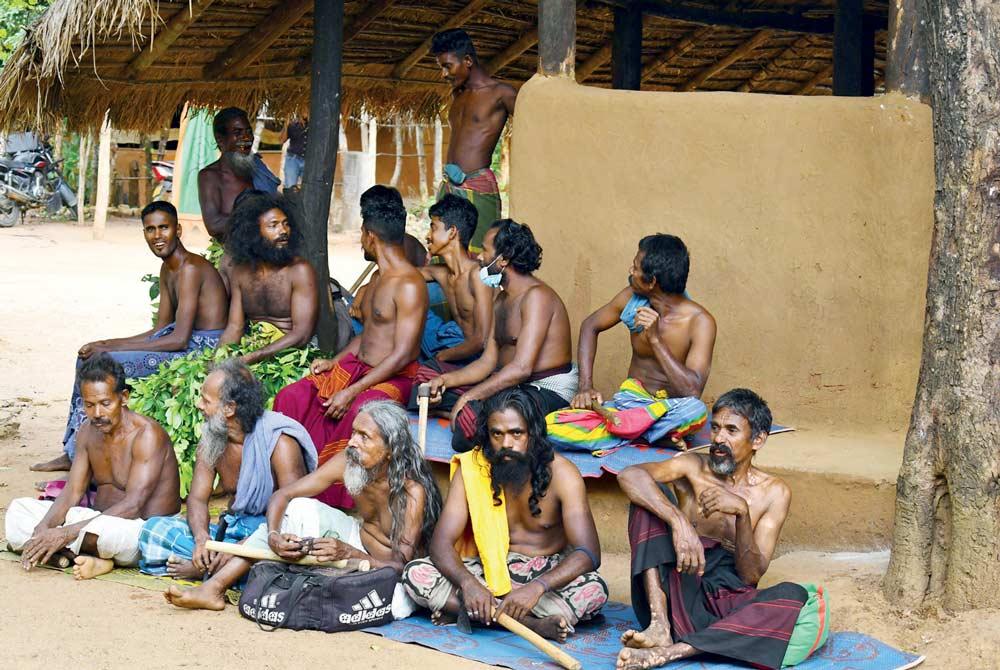
The Veddha community that lives as an isolated race is facing a series of issues that are affecting them. Here a group of Veddas have gathered at Kotabakiniya
 The main object of the World Indigenous People’s Day is to address the issues affecting the indigenous people
The term Veddas, assigned to them, is perhaps a diminution of their self-importance
The history the Vedda community dates far back as the Homo Sapiens of Balangoda pre-historic civilization
 August 9 has been declared the ‘World Indigenous People’s Day’ and Sri Lanka has been celebrating this day in a grand manner every year under state patronage. However in the global context, the main object of the World Indigenous People’s Day is to address the issues affecting indigenous people, to protect their age-old culture, rights and the life style and to evaluate their contribution to protect the environment.
With this in view, it is imperative that the history of the indigenous people, popularly known as the Vedda community, their cultural heritage and the challenges facing them owing to the pressure of modernization are scrutinised. The term Veddas, assigned to them, is perhaps a diminution of their self-importance.
Are they Aborigines of Sri Lanka?
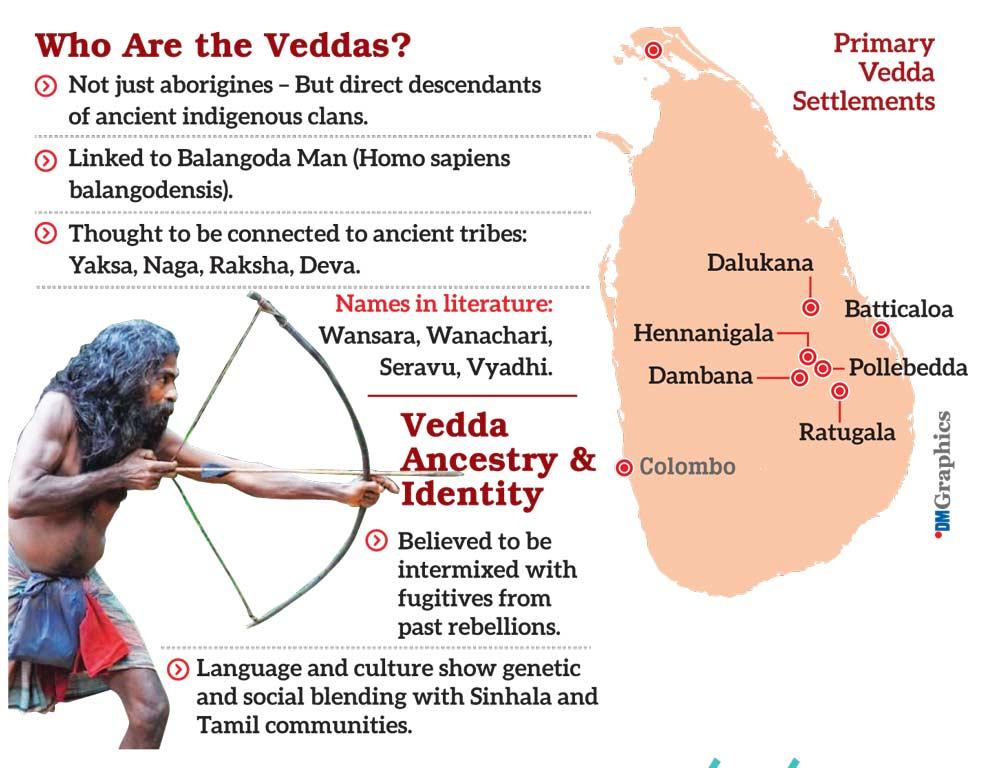
It is a misconception that Veddas are the aborigines of Sri Lanka. However, just as the Sinhala community, Veddas are a race that descended from the indigenous people in the country. Ethnologists have inclined to classify the aborigines into three primitive clans of natives: Yaksa, Naga, Raksha and Deva that lived in Sri Lanka even before the advent of Vijeya and his retinue.
It is believed that the Vedda community is an intermixture of these primitive races. However the widespread opinion that the indigenous people were descendants of the children of legendary Kuweni of the Yaksha race and Vijeya and that they are the aborigines of Sri Lanka has been refuted by scholars.
Was the Wellassa great rebellion (1818) originated by Veddas?
The Sinhalese blended with the Aryan tribes that migrated from North India and the South Indian Tamils in the remote past when Sri Lanka had been a nerve centre of commerce and trade. They had genealogically intermingled with the Arabian, Chinese and Malay communities and in the recent past with the Portuguese, Dutch and the British as well. Historians believe that the Sinhalese race was vulnerable to the influence of migratory tribes while the Vedda community, though a tribe of foresters, too would have been affected by similar influences.
No longer isolated
Historians have pointed out that the Veddha community was no longer an isolated clan. History has recorded that during rebellions to seize the throne, the defeated had fled into the jungles and it is clearly understood that the Vedda community genealogically mingled with these fugitives and had a blood relationship with them. The dialect of the Veddha community is a clear indication of it.
It is said that the people of Uva-Wellassa- who lost the 1848 rebellion against British rule- sought refuge in the terrain of this region with intricate ramifications and multiplicity of mountains.
Those who share the opinion that the Uva-Wellassa rebellion was in fact a struggle of the Veddha community have pointed out that the Govt. Agent in Uva, Major Sylvester Wilson succumbed to an arrow fired by a Vedda named Hitihamy.
However, renowned archaeologist and historian Prof. Raj Somadeva, based on archeological and anthropological evidence, has pointed out that the Vedda community was undoubtedly the aborigines of Sri Lanka.
“Sri Lanka had a fair share of the spread of Homo Sapiens Species all over the world. Balangoda Man (Homo sapiens balangodensis) is a clear indication of it. Only the Vedda community has genealogical relations with the Balangoda Man and it provides convincing evidence to conclude that they are the aborigines of Sri Lanka,” Prof. Somadeva said.
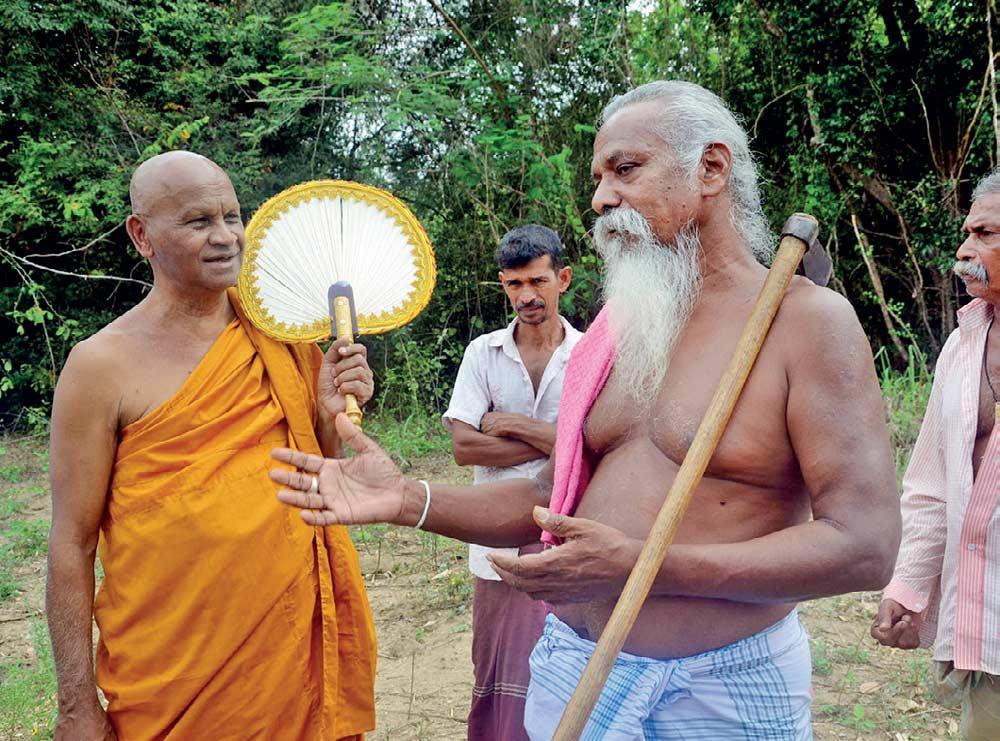
Vedda Chief Vanilla Eththo joins a community agitation campaign against a sugarcane cultivation project. Also in the picture is the village head priest
Vedda Community identified by different names
|
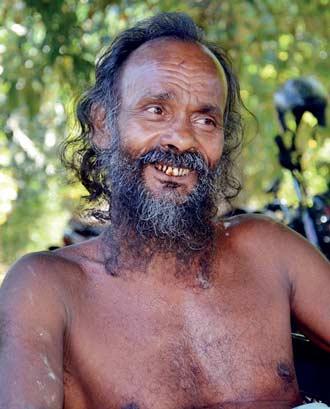
Rathugala Vedda Chief Suda Vanilla Eththo |
Former Minister of Cultural Affairs and renowned linguist W.J.M. Lokubandara has cited several terms used in the Sinhala Literature to identify Veddas. “Wansara” or “Wanachari” associated with the forest, “Seravu: the bearer of bows and arrows, and “Vyadhi: who shoots arrows are among them. According to him the term Vedda is a corruption of the term “Bedda” which means the forester
All these early beginnings of the Vedda community must have taken place far back in time and in the regions of the world that have been scientifically explored only after 19th century. British researchers have been in the forefront. They have published much literature on the Vedda community, their culture, their customs and the pattern of living.
Among these written accounts are ‘Historical Relations of the Island of Ceylon’ and ‘An Account of Wild Tribes of The Veddas of Ceylon and their Customs and Superstitions’ written by John Doyly. A series of articles on Veddas written by Dr. D.G. Seligman and his wife Brenda Z. Seligman, “Wild Ceylon” (1925),” Far Off Things” (1930) “ Vanished Trails” (1939) “Savage Sanctuary” (1945) Sanctuary ( 1945 ) Life Story of Wannakau Tissahamy” authored by Dr. R.L. Spittel are among them.
They were followed by several works by researchers on the subject and they included Nandadeva Wijesekara, Piyasena Kahandagama, E.M. Ratnapala, and P.B. Migahakumbura. Dr. Sugathapala De Silva, Tissa Weerakoon, Piyadasa Udawatta and Dr. Shiran Deraniyagala, who conducted research and authored several books.
According to Dr. Shiran Deraniyagala, the Veddha people are descendants of the Balangoda pre-historic civilization and the Yaksha clan mentioned in Buddhist literature was the Vedda community.
The history the Vedda community dates far back as the Homo Sapiens of Balangoda pre-historic civilization according to Archaeological and Anthropological evidence.
Ethnologists class this human race under one common specific name Homo sapiens but the Vedda community has several divisions. However they have no idea about the origin of these divisions. Seligman’s book has referred to three divisions, similar to castes in the case of other communities.
The census in 1871 had enumerated the Veddas as a distinctive race. In 1901 a census they have been descried as a clan of people with shabby appearance. It further said that they kill animals using bows and arrows and eat meat with honey.
Although the Veddha Community had been scattered all over the country in the past, at present they have been confined to Dambana, Ratugala, Dalukana, Pollebedda, and Hennanigala areas. Meanwhile a small fraction known as Sea Veddas live in the coastal areas in Batticaloa.
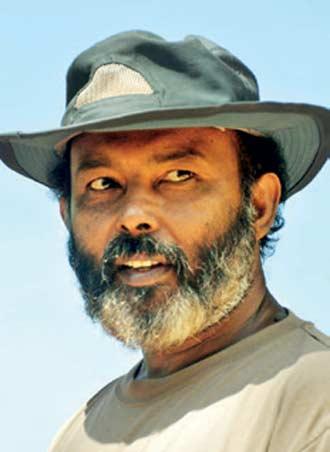 “Sri Lanka had a fair share of the spread of Homo Sapiens Species all over the world. Balangoda Man (Homo sapiens balangodensis) is a clear indication of it. Only the Vedda community has genealogical relations with the Balangoda Man and it provides convincing evidence to conclude that they are the aborigines of Sri Lanka”
- Prof. Raj Somadeva, Archaeologist and Historian
Challenges
The Veddha community that lives as an isolated race is facing a series of issues that are affecting them. Their lives are interwoven with the forest and their main grievance is that they have been deprived of their right to use the forest for their existence. They are in possession of a vast knowledge of the environment and natural resources and a culture unique to them. But their territory has been invaded under the pretext of providing them with modern facilities.
Meanwhile the wildlife regulations have created serious issues which are affecting the traditional livelihood of the indigenous people. It is sad to know that the authorities who implemented amendments to the wildlife regulations had failed to focus attention on the issues affecting the indigenous people. It is imperative that the authorities should have been sensitive to the needs of this isolated clan.