 Kamanthi Wickramasinghe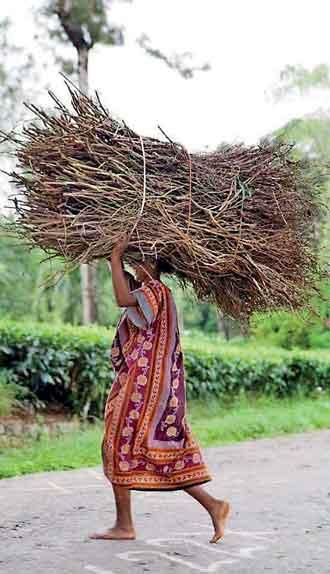
Reply To:
Name - Reply Comment
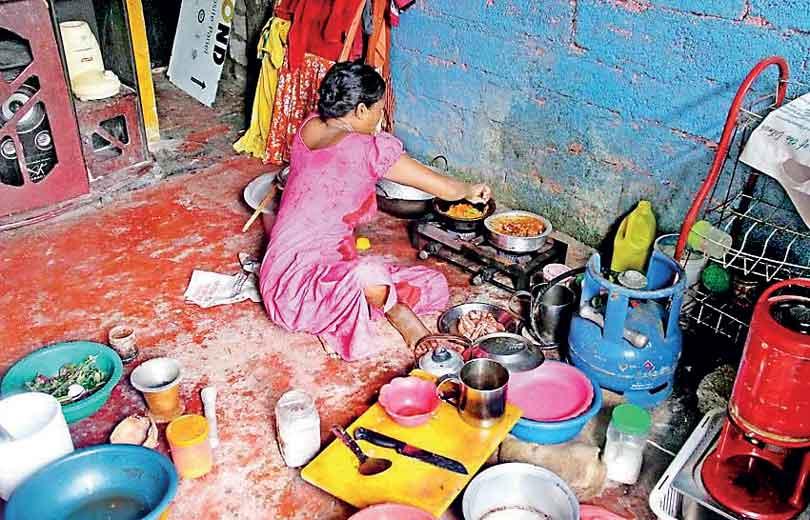
A woman from a suburb in Colombo preparing meals for her family (Pic by Waruna Wanniarachchi)
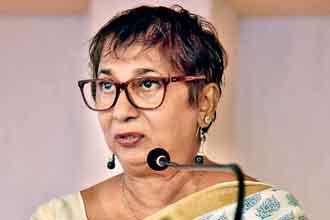
Dr. Sepali Kottegoda
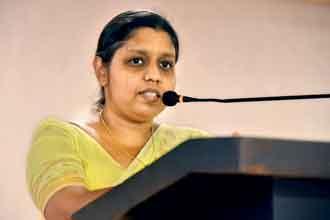
MP Lakmali Hemachandra
 The study revealed how women act as ‘shock absorbers’ during a climate crisis, stretching their time, labour and bodies to sustain households and communities. As climate shocks intensify in frequency, duration, scale and impact, so do the demands placed on women’s unpaid care work, pushing many towards deeper poverty
Dr. Kottegoda introduced the concept of social reproduction. She said that by framing unpaid care within the context of social reproduction, we can understand its structural significance and ways in which it is systematically overlooked in mainstream economic models
|
The study indicates that women spend more time collecting firewood, especially in remote areas of the country. (File photo) |
As a country that is recognised as extremely vulnerable to climate change impacts, Sri Lanka is now at a critical juncture in terms of prioritising climate resilience.
A 2023 study conducted by United Nations Sri Lanka indicates that around 19 million of the population are living in locations set to become moderate or severe climate hotspots by 2050. However, with climate change impacts and natural disasters becoming more rampant, women and girls continue to be at the receiving end of a vicious cycle of vulnerability. It is in this backdrop that the Women and Media Collective (WMC) launched findings of a pilot study exploring how climate change impacts unpaid care work done by women from Colombo, Gampaha and Moneragala Districts.
Women as ‘shock absorbers’
A sample of 60 women were selected for the study. Participants included carers for dependents with disabilities, those shouldering the dual burden of income generation and care work, and those whose work is linked to climate vulnerable sectors such as agriculture among others. The findings indicate that around 95% respondents (57 women) have reported that their care tasks become more difficult and time consuming during extreme weather events. Women from Moneragala and Gampaha (18 of 20 women per district) reported caring for dependent children, the highest percentage in terms of childcare responsibilities. 61.7% of respondents provided care for at least one person with a disability. Extended family care was most pronounced in Gampaha with 55% respondents caring for non-immediate family members far more than that of Colombo and Moneragala. Gampaha also recorded the highest concentration of self-employed women. The study also indicated a bleak picture in terms of awareness and access to services such as childcare and elderly care centres in each of the districts. Respondents claimed that even if there are affordable childcare centres they wouldn’t know how to care for children with disabilities or understand what their needs are. More than half of the respondents spent 1-3 hours cooking or cleaning. In Moneragala, women spend much of their time collecting firewood.
The study revealed how women act as ‘shock absorbers’ during a climate crisis, stretching their time, labour and bodies to sustain households and communities. As climate shocks intensify in frequency, duration, scale and impact, so do the demands placed on women’s unpaid care work, pushing many towards deeper poverty.
The need to value women’s unpaid care work
In her remarks, Dr. Sepali Kottegoda, WMC’s Director Programmes, Gender and Political Economy said there’s still a way to go to realise the actual value and role of care provided by women for their households with no expectation of monetary remuneration but with an entire fabric of society that expects the tasks are being carried out. “We need to problematise the way in which these discourses distinguish work and labour. Unpaid care work despite the inclusion of the word ‘work’ is not considered to constitute labour. The dichotomy here is where one form of physical activity is seen to contribute to the national economy and is entitled to monetary remuneration, that is labour. The other form of physical activity is positioned in the arena of the family and family wellbeing, social cultural norms, duties and obligations - which is unpaid care work,” she explained.
She underscored the need to bring in the nexus of care, climate and recovery into the dominant discourse which is often about economic recovery and cutting down budgets required for national services for instance. “We need to ask how climate change impacts relations of unpaid care in households. Increases in fuel costs, electricity, water, cuts in finances or increasing cost of public transport, has a direct impact on the level of care given at the household level. It means that in districts where droughts have diminished access to water for household use, in areas where there is no access to pipe borne water, women are compelled to walk or travel further to find water. It means that the level of care she’s expected to provide becomes much more arduous,” she added.
Dr. Kottegoda introduced the concept of social reproduction. She said that by framing unpaid care within the context of social reproduction, we can understand its structural significance and ways in which it is systematically overlooked in mainstream economic models. “These structural inequalities define women’s unpaid care work, often invisible and indispensable and can be better understood, allowing us to understand how these roles are assumed and assigned. As such, we need to push for value in unpaid care work, both socially and economically. We need to consolidate our learnings to inform policy at all levels and ensuring long-term climate Justice,” she concluded.
Integrating into policy-making
In her keynote speech, Lakmali Hemachandra, National People’s Power Member of Parliament (MP) said that climate crises are now becoming part of people’s daily lives. She said that despite the frequency of occurrence, natural disasters are often overlooked at policy-making level. “Over the past one and a half years, women parliamentarians have focused on establishing district and divisional secretariat level committees on women and children. But we have observed an alarming drop in birth rates. This is evident when looking at school admissions and hospital figures. On the other hand, women’s labour force participation has fallen below 30% over the past year,” she said.
She further said that state officials would often provide cultural reasons for these kinds of statistics. “We see more mental health issues being reported among married women than unmarried women. Perhaps the bigger issue could be linked to the disproportionate care work that women have to perform. I believe that unpaid care work that women perform is distancing them from family life. It could be forced or it could be a choice but I don’t know how much of it is a choice when women have to juggle between multiple crises. Therefore it is high time that the concept of care work is now integrated into policy-making,” she underscored.
The launch also included a panel discussion to explore challenges faced by disabled communities and women in remote areas of the country during rescue operations in the aftermath of Cyclone Ditwah. Panelists highlighted the lack of infrastructure in temporary evacuation centres that made it uncomfortable for disabled women and children to settle in. The lack of commodes and sanitary facilities, lack of separate changing rooms made it increasingly difficult for women. In the outskirts, people had been deprived of cooked food to be purchased from shops as many people have purchased large quantities of cooked food packets from local shops to be distributed to disaster-affected communities. The discussion further highlighted the difficulties in obtaining exact numbers of deaf and blind individuals who were affected by floods and landslides due to lack of proper communication channels. The need to disseminate early warnings in sign language format was also addressed at this discussion.
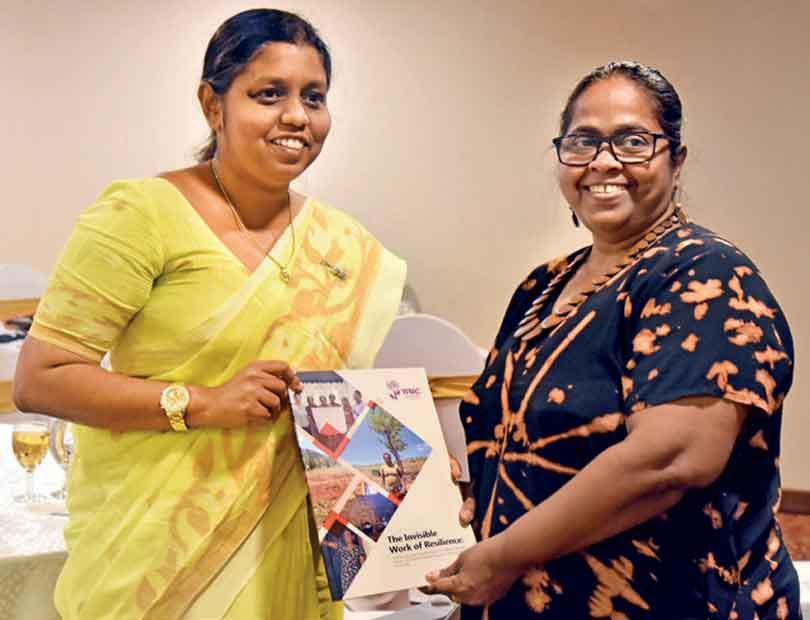
WMC member (right) handing over the report to MP Lakmali Hemachandra
(Pix by Kithsiri De Mel)